Anesu stopped breathing, momentarily stunned by the pain that bloomed across her back, spreading to her tailbone and seeming to crawl and grip onto the bones that formed her hips. She had been sitting with her legs stiffly pressed against the side of the dinghy when the captain abruptly stood up, causing it to jostle, and scaring her out of a delicate slumber. Stooping to pick up a thick roll of cloth off the dinghy floor, he told her to hold on to one end, then jumped into the sea with the other. Using her free hand, she tentatively traced her finger along a small part of her spine to feel for any sensitivity, stopping when she decided that if something was terribly wrong she’d rather find out when they reached land.
Through the night she had been shivering in shifts, her body and mind unable to reach a consensus on whether she was heating up or cooling down. The sweat on her face clung to her skin almost discreetly, as though it had been sprayed on, yet it still creased into the contours of her nose and inside the thinnest folds of her eyelids. Anesu swallowed a little saliva: a reminder that the last time she’d had something to drink was one day ago. “I think it’s actually been two days,” she murmured to herself, keeping her upper and lower lips apart because she didn’t want to aggravate the cracks that she’d spent the night nibbling open. The pricks of pain she felt after tenderly tearing open slivers of her skin and pulling them from the outer part of her bottom lip kept her awake. It also made her realize that, like an animal, she bled. Like an animal, she was vulnerable. But, unlike an animal, she could never be wholly consumed by another. Only in the smallest pieces, and likely by her own curious and bored self. It relieved her to be this fragile in some parts.
Since making her escape alone, Anesu felt as though the girl she became while imprisoned was now the only embodiment of her being that remained. Something abstract, impossible to understand and only existing according to the imaginations of every observer. When she had sat down in a tea shop (the first time she’d had a chair of her own in three months) several kilometers from the prison, the woman who worked there had been so startled by her presence she had stopped reading the book in her hands, and stared at Anesu from behind the counter the entire time that she rested her back. Her glare had been so silencing, Anesu did not allow herself to ask for a cup of water, or inquire what the woman was reading. There used to be a time when people would tell her about their private leisures without a prompt. They used to smile at her in public, ask her to watch their bags, and once a vegetable seller even imposed on her the responsibility of guarding his stand while he ran to use a nearby toilet. She had felt like the neighbor everyone trusted, even strangers. The prison had stolen that particular state of her being, leaving her only able to reflect the despair she felt and the unbearable resignation that hardened her face so it could no longer easily crumble into tears, nor break into a smile with little effort. Would she ever let herself be soft again? She lightly dabbed at her sore lips. Perhaps.
She heard the captain gasping for breath as he emerged out of the water holding his end of the rope, clumsily pulling himself back onto the dinghy, splashing water onto her pants and scooping more onto their transport with the bag that he had kept on his back since they left port. Roughly tugging at the sleeves on his red shirt, he nodded toward the cloth she still gripped. “Give that to me,” he said. Anesu handed it to him and he tied the two ends together, fastening it into multiple knots. Once tightened he returned it to her waiting hands. “Keep holding that. If you see the knots start to untangle, tell me immediately.” The captain coughed out a few words meant only for himself before sitting down and wrapping his arms around his chest. Anesu’s hands were dry and her fingers itched and burned, perhaps from the water’s salt or the wind that sharpened its cold teeth on her knuckles. She was keeping the dinghy from coming undone with her fists and some cloth wrapped across the bottom of the splintering wood. Anesu didn’t think to ask why this was her job as she was the passenger. All she knew was that she was the one who had the strength.
Instead, she thought about the sounds of the city: Midday during the week meant congested streets, nose to nose traffic, and heel to heel pedestrians who were often forced to dodge loosely tied leashes held by dog owners who refused to notice the incongruity of leading animals along pavements lined with short tempers, anxious egos, and late risers. Her ears caught the humming of the waves; a sound that had soothed her when she was on the shore, forming a language of greetings and farewells that made the sea a companion she would meet over and over again. The sea was always there—comfort and constancy. Every time she visited it taught her to listen close and sink in further. It made her life feel curious and elastic, hearing more than the people around her and the thoughts in her head. Now she wished the water would portion out some silence from its expanse, quiet itself so she could hear and recognize the rest of the world. She prayed for it to lead their dinghy to a temporary patch of sand where they could stop and feel something solid beneath their legs. The water had become all she could see. Claiming itself as the only thing that existed when she knew otherwise. Where were the honking car horns, the ambulance sirens, the blasting engines of motorcycles, the sharp trill of bicycle bells? Sounds as piercing as they were uncertain. Had the Adhan rung out already? The waves swallowed up all of this noise, making the memories inaudible in her mind.
She felt the boat continue to bob through the water and the pain once again flared across her back. “It’s fine. Everything is going to be fine,” said the voice that carried her faith. Again, she ran to her city. Had the Adhan rung out already? How many birds had flown over the pier at sunset? She looked up at the sky, where faint slits of early morning sunlight were scratching open the grey. What an easy day for a walk, she thought, as her eyes shut and the call to prayer floated in and out of her mind, belonging to her past and moving like the ocean.
“It’s strange,” the captain began, “that each time I set sail I never worry about the weather turning bad or forgetting my way. I worry that I won’t want to return to the land.” She listened, not knowing if he was musing to receive a response, or reflecting because he had finally found one. He roughly scratched his head then pulled on his left earlobe. They were his own revealing gestures and if Anesu had known him as a boy she would have recognized that he pulled his left ear when trying to stop from crying. And that he always scratched his head after saying something that left him feeling naked. “I don’t think I would continue trying to live, if the sea refused to take me,” he said slowly. “I’m afraid one day I’ll ask it to, and it will refuse and drift me to another place. That it will turn away.” A single bird swooped down toward the water, hovering above it at a glide and then flying back up almost in slow motion.
“I don’t want to die out here,” Anesu whispered.
“No one dies in the sea. It only takes the body and returns the voice.”
The captain noticed Anesu’s reticence to believe his words. He read the distraction in her muteness which made it appear as though she was paying attention, when she was merely ceding space to avoid silence. She was still holding on to the rope, pulling it closer to her chest whenever the boat happened to lurch a little lower.
“It is not the ocean that you are hearing right now,” he said, lifting a finger and moving it through the air as though twirling a piece of ribbon tied to his fingertip. “That crushing of the water on the rocks, the whispering of the foam that hesitates on the shore, the hissing as it rises up to meet the wind during a storm are not the sounds of sea. It’s the voices that have crossed over it, prayed for it, and descended. Inside this liquid echo chamber hollowed out of a cracked earth, all these voices writhe and heave. Talking to each other of their journeys and the lands the water took them from or led them to. We sail inside the mouth of the world. The only place where all our voices can be the same.”
“So who does the mouth belong to?”
“Isn’t it clear?”
Anesu shook her head.
*
Several miles from where Anesu was sailing, Danai was jerked awake by the sound of the Adhan. It didn’t feel right hearing it in this place where faith could kill you. Soon after walking into the prison, every day spent inside had started to corrode each day spent outside. She looked around the humid room and saw three new girls sleeping in a corner, their bodies huddled together. Everyone else was still asleep in their pods of two, four, or five. Since Anesu had escaped, Danai now slept alone, without another body close by. There was a girl who had been inside when the two had arrived and she too slept alone but not because she was missing a friend. According to Awar, it was because when this girl first arrived she had failed to protect someone just like herself.
“How?” Anesu had once whispered.
Awar had responded bluntly. “We are not allowed to bleed in here.”
“What do you mean?” asked Danai, who was always the one of the two to ask for more in every way. More books. More sweets. More room. More of the future. The three girls had been leaning against the left wall, far from the metal door but still able to see into the compound and glimpse part of the well in the center.
“When you bleed, you’re supposed to hide it. Clean yourself quickly and quietly, and never let any of the guards see you. They think it’s unclean to look at blood that should have been a child.”
“But it’s natural!” Danai had said angrily.
“When one of the girls bled through her dress, instead of lending some help, that girl called the guard.”
“What did the guards do to her?” Anesu had asked.
“They took her to the well and told her to remove her clothes and wash herself in front of everyone.”
The three girls had been silent after this disclosure; one to stall a creeping rage, the other two to curb a rising panic.
“Which girl was it?” Danai had later asked. Anesu would never do so, out of respect, but she had also wanted to know.
“You know why the girl did that?” Awar began, not to avoid giving an answer, but because she needed to tell someone what she thought. “She wanted to get close to the guards. Have them treat her with favor after they saw her give them something amusing to do. Like a dog delivering a stick to its owner. As if that would restore her dignity.”
Unable to keep listening to the story, Anesu had moved to another part of the cell while Danai shifted closer to Awar who seemed to need support, but didn’t want to be touched.
“She did it out of a selfish kindness that would only better her life marginally,” Awar had continued. “And what good is a soft pillow if it’s placed on top of thorns?”
Looking at the accused girl who sat alone on a corner bench that ordinarily fit six, Danai had failed to give a name to her feelings. “I think she wanted to forgive them,” she finally said after a long break. “I think she thought they would help, and that once they did, she could forgive them, and they would see us.”
Awar had been quiet. Then she abruptly pushed herself off the wall. Wearily she asked, “So she wanted to redeem people who had never asked for forgiveness?”
Danai couldn’t answer.
“What a fool. I would rather she was cruel. Maybe even piously self-centered. But not a fool. Cruel people protect only themselves. Fools get other people killed.”
Danai stretched out her arms as she stood up, making sure not to pull on her muscles. Her elbow was still aching and her shoulder burned when she moved. Nervously probing, she wondered if it really was just sprained as Awar had said, or if it was actually broken. When she was slammed against the wall during the riots she hadn’t felt any pain. It must have been the adrenaline. She walked over to the door and hung her hands outside the bars. The sunlight from the window above barely touched her skin, but she still felt its weight. It grounded her feet into the mud and helped straighten her back.
So much had happened three days ago that it felt odd for her body’s only evidence to be the ache building a home in her right arm. They would have simply walked out without making any noise if that was possible. But the guards had aimed their guns and sprayed countless bullets into the large compound, which landed inside the bodies of the cursed dozens who tried to force their way out of the prison. Danai saw one girl fall after the side of her head burst open. The day before, she had been smelling her armpits and making a quip that if her mother could smell her now, her bathing mix of salts and dettol antiseptic would gnaw through her skin and dry out her bones. Her name was Rose. The day before Rose had been laughing. Stifling odors of stale frying oil, dish soap, and the chemical haze of cloyingly sweet cologne had started to mix with the air blowing over dried blood and gunpowder. It made those imprisoned conscious of their tenacious hunger, and also placed their shared secret in front of the guns and behind the prison gate: if they could no longer be ordinary, they were ready to die.
During the afternoon shift on the day after the rebellion, the chief guard had slipped on a bloody puddle and after he caught himself, screamed at the prisoners for almost soiling his uniform with the remnants of their disobedience.
It wasn’t disobedience that brought her here. Only a public activity that was for her also a cheap pleasure. For almost two hours, they had fought to escape. But what would they have won? Danai thought. If you’d told her six months ago that she’d be living like a caged animal, only eating, bathing, and relieving herself when allowed, she would have thought your sense of humor distasteful but still a joke. She turned and looked back at the girls who were huddled and breathing in unison. Eyeing their rising chests, she began to match their rhythm. Their breaths were shallow in the prison. When she was outside, she had enjoyed filling her lungs with so much air that it pushed against her chest, and then marveled at how her body appeared to recede and re-form as she exhaled, leaving her relaxed and spent. Inside, the smell from the bathrooms made it impossible to enjoy a long inhale, and yet it was the only way she could smell the sea. When Danai needed more help to stay in her body, she would take one long breath just so she could find the smell of the salt, and the fish and the shells and the algae. So she could remember its sound and its shape. So she could remember her friend, who had run toward the sea. So she could remember that, soon, so would she.
Afterword
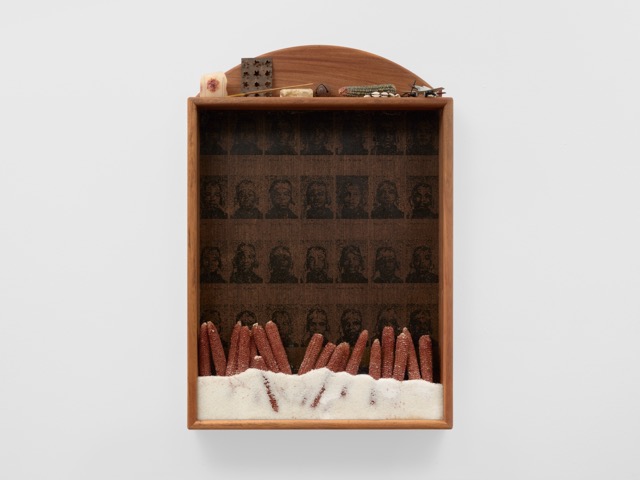
Possibility is what drew me to the work of Turiya Adkins; particularly the piece Vertigo (2024). It’s an intimate sculpture that feels quite solemn in its presentation, embodying a quiet projection of history that is urgent, and still quite long-lasting. With its tactility and dimension, it reveals immensely varied ways of observing the ancestors we call on and the future that’s presented every time we glance into and linger within our past. At first look, I noticed the dry cobs of maize, colored like red soil. Then, my eyes met those of the faces imprinted on the inside, traveling over each visage, until I paid attention to their headgear, which spoke of the potential for takeoff.
Turiya’s work asks us to take flight, to sweep our own feet from under our own desires and doubts, to explore beyond familiar frontiers, to move with purpose and faith. On the small shelf framing the faces are objects (both man-made and foraged from the earth) that remind me of the small but consequential things that exist in my own home—in spaces that could be easily missed, but where they fit and belong. These objects were once foreign yet when they became a part of my interior, they introduced a thread that connected my past and present, to form my memory. And it’s this memory that frames the future that Anesu and Danai fly into with unceasing purpose and unflappable faith.