Afterimages in Accra
A trash mound burns on a land parcel carpeted with coconut husks; all waste from one of Accra’s lifelines. The vibrant Oxford Street, where I am staying for the duration of my visit, is lined with restaurants, gas stations, kiosks, and black market foreign exchangers. The smell of burning plastic thickens the air. Bats swirl under a light-polluted night sky. Some youths complain in Twi. Their voices reflect off an unfinished five-story concrete building. From the fire’s glow on the building’s corrugated tin fence, I discern a shared dream spread across the continent, an ambition for economic prosperity, progress, and urbanization, all shaped by concrete. Gray gold. It’s a long dream still waiting to be fulfilled, one that Ghana’s inaugural president, Kwame Nkrumah, shared with Soviet Union leader Nikita Khrushchev in 1960.
Nkrumah wanted “Soviet experts to come and start their work [in Ghana] without delay” so he could “promote the industrialization and electrification of the country.”1 Khrushchev responded by sending specialists who set up state-run farms to feed the young, newly independent nation, along with architects and engineers from the Soviet bloc—including Hungarian Charles Polónyi, who designed Flagstaff House—to construct concrete, Brutalist grain storage silos in Ghana’s Northern region, and hospitals and police stations in Accra.2 The socialist-inspired dream faltered: Ghana’s limited economic capacities couldn’t support the technical assistance offered by the Soviets, primarily the machinery needed to expand rubber and palm oil plantations, of which the Soviets lacked the knowledge to cultivate. Rural farmers also opposed the government’s expropriation of their lands for state-owned farms, and when the 1966 U.S.-backed coup d’état deposed Nkrumah, the International Monetary Fund directed the new government to undo his socialist aspirations.3 What’s left behind from this period are degraded silos that today are reminders of what could have been if a post-colonial society had unified and relied on its own resources to rehabilitate its pillaged past. The generation bearing the weight of these past and present ruins (and the dubious conditions that made them possible, too, like corruption and liberal economic policies that enable inequality by promoting largely foreign-owned, private sectors with senior positions offered to expatriates) has brought a renewed sense to them.
Nkrumah wanted “Soviet experts to come and start their work [in Ghana] without delay” so he could “promote the industrialization and electrification of the country.”1 Khrushchev responded by sending specialists who set up state-run farms to feed the young, newly independent nation, along with architects and engineers from the Soviet bloc—including Hungarian Charles Polónyi, who designed Flagstaff House—to construct concrete, Brutalist grain storage silos in Ghana’s Northern region, and hospitals and police stations in Accra.2 The socialist-inspired dream faltered: Ghana’s limited economic capacities couldn’t support the technical assistance offered by the Soviets, primarily the machinery needed to expand rubber and palm oil plantations, of which the Soviets lacked the knowledge to cultivate. Rural farmers also opposed the government’s expropriation of their lands for state-owned farms, and when the 1966 U.S.-backed coup d’état deposed Nkrumah, the International Monetary Fund directed the new government to undo his socialist aspirations.3 What’s left behind from this period are degraded silos that today are reminders of what could have been if a post-colonial society had unified and relied on its own resources to rehabilitate its pillaged past. The generation bearing the weight of these past and present ruins (and the dubious conditions that made them possible, too, like corruption and liberal economic policies that enable inequality by promoting largely foreign-owned, private sectors with senior positions offered to expatriates) has brought a renewed sense to them.

TAELON7, Limbo Engawa, 2026. Courtesy of Juergen Benson-Sthromayer and Limbo Museum
“I’m here to see the Limbo Museum,” I say to a uniformed guard sheltering from the sun. The wandering museum’s 2024 debut site in the Labone neighborhood was a Brutalist building, sleek and minimal. Its current iteration, housed in a two-story abandoned concrete shell on the University of Ghana’s Legon campus (UG Legon), is rougher, less manicured, and atrophied—a physical symptom of overly ambitious government projects. A decade has passed since construction halted on what was meant to be lecture halls, administrative offices, and student spaces. There are four other abandoned buildings scattered across the campus, and they decay amid the domineering colonial architecture the British imposed when they founded the university in 1948. The colonists imported tons of cement, replacing the ephemeral wood, bamboo, and straw materials locals had long used to build settlements.4 So, when I look at this troubled past contrasted against this ruin of concrete and cement, materials that symbolically represent progress, perpetuity, and modernity within the continent, I can’t help but think how we, as Africans, continue to live in spaces where our decimated futures are so evidently glaring back at us.
The Limbo Museum confronts the reality of this dissonance. Its co-founders, Dominique Petit-Frère and Emil Grip, take advantage of the prolonged decay afflicting Accra’s built environment by creating a museum that rejects the way Western cultural institutions assert a link between perpetuity and legitimacy, rigor, and value. Instead of, for example, ceding to conventional logics that prioritize establishing a permanent collection, the Limbo Museum stages a series of transient creative initiatives that often respond to the landscape of unfinished architectural projects. No precedence is given to physically restoring a building, rather opting to work with what the structure already offers.
For instance, On the Other Side of Languish (2025), Limbo’s inaugural show at UG Legon organized by director of exhibitions Diallo Simon-Ponte, included newly commissioned, site-responsive paintings and sculptures by Reginald Sylvester II. The artist worked primarily with materials like rubber, which, in Nkrumah’s post-independence Ghana, the U.S. government largely invested in to counter Soviet influence. Limbo Engawa (2026), a recent commission produced by the architectural firm TAELON7, salvaged polyester billboards then stripped and stretched them onto steel frames, providing shade and, importantly, introduced seating for the space, a condition that museums notoriously do not consider for their visitors.
The Limbo Museum confronts the reality of this dissonance. Its co-founders, Dominique Petit-Frère and Emil Grip, take advantage of the prolonged decay afflicting Accra’s built environment by creating a museum that rejects the way Western cultural institutions assert a link between perpetuity and legitimacy, rigor, and value. Instead of, for example, ceding to conventional logics that prioritize establishing a permanent collection, the Limbo Museum stages a series of transient creative initiatives that often respond to the landscape of unfinished architectural projects. No precedence is given to physically restoring a building, rather opting to work with what the structure already offers.
For instance, On the Other Side of Languish (2025), Limbo’s inaugural show at UG Legon organized by director of exhibitions Diallo Simon-Ponte, included newly commissioned, site-responsive paintings and sculptures by Reginald Sylvester II. The artist worked primarily with materials like rubber, which, in Nkrumah’s post-independence Ghana, the U.S. government largely invested in to counter Soviet influence. Limbo Engawa (2026), a recent commission produced by the architectural firm TAELON7, salvaged polyester billboards then stripped and stretched them onto steel frames, providing shade and, importantly, introduced seating for the space, a condition that museums notoriously do not consider for their visitors.
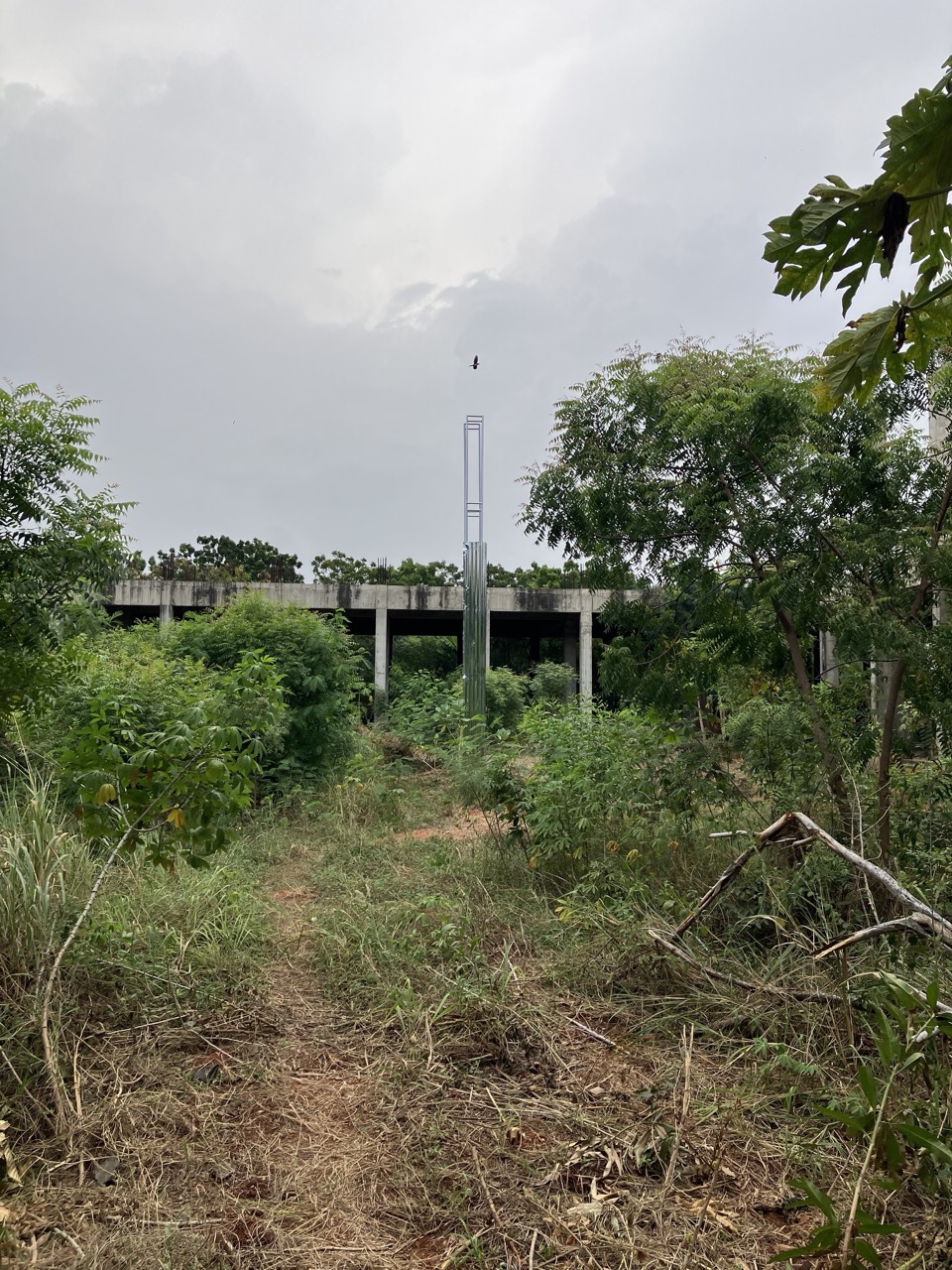
Limbo Museum’s courtyard. Courtesy of the author.
Walking through Limbo’s current dwellings, I’m struck that there’s no barrier between the ruin and its surrounding ecology, especially considering the preeminent assumption that a museum’s infrastructure must support the physical preservation of artworks. Instead, the artwork and the environment it inhabits are all a constitutive part of one another. The echoing bird songs in the unfinished concrete classrooms, the panoramic view of a hazy Accra (dust plumes moving across the Sahara to the Atlantic) from the second floor, the clustered unripe papayas, and cassava growing in the wild courtyard where a towering steel tube sculpture by Sylvester II is covered by a cloak of crows. All this porousness, the artwork’s exposure to the weather, influences the commissioning program.
A common hurdle in urban planning across African cities is compliance with building regulations. Constructing multistory structures often comes to a halt when funds run out (such is the case for the building housing the Limbo Museum) or when permits are rejected. In this latter case, developers or property owners might opt out of the clunky, long-winded, bureaucratic permit process altogether and instead begin construction informally. When regulatory authorities intervene, these cement-based buildings are abandoned. With time weighing on their pending possibility of becoming an apartment building, offices, or a lecture hall, the corroding concrete also becomes dwellings for the houseless. Such is the case for the Limbo Museum’s compound, where fruits and corn growing around it are a food resource for a couple who are its groundkeepers.
Reinvesting in the loss the university has inflicted on its students must influence the psyche of those who pass by it in their daily routines. Perhaps the other ruins on campus become invisible since there are no interactions at the site. This undoubtedly also applies within the urban environment. Perhaps they are a cautionary tale, warning against investing too much hope in the state’s ambitions. The scholar Laura Ann Stoler reminds us that ruination is “a political project that lays waste to certain peoples, relations, and things that accumulate in specific places.”5 Given how the Limbo Museum considers ruination within Ghana’s urban context and embraces this notion in its curatorial vision, it has a distinct conceptual kinship with Nkrumah Voli-ni, a public building in Tamale that hosts exhibitions and public programs. Bought from the state and restored by artist Ibrahim Mahama in 2020, the site is located in one of the aforementioned abandoned Brutalist concrete silos built by the Soviets.
Limbo Museum and Nkrumah Voli-ni are both evidence of how historical and cultural forces produce the urban landscape. Labor, memory, and conflicts are all inscribed on it, and architecture is among the prevailing means of displaying power. Both offerings demonstrate how the damage caused by economic conditions can be strategically seized upon within a nation’s cultural imaginary. They contrast narratives the state constructs and maintains from the former colonial empire’s dead artifacts, like Osu Castle, which rises on the edge of the Atlantic Ocean, with its fortified, white-washed walls above us on the beach.
“How do I enter the castle?” I ask a young boy heading toward the promontory behind me. “Through there,” he points to a door from which two tourists emerge. I walk past them, opening the propped, heavy metal door with a letter-sized piece of copy paper taped to it that boldly reads, “The Door of No Return.” The Danes built this castle as a trading station for gold, ivory, and Africans. The Portuguese later controlled it, the British colonial administration lived here, and so did Nkrumah himself post-independence. It now, too, sits in ruin. What were once glitzy rooms are now dark, damp, crumbling, and waiting to be dissolved by the humid winds and salty air.
The distance separating the castle and the UG Legon campus where Limbo sits is occupied by an ever-changing landscape of informal settlements constructed from wood and corrugated metal, one-story homes, and high-rise apartments mostly built of concrete and cement. Aimless loitering on the campus steers me to the Institute of African Studies, a building just north of the museum. I’m skeptical about walking through what, I assume, is a cultural center rich with historical material on the country’s political thought as defined by Nkrumah. A friend, Yaw, later tells me I’d be disappointed by its demoded ambiance, its mundaneness as a space for students to study and rest while passing the time between classes. Against the many classrooms and halls built in a British colonial style, I pass an extraordinary, almost four feet tall mound that termites have built from the red soil. I watch it, observing students who walk by. Their attention to the mound rolls off like water on a duck’s back. I wonder why many architects in Africa have yet to mimic it.
Now it’s dawn. I return to the five-story building near Oxford Street, observing the rust streaks from the reinforced steel bars. I suspect cracks are slowly forming from the bars expanding. It’s the age of concrete.
A common hurdle in urban planning across African cities is compliance with building regulations. Constructing multistory structures often comes to a halt when funds run out (such is the case for the building housing the Limbo Museum) or when permits are rejected. In this latter case, developers or property owners might opt out of the clunky, long-winded, bureaucratic permit process altogether and instead begin construction informally. When regulatory authorities intervene, these cement-based buildings are abandoned. With time weighing on their pending possibility of becoming an apartment building, offices, or a lecture hall, the corroding concrete also becomes dwellings for the houseless. Such is the case for the Limbo Museum’s compound, where fruits and corn growing around it are a food resource for a couple who are its groundkeepers.
Reinvesting in the loss the university has inflicted on its students must influence the psyche of those who pass by it in their daily routines. Perhaps the other ruins on campus become invisible since there are no interactions at the site. This undoubtedly also applies within the urban environment. Perhaps they are a cautionary tale, warning against investing too much hope in the state’s ambitions. The scholar Laura Ann Stoler reminds us that ruination is “a political project that lays waste to certain peoples, relations, and things that accumulate in specific places.”5 Given how the Limbo Museum considers ruination within Ghana’s urban context and embraces this notion in its curatorial vision, it has a distinct conceptual kinship with Nkrumah Voli-ni, a public building in Tamale that hosts exhibitions and public programs. Bought from the state and restored by artist Ibrahim Mahama in 2020, the site is located in one of the aforementioned abandoned Brutalist concrete silos built by the Soviets.
Limbo Museum and Nkrumah Voli-ni are both evidence of how historical and cultural forces produce the urban landscape. Labor, memory, and conflicts are all inscribed on it, and architecture is among the prevailing means of displaying power. Both offerings demonstrate how the damage caused by economic conditions can be strategically seized upon within a nation’s cultural imaginary. They contrast narratives the state constructs and maintains from the former colonial empire’s dead artifacts, like Osu Castle, which rises on the edge of the Atlantic Ocean, with its fortified, white-washed walls above us on the beach.
“How do I enter the castle?” I ask a young boy heading toward the promontory behind me. “Through there,” he points to a door from which two tourists emerge. I walk past them, opening the propped, heavy metal door with a letter-sized piece of copy paper taped to it that boldly reads, “The Door of No Return.” The Danes built this castle as a trading station for gold, ivory, and Africans. The Portuguese later controlled it, the British colonial administration lived here, and so did Nkrumah himself post-independence. It now, too, sits in ruin. What were once glitzy rooms are now dark, damp, crumbling, and waiting to be dissolved by the humid winds and salty air.
The distance separating the castle and the UG Legon campus where Limbo sits is occupied by an ever-changing landscape of informal settlements constructed from wood and corrugated metal, one-story homes, and high-rise apartments mostly built of concrete and cement. Aimless loitering on the campus steers me to the Institute of African Studies, a building just north of the museum. I’m skeptical about walking through what, I assume, is a cultural center rich with historical material on the country’s political thought as defined by Nkrumah. A friend, Yaw, later tells me I’d be disappointed by its demoded ambiance, its mundaneness as a space for students to study and rest while passing the time between classes. Against the many classrooms and halls built in a British colonial style, I pass an extraordinary, almost four feet tall mound that termites have built from the red soil. I watch it, observing students who walk by. Their attention to the mound rolls off like water on a duck’s back. I wonder why many architects in Africa have yet to mimic it.
Now it’s dawn. I return to the five-story building near Oxford Street, observing the rust streaks from the reinforced steel bars. I suspect cracks are slowly forming from the bars expanding. It’s the age of concrete.
1. Quoted in Keri Lambert, “‘It’s all Work and Happiness on the Farms’: Agricultural Development Between the Blocs in Nkrumah’s Ghana,” Journal of African History, vol. 60, no. 1, March 2019, 33.
2. Łukasz Stanek, Architecture in Global Socialism: Eastern Europe, West Africa, and the Middle East in the Cold War, (Princeton University Press, 2020), 50–55.
3. Lambert, 43–44.
4. Armelle Choplin, Concrete City: Material Flows and Urbanization in West Africa, (John Wiley & Sons Ltd., 2023), 33.
5. Laura Ann Stoler, “‘The Rot Remains’: From Ruins to Ruination” in In Imperial Debris: On Ruins and Ruination, (Duke University Press, 2013), 11.
2. Łukasz Stanek, Architecture in Global Socialism: Eastern Europe, West Africa, and the Middle East in the Cold War, (Princeton University Press, 2020), 50–55.
3. Lambert, 43–44.
4. Armelle Choplin, Concrete City: Material Flows and Urbanization in West Africa, (John Wiley & Sons Ltd., 2023), 33.
5. Laura Ann Stoler, “‘The Rot Remains’: From Ruins to Ruination” in In Imperial Debris: On Ruins and Ruination, (Duke University Press, 2013), 11.
This essay was generously supported by Dr. Makala Kusi.
Denny Mwaura is a curator and writer with a practice invested in the social histories of Black life, life under political economies, and overlooked narratives of Chicago’s creative communities. He is Assistant Director and Curator of Gallery 400 at the University of Illinois Chicago where he organizes exhibitions and programs including Press & Pull: A Legacy of the Robert Blackburn Printmaking Workshop (2026), Imagination Doctors (2026), Maria Gaspar: We Lit the Fire and Trusted the Heat (2025), Learning Together: Art Education and Community (2024), and The Mask of Prosperity (2024). He was Program Manager for the Black Arts Movement School Modality and has published in E-Flux, Frieze, New Art Examiner, Boston Art Review, and MIT Press. Mwaura received his MA in Modern and Contemporary Art History from the School of the Art Institute of Chicago and is a recipient of the Schiff Foundation Fellowship for Critical Architectural Writing, awarded by the Art Institute of Chicago’s Department of Architecture and Design.
