What the Highway Couldn’t Take: Imagining Relation After Spatial Rupture
When Dr. Johnnetta Betsch Cole sounds an alarm, you answer. Immediately. Few people can transform a lecture hall, an exhibition opening, a commencement address, or even Sunday brunch into a gripping call to conscience. So, when artist Calida Rawles publicly shared an image online of a handwritten note from Dr. Cole stating that her body of work on view at the Cummer Museum of Art and Gardens in Jacksonville, Florida left her with “no words,” I immediately cleared my schedule. The next morning, I took a scenic drive on U.S. Route 30 to Jacksonville to see Rawles's exhibition—the first of my two journeys along the ribbons of asphalt that stitch and sever the United States to commune with her exhibition. Two weeks later, I followed her work again; this time north across Interstate 75 to the Spelman College Museum of Fine Art (SCMFA) in Atlanta, Georgia. In both instances, Rawles’s sprawling titular tableau Away with the Tides (2024), greeted me upon arrival.
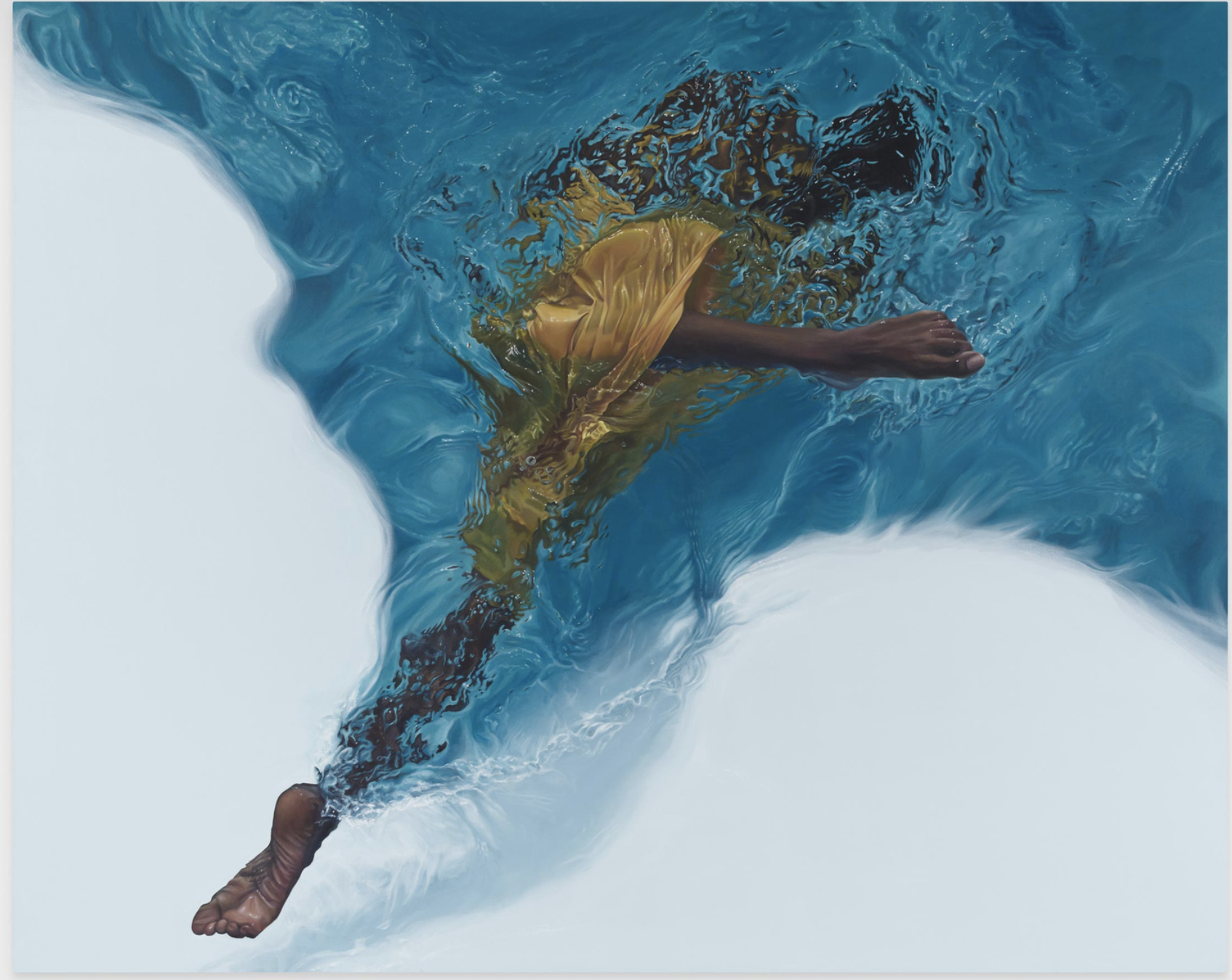
Calida Rawles, Away with the Tides, 2024. Acrylic on canvas, 96 x 120 inches, 243.8 x 304.8 cm. Photo by Marten Elder. Courtesy the artist and Lehmann Maupin, New York, Seoul, and London.
Approaching the work at SCMFA felt particularly ceremonial, like a beckoning call to give oneself over to rapture. As I processed down the entrance to the galleries, the full glory of the painting came into focus. A long-footed figure’s arabesque lengthened, Revelations-by-Alvin-Ailey-esque, toward rich mahogany below the canvas. The SCMFA, founded in 1996 during Dr. Cole’s tenure as president of Spelman College, is the only museum in the United States dedicated to art by and about women of the African Diaspora. Thus, the arrival of Away with the Tides at Spelman exactly three decades later was an especially resonant homecoming for Rawles who has described our alma mater as “the mother ship … the source where I can always go back to get re-charged, re-energized.”1 Yet the significance of the Atlanta iteration of Away with the Tides extends beyond biography.
Originally commissioned by the Pérez Art Museum Miami, Away with the Tides holds Overtown, Miami at its core, but its travels trace a terrain marked by the displacement of Black communities at the hands of state-sanctioned development. The exhibition’s second iteration in Jacksonville unfolded within a city where the memory of Sugar Hill—the thriving Black enclave built in part by Dr. Cole’s great-grandfather Abraham Lincoln Lewis (1865–1947) and later removed for what would become the Jacksonville Expressway—endures.
At SCMFA, its final destination, Away with the Tides engages with another neighborhood harmed by highway construction—Atlanta’s West End. SCMFA’s curatorial team embraced this dialogue by expanding the exhibition with a gallery of archival news coverage documenting the destruction caused by Atlanta’s interstate system in predominantly Black neighborhoods. In doing so, the museum positions itself not simply as a venue but as an institution committed to igniting public conversations about the enduring consequences of racialized city planning.
With these histories and convergences in mind, I returned to Away with the Tides (2024) in relevé, following the figure’s crescentic foot upward as folds of water unfurled from her ankles and expanded into a distinct coastline. Her calf muscles jetted through the south of Texas. To her right were waves whispering the boundaries of Louisiana, Mississippi, Alabama, Georgia, and West Florida. These gestures link the history of the once prosperous Overtown, Miami to a broader geography of the forced removal of Black neighborhoods disguised by city officials as “revitalization efforts” along the Gulf Coast.
Originally commissioned by the Pérez Art Museum Miami, Away with the Tides holds Overtown, Miami at its core, but its travels trace a terrain marked by the displacement of Black communities at the hands of state-sanctioned development. The exhibition’s second iteration in Jacksonville unfolded within a city where the memory of Sugar Hill—the thriving Black enclave built in part by Dr. Cole’s great-grandfather Abraham Lincoln Lewis (1865–1947) and later removed for what would become the Jacksonville Expressway—endures.
At SCMFA, its final destination, Away with the Tides engages with another neighborhood harmed by highway construction—Atlanta’s West End. SCMFA’s curatorial team embraced this dialogue by expanding the exhibition with a gallery of archival news coverage documenting the destruction caused by Atlanta’s interstate system in predominantly Black neighborhoods. In doing so, the museum positions itself not simply as a venue but as an institution committed to igniting public conversations about the enduring consequences of racialized city planning.
With these histories and convergences in mind, I returned to Away with the Tides (2024) in relevé, following the figure’s crescentic foot upward as folds of water unfurled from her ankles and expanded into a distinct coastline. Her calf muscles jetted through the south of Texas. To her right were waves whispering the boundaries of Louisiana, Mississippi, Alabama, Georgia, and West Florida. These gestures link the history of the once prosperous Overtown, Miami to a broader geography of the forced removal of Black neighborhoods disguised by city officials as “revitalization efforts” along the Gulf Coast.
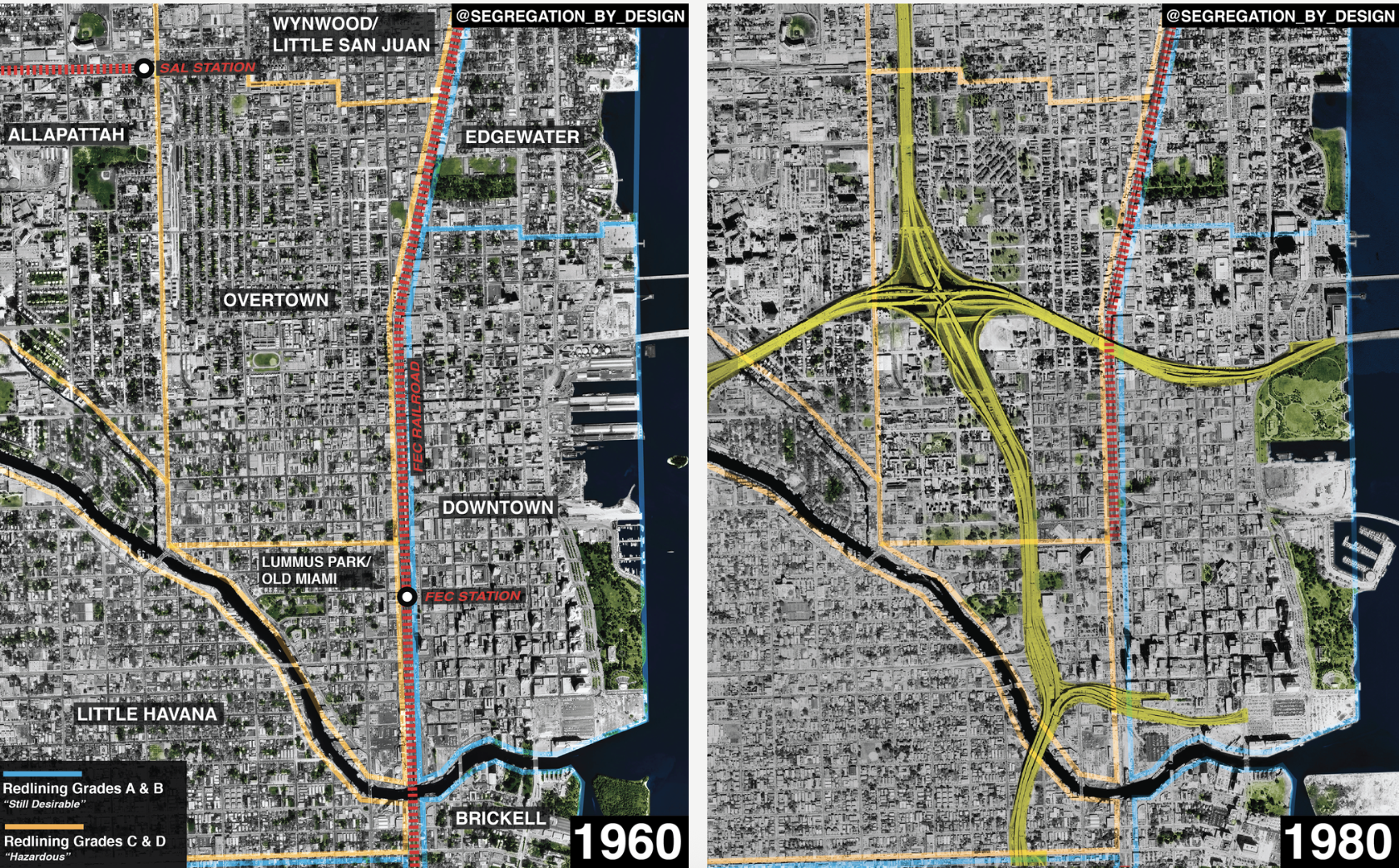
“Downtown Miami and Overtown before and after highway construction and “urban renewal.” In all, construction of I-95 in Miami required the forcible relocation of over 12,000 residents in Overtown—nearly 100% of them Black.” Susaneck, Adam Paul. “Segregation by Design: Miami.” TU Delft Centre for the Just City, 2026. https://www.segregationbydesign.com/
Once known as the “Harlem of the South,” from the 1930s–1950s, Overtown was a vibrant African American community. Where there were Fords carrying families beneath cathedral-like canopies of live oak trees to Mt. Zion Baptist Church each Sunday, children double dutching in courtyards, and jazz drifting from the Fiesta Club long after dusk now ropes a paved laceration: Interstate 95.
The demolition of housing and businesses to clear space for the highway, combined with systemic neglect, caused the population to plummet by 80% and has led to decades of severe economic decline. In Rawles’s view, the construction of I-95 struck Overtown like a Category 5 hurricane, not only destroying the physical landscape, but also leaving residents to navigate decades of neglect, disinvestment, and inadequate recovery efforts. As Rawles shared during our conversation in May, “Towners were sold an idea but didn’t see its effect coming. Sort of like when you underestimate a hurricane.” In Away with the Tides, Rawles translates that catastrophe into bodily form. The figure’s dress, hair, and flesh dissolve into prismatic turbulence that both synchronizes with and disperses the surrounding water. At her anatomical heart, the churning surface froths into the unmistakable silhouette of Overtown itself, collapsing the distance between painted landscape and body so that the neighborhood’s destruction registers as a wound carried within its people.
The demolition of housing and businesses to clear space for the highway, combined with systemic neglect, caused the population to plummet by 80% and has led to decades of severe economic decline. In Rawles’s view, the construction of I-95 struck Overtown like a Category 5 hurricane, not only destroying the physical landscape, but also leaving residents to navigate decades of neglect, disinvestment, and inadequate recovery efforts. As Rawles shared during our conversation in May, “Towners were sold an idea but didn’t see its effect coming. Sort of like when you underestimate a hurricane.” In Away with the Tides, Rawles translates that catastrophe into bodily form. The figure’s dress, hair, and flesh dissolve into prismatic turbulence that both synchronizes with and disperses the surrounding water. At her anatomical heart, the churning surface froths into the unmistakable silhouette of Overtown itself, collapsing the distance between painted landscape and body so that the neighborhood’s destruction registers as a wound carried within its people.
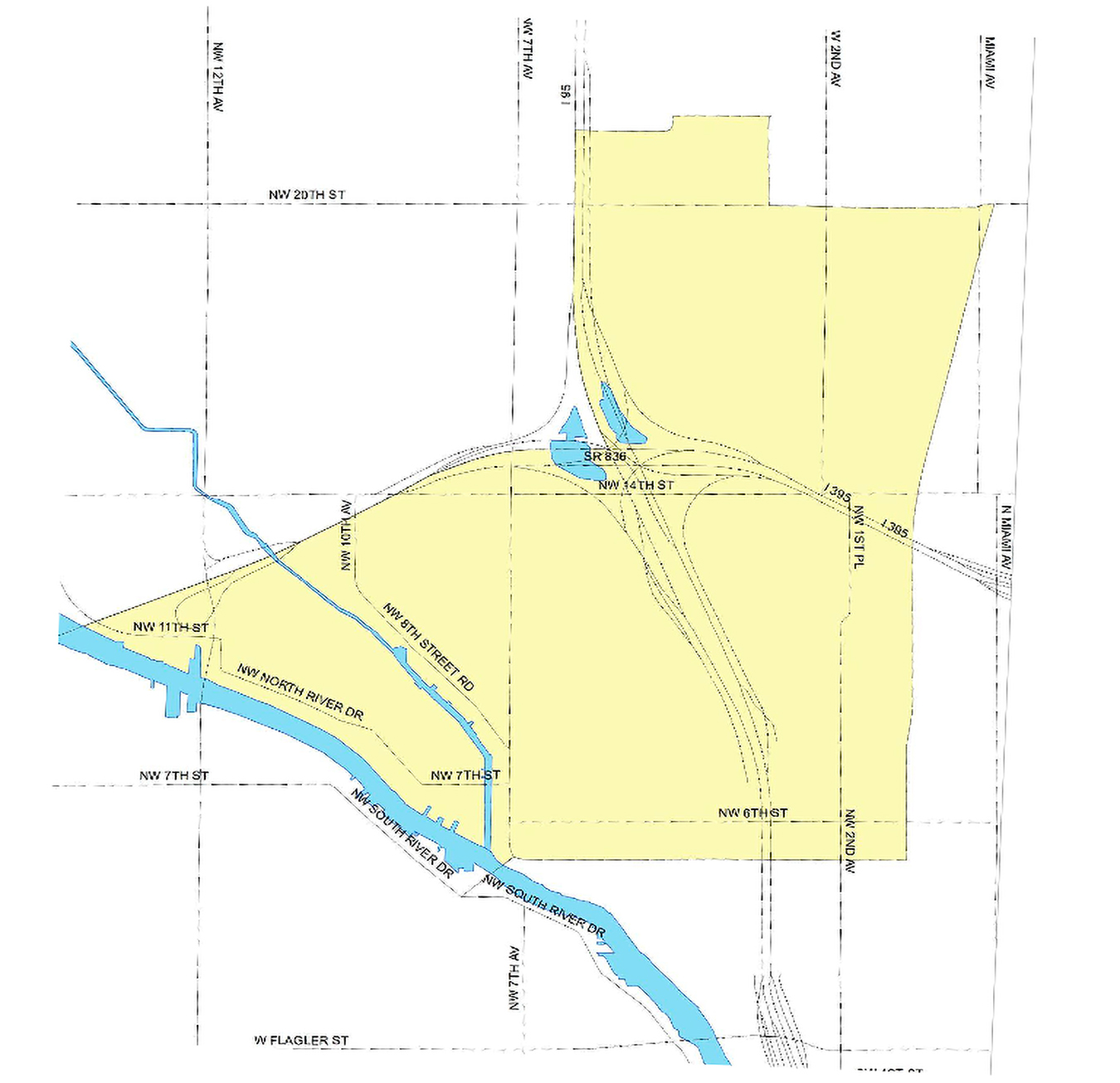
Aerial view of Overtown. Courtesy of the artist.
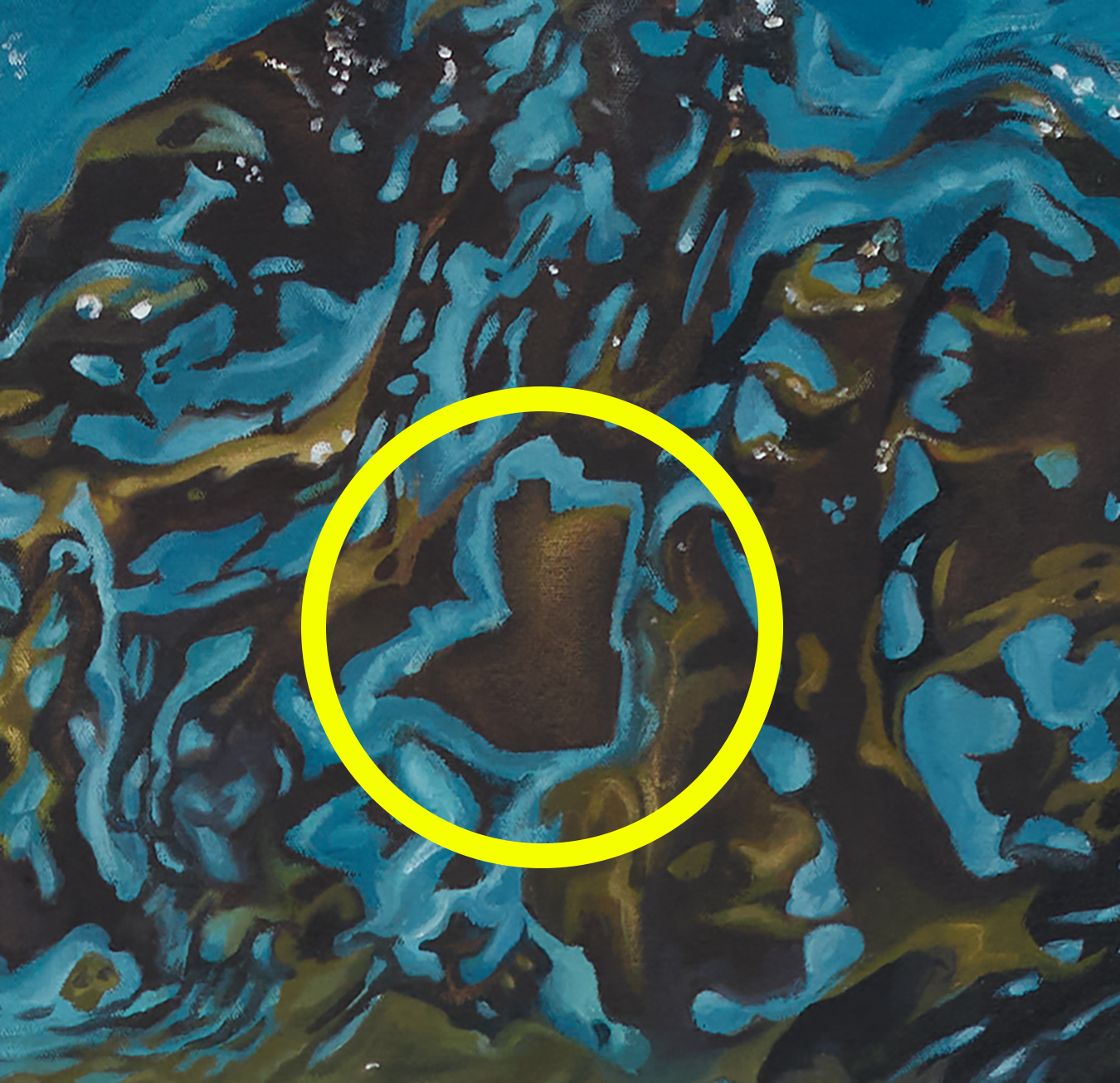
Calida Rawles, Away with the Tides (detail), 2024. Acrylic on canvas, 96 x 120 inches, 243.8 x 304.8 cm. Photo by Marten Elder. Courtesy the artist and Lehmann Maupin, New York, Seoul, and London. Yellow circle added by Jupiter Magazine.
Rawles has become known, in part, for what she calls “mapping.” That is, she embeds locations of significance to African American communities, often places scarred by terror and disenfranchisement, within her jewel-toned visions of Black amphibious life. This Trojan horse strategy—smuggling spatial histories into the “pretty blue paintings”2 patrons fight and claw to acquire—has become one of her defining artistic signatures. However, within the totality of Away with the Tides, a new evocation of this experiment comes to the fore: in some of the works, Rawles includes aerial images of the city blocks of Overtown directly behind her fluvial figurations.
Instead of layering saturated acrylic paint with glitter washes to create her celebrated phosphorescence, Rawles rendered Hallowed Be Her Name (2024) in delicate pastel. Porous pockets of parchment peek through, never quite surrendering to pigment. Against this softened ground floats a young mother. Her eyes are closed. One arm extends, while the other cradles her sleeping infant. Beneath them, whispered marks reveal the contours of Overtown after I-95 cleaved through its center.
Instead of layering saturated acrylic paint with glitter washes to create her celebrated phosphorescence, Rawles rendered Hallowed Be Her Name (2024) in delicate pastel. Porous pockets of parchment peek through, never quite surrendering to pigment. Against this softened ground floats a young mother. Her eyes are closed. One arm extends, while the other cradles her sleeping infant. Beneath them, whispered marks reveal the contours of Overtown after I-95 cleaved through its center.
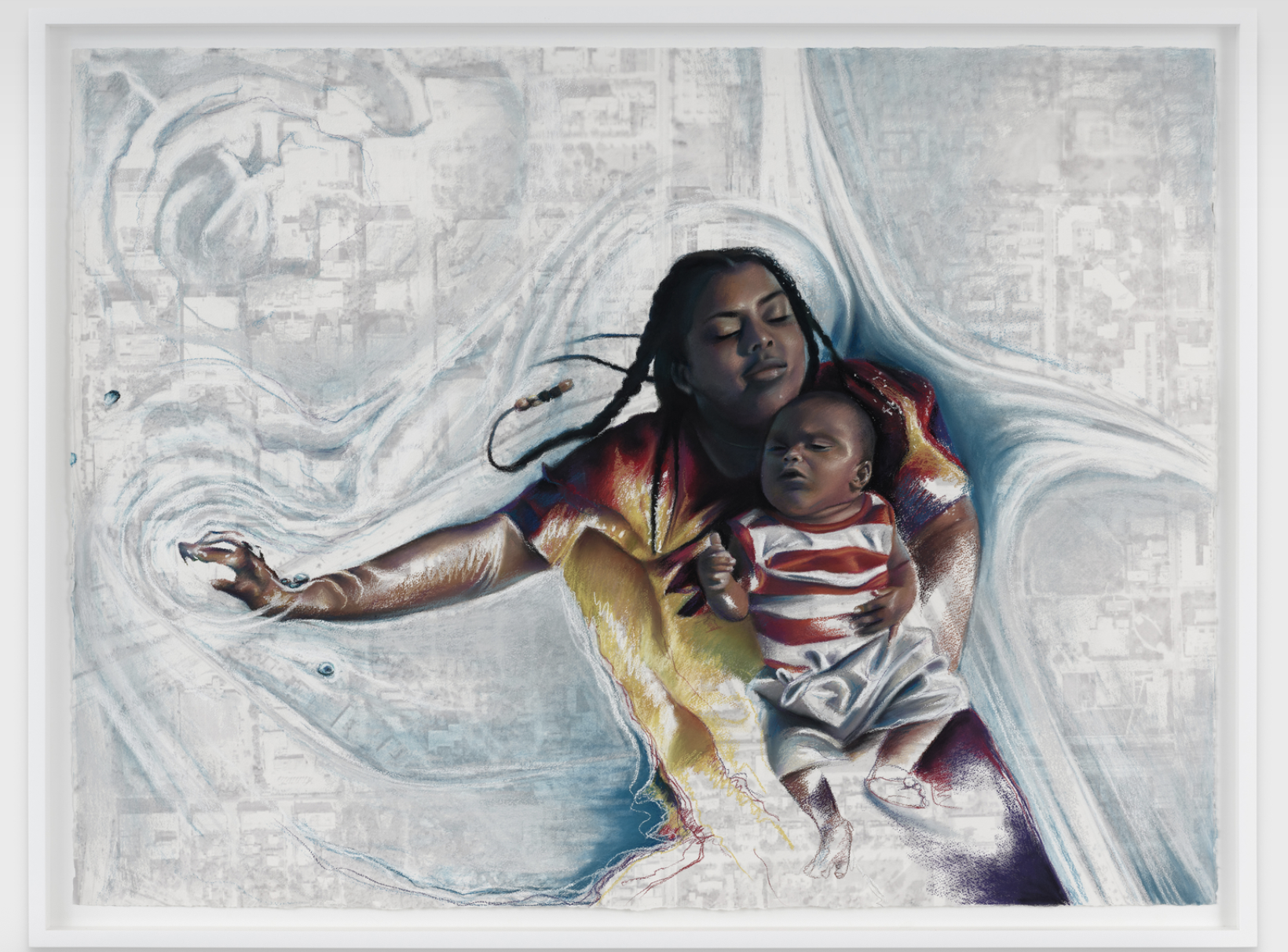
Calida Rawles, Hallowed Be Her Name, 2024. Pastel on paper, 38 x 52 inches (paper), 96.5 x 132.1 cm, 42 x 55 x 2 inches (framed), 106.68 x 139.7 x 5.08 cm. Photo by Marten Elder. Courtesy the artist and Lehmann Maupin, New York, Seoul, and London.
With the mother and child positioned squarely at the intersection of the north/south and east/west-bound lanes of I-95, the scene assumes the unmistakable geometry of a crucifixion. During our conversation, Rawles reflected that “mothering is the ultimate sacrifice … giving yourself to a new generation.” The mother’s libation unfolds atop another sacrifice: the hecatomb of a Black neighborhood on the altar of “American progress.” The cruciform interstate reveals that motherhood, like geography, is never politically neutral. Instead, maternal sacrifice emerges as inseparable from the public sacrifices demanded by racial capitalism and the infrastructures built to sustain it.
From her home in California, Rawles watched with frustration as national news outlets covered the passing of legislation restricting race- and gender-based conversations in Florida’s public schools while rarely asking Black Floridians how they understood its consequences. Tired of “waiting for reporters to talk about how Black Floridians feel,” she took matters into her own hands, spending several weeks with contemporary residents of Overtown as she prepared to create Away with the Tides. She photographed them in the waters surrounding Virginia Key Beach, the only beach open to Black Miamians under Jim Crow, and in Gibson Park Pool, the first public pool Miami’s Black residents could bathe in. She then translated those encounters into portraits that carry not only her sitters’ likenesses, but also their memories, aspirations, and lived relationship to place. In doing so, Rawles enters a canon of artists, chief among them Purvis Young and the Highwaymen, who refuse to allow the state’s official narratives around urban renewal as an innocuous harbinger of prosperity and paradise to eclipse the histories of African American displacement, exclusion, and endurance.
From her home in California, Rawles watched with frustration as national news outlets covered the passing of legislation restricting race- and gender-based conversations in Florida’s public schools while rarely asking Black Floridians how they understood its consequences. Tired of “waiting for reporters to talk about how Black Floridians feel,” she took matters into her own hands, spending several weeks with contemporary residents of Overtown as she prepared to create Away with the Tides. She photographed them in the waters surrounding Virginia Key Beach, the only beach open to Black Miamians under Jim Crow, and in Gibson Park Pool, the first public pool Miami’s Black residents could bathe in. She then translated those encounters into portraits that carry not only her sitters’ likenesses, but also their memories, aspirations, and lived relationship to place. In doing so, Rawles enters a canon of artists, chief among them Purvis Young and the Highwaymen, who refuse to allow the state’s official narratives around urban renewal as an innocuous harbinger of prosperity and paradise to eclipse the histories of African American displacement, exclusion, and endurance.
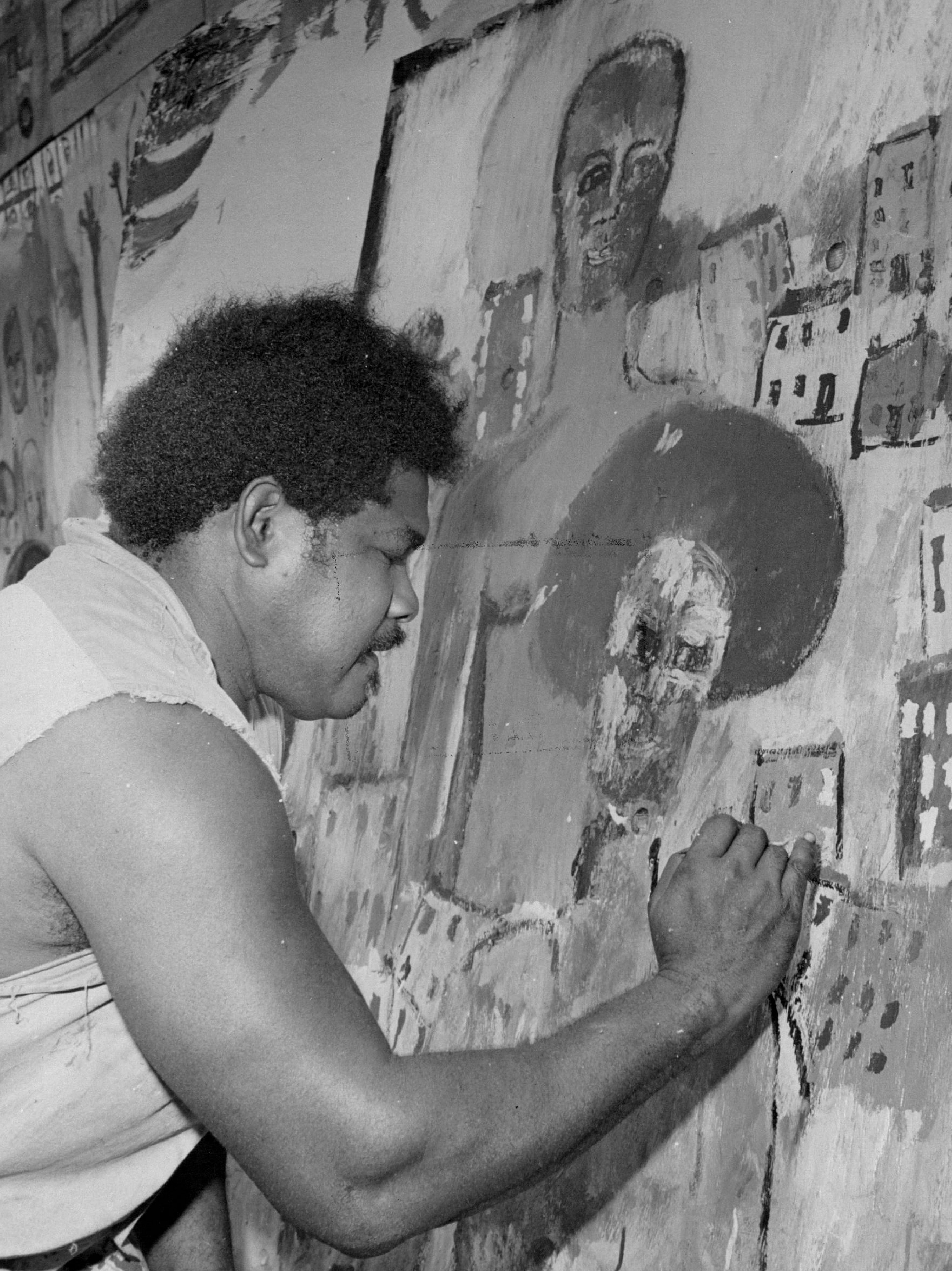
Purvis Young painting in Goodbread Alley, which the I-95 highway cut through, 1974. Photo by Roy Bartley. Courtesy of the Miami Herald
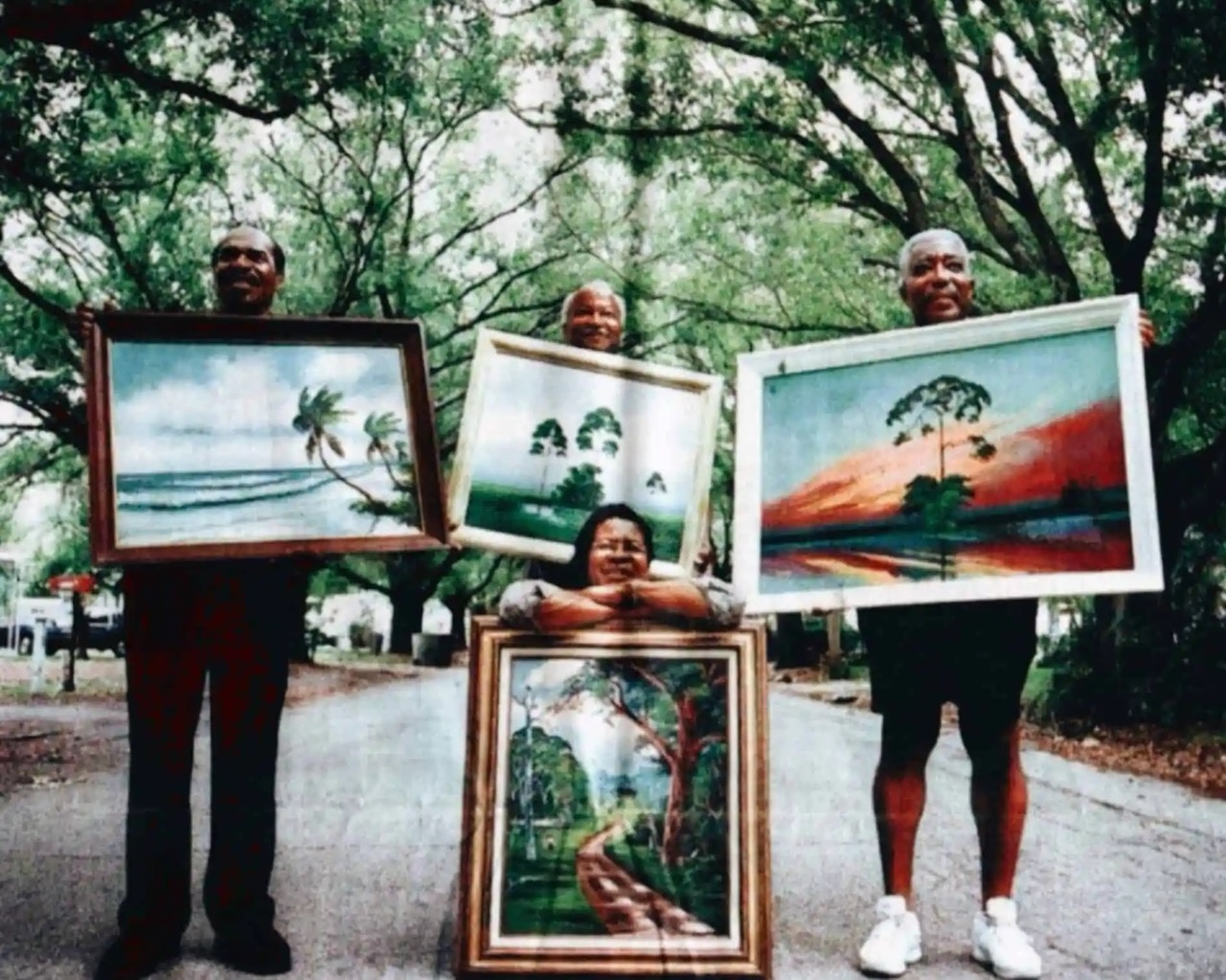
Willie Reagan, Lemuel Newton, Rodney Demps, and Mary Ann Carroll show off their paintings for a 2012 article in the American Airlines in-flight magazine.
Born in Liberty City, Miami in 1943, Young moved to Overtown as a young man and witnessed the rapid decline of his formative environment after construction of I-95 began. He used the detritus of shuttered businesses to create paintings that held Overtown’s grief alongside its enduring vitality. Blues City (1972), with saxophonists amid shifting tenement buildings, evokes the neighborhood’s history as a cultural sanctuary where legends including Ella Fitzgerald, Billie Holiday, and Nat King Cole performed. Yet Young’s composition refuses nostalgia alone. The musicians are tearful, perhaps despairing the contradictions of a place defined by both extraordinary cultural abundance and profound loss. Young often combined his paintings into sprawling murals that clothed the elevated concrete coil that pushes through Black Miami’s core.
While Young transformed the highway into a surface that bears witness to the history of the neighborhood it disrupted, the Highwaymen—a collective of twenty-six African American artists from Fort Pierce, Florida—utilized the interstate into a marketplace. They traveled the Florida freeway selling their paintings directly to businesses and homes beginning in the mid-1950s. Reflecting on the group’s ethos, Mary Ann Carroll (1940–2019), the only woman member, remarked that “it was an honest dollar for an honest day’s work.”3 The irony at the heart of their story mirrors the contradiction Rawles uncovers throughout Away with the Tides. The same highway that expanded the artists’ market catalyzed the postwar vision of modernity that displaced neighborhoods like Overtown. By the 1980s, that paradox sharpened. As Florida’s tourism industry consolidated around destinations like Walt Disney World and interstate travel encouraged motorists to speed directly toward vacation resorts, visitors increasingly bypassed the small towns where Highwaymen once sold their work.
Rawles responds to the interstate as a technology of displacement by returning to water—a motif in her practice that holds together seemingly irreconcilable histories: Water is simultaneously an archive of racial exclusion and collective trauma, recalling segregated beaches, environmental violence, and the Middle Passage. It also functions as a site of spiritual renewal, bodily freedom, and collective gathering. Rather than trying to soothe this tension, Away with the Tides inhabits it. The exhibition’s three-channel film We Gonna Swim (2024), made in collaboration with documentary filmmaker Laura Brownson, follows contemporary residents of Overtown as they reclaim the water as a space of leisure, communion, and joviality. That reclamation opens onto a broader question taken up by Chicago-based painter Lindsay Adams in her ongoing series Where Can I Go to Frolic? (2023–Present). Beneath the playfulness of her title, Adams asks: Where are people whose neighborhoods have been repeatedly seized, flooded, razed, or partitioned, permitted simply to exist, let alone to belong and remain?
While Young transformed the highway into a surface that bears witness to the history of the neighborhood it disrupted, the Highwaymen—a collective of twenty-six African American artists from Fort Pierce, Florida—utilized the interstate into a marketplace. They traveled the Florida freeway selling their paintings directly to businesses and homes beginning in the mid-1950s. Reflecting on the group’s ethos, Mary Ann Carroll (1940–2019), the only woman member, remarked that “it was an honest dollar for an honest day’s work.”3 The irony at the heart of their story mirrors the contradiction Rawles uncovers throughout Away with the Tides. The same highway that expanded the artists’ market catalyzed the postwar vision of modernity that displaced neighborhoods like Overtown. By the 1980s, that paradox sharpened. As Florida’s tourism industry consolidated around destinations like Walt Disney World and interstate travel encouraged motorists to speed directly toward vacation resorts, visitors increasingly bypassed the small towns where Highwaymen once sold their work.
Rawles responds to the interstate as a technology of displacement by returning to water—a motif in her practice that holds together seemingly irreconcilable histories: Water is simultaneously an archive of racial exclusion and collective trauma, recalling segregated beaches, environmental violence, and the Middle Passage. It also functions as a site of spiritual renewal, bodily freedom, and collective gathering. Rather than trying to soothe this tension, Away with the Tides inhabits it. The exhibition’s three-channel film We Gonna Swim (2024), made in collaboration with documentary filmmaker Laura Brownson, follows contemporary residents of Overtown as they reclaim the water as a space of leisure, communion, and joviality. That reclamation opens onto a broader question taken up by Chicago-based painter Lindsay Adams in her ongoing series Where Can I Go to Frolic? (2023–Present). Beneath the playfulness of her title, Adams asks: Where are people whose neighborhoods have been repeatedly seized, flooded, razed, or partitioned, permitted simply to exist, let alone to belong and remain?
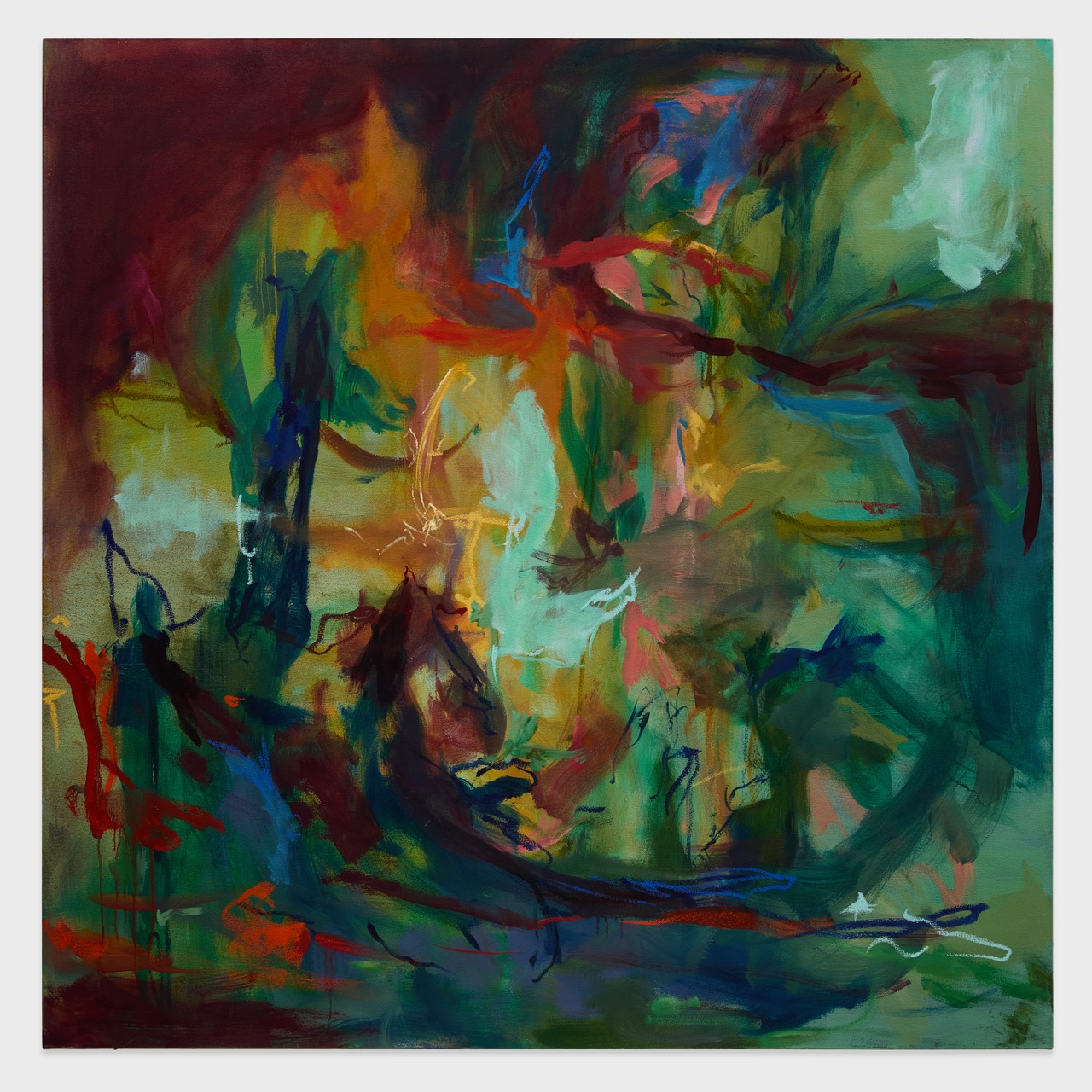
Lindsay Adams, moon whispers and waves that glow, 2026. Oil, oil pastel, and oil stick on canvas. 60″ x 60″. Image courtesy of the artist and Patron Gallery, Chicago, IL.

Lindsay Adams, Where Can I Go to Frolic? (06), 2025. Oil on canvas, 12″ x 12″. Image courtesy of the artist.
Adams’s canvases refuse stable horizon lines and fixed vantage points. Gestural passages emerge and dissolve into twitches and smears of emerald, indigo, rust, and ochre. The works collapse memory and topography until they become indistinguishable, suggesting that what survives displacement depends on what we have the capacity to call back to life on the page and on the canvas, in song and dance, in stories shared … By dissolving the boundaries between the natural, the built, the ancestral, and the spiritual, Adams’s works chart the alchemy between interior lives and communal histories. As such, she calls her paintings “floras,” a counterargument to traditional landscape painting. In her view, “geography is about transience and fugitivity, and not possession.” As Adams writes in her Master of Fine Arts thesis, her practice contends that “true spaces of belonging are not anchored in geographic permanence but emerge from an ephemeral core, shaped by movement—across bodies, histories, temporal landscapes … and collective memory.”4
Together, Adams’s paintings and her notion of the “ephemeral core” suggest that what survives dispossession is not simply memory, but the bonds among people, land, and history that continue to animate a place long after its spatial order has been altered. What has been submerged is neither erased nor irretrievable. It changes form, asking us to cultivate new ways of seeing and relating to it.
These inquiries take root in a longer lineage of Black geography scholars. For instance, scholar, curator, and fellow Spelman College alumna Michelle Lanier has explored “womanist cartographies” as forms of ancestral knowledge-making. I encountered this embodied approach at A Sojourn for Harriet Jacobs in March 2024, which is also where I met Adams. Both Rawles and Adams’s paintings ask not simply what violence has taken from Black communities, but how we might cultivate care, regard, and reciprocity with the places that have always held us.
Together, Adams’s paintings and her notion of the “ephemeral core” suggest that what survives dispossession is not simply memory, but the bonds among people, land, and history that continue to animate a place long after its spatial order has been altered. What has been submerged is neither erased nor irretrievable. It changes form, asking us to cultivate new ways of seeing and relating to it.
These inquiries take root in a longer lineage of Black geography scholars. For instance, scholar, curator, and fellow Spelman College alumna Michelle Lanier has explored “womanist cartographies” as forms of ancestral knowledge-making. I encountered this embodied approach at A Sojourn for Harriet Jacobs in March 2024, which is also where I met Adams. Both Rawles and Adams’s paintings ask not simply what violence has taken from Black communities, but how we might cultivate care, regard, and reciprocity with the places that have always held us.
Calida Rawles and Laura Brownson, We Gonna Swim (clip), 2024. Three channel video installation. Courtesy the artist and Lehmann Maupin, New York, Seoul, and London.
Rawles honors those who have persisted in the highway’s wake. Young alchemized this maiming structure into a bearer of Overtown’s memory. The Highwaymen made it a route through which Black artistic freedom could be compensated. Adams reminds us that even as a physical terrain is fractured, its “ephemeral core” can endure through reimagined relationships to architecture, land, water, memory, kinship, and history in ways that exceed structures of domination. What this constellation of artists make possible is not simply remembrance but relation across rupture. Collectively, they refuse the premise that geography belongs to those who build, own, or divide it.
1. Larry Calhoun, “Calida Rawles: Her Signature Art’s Rippling Effects,” Spelman Messenger vol. 133, no. 1 (2022): 39, https://www.spelman.edu/_1_Docs-and-Files/spelman-messenger/spelman-messenger-spring-2022.pdf
2. Calida Rawles in conversation with Sandra Jackson-Dumont at the Atlanta University Center Art Collective’s 5th Annual Symposium, March 27, 2026.
3. Gary Monroe, The Highwaymen: Florida's African-American Landscape Painters. (Florida: Florida University Press, 2001), 26, https://floridapress.org/9780813022819/the-highwaymen/
4. Lindsay Adams, “Tracing the Ephemeral: Belonging, Memory, and Spatial Refusal,” Master of Fine Arts in Studio thesis, (School of the Art Institute of Chicago, 2025).
2. Calida Rawles in conversation with Sandra Jackson-Dumont at the Atlanta University Center Art Collective’s 5th Annual Symposium, March 27, 2026.
3. Gary Monroe, The Highwaymen: Florida's African-American Landscape Painters. (Florida: Florida University Press, 2001), 26, https://floridapress.org/9780813022819/the-highwaymen/
4. Lindsay Adams, “Tracing the Ephemeral: Belonging, Memory, and Spatial Refusal,” Master of Fine Arts in Studio thesis, (School of the Art Institute of Chicago, 2025).

Nailah Reine Barnes is a writer, curator, and researcher who uses womanist geography, cultural memory, and Black diasporic anthropology to examine contemporary art and architecture. She is a graduate of Spelman College and the Atlanta University Center's Art History + Curatorial Studies Collective. Her writing and curatorial work has been presented by Camden Art Centre (London, England), the High Museum of Art (Atlanta, USA), the Fulbright Program (Dakar, Senegal), the Institute of Contemporary Art (Boston, USA), the Pulitzer Center (Venice, Italy), and Condé Nast (Venice, Italy). She is the founder of The Brains with Beauty Project, a multi-channel nonprofit organization that nurtures academic excellence and holistic wellness in Black girls. Currently based between Gainesville, Florida, USA and Atlanta, Georgia, USA, Nailah continues to work internationally across writing, research, and cultural programming.
Photo: Aisha Olamide Seriki, 2025
Instagram: @occupiedbythelense
Photo: Aisha Olamide Seriki, 2025
Instagram: @occupiedbythelense
