Contending with Modernism’s Ceiling: A Review of Architects of Liberation at MoMA
“Culture and politics need not present an either/or proposition if politics is restored to its original meaning—‘of the polis,’ the village, the community.” —Elizabeth Alexander, The Black Interior
Stretching beyond a display of architectural style, Architects of Liberation: Modernism in Western Africa pulses within the heart of a contradiction: while these newly independent nations looked to architecture as a means of giving material form to political freedom, the idioms and practices they deployed often rhymed with the very colonial systems, foreign dependence, and contested visions of progress they were working to disentangle their futures from.
On view at the Museum of Modern Art until January 2027 and curated by Martino Stierli and Ikem Stanley Okoye, the exhibition surveys the architecture produced in Benin, Cameroon, Côte d’Ivoire, Ghana, Nigeria, Senegal, and Togo during the first decades of independence (spanning the late 1950s to early 1980s). Divided into seven sections, Networks of Modernization, Cityscapes, Building Civic Institutions, Modern Living, Event Architecture, Identities, and Landscapes of Education, visitors are encouraged to move across materials, national contexts, and historical timelines, tracing both the shared ambitions and political differences across western Africa. In addition to the sites themselves, it also brings into focus the distinct imaginaries of the leaders and thinkers including Félix Houphouët-Boigny, Sékou Touré, Kwame Nkrumah, Léopold Sédar Senghor, Nnamdi Azikiwe, and the brothers Amílcar and Luís Cabral, who shaped the cultural consciousness on the continent and diasporically during this critical period.
Including canonical archives, state commissions, and the work of predominantly foreign architects—with a few African-born practitioners appearing largely as exceptions—Architects of Liberation produces a materially rich show. Its curatorial logic, on the other hand, reproduces the premise that Africa only becomes legible as modern through its assimilation into Western paradigms. In this case, Western definitions for modernism are not positioned as one vocabulary of progress among many; it becomes the standard in which advancement itself is measured, often at the expense of African nations developing and legitimizing sovereign vocabularies of modernism on their own terms. Perhaps, this is also the difficulty of asking an institution that has played a central role in constructing the image of modernism itself to account for its blind spots.
Kwame Nkrumah’s distinction between adoption (the repetition of foreign forms) versus adaptation (the reshaping of forms to meet a different cultural and economic reality from whence they emerged, thus preserving the possibility of choice and agency),1,2 as cited in the exhibition’s catalogue, proves illuminating when considering the dilemma at the center of the exhibition, namely how these newly independent nations attempted to adapt modernism while also being compelled to perform it. While, in the shadow of the Cold War, architecture offered a means of symbolically breaking from colonial rule and announcing distinct political identities to the world, the urgency of that task often outpaced the local systems and technical infrastructure available to realize it. The exhibition brings this tension into sharpest relief as it moves from master plans that capture the scale of post-independence aspiration to projects that expose the human costs of their realization, such as the Akosombo Dam.
On view at the Museum of Modern Art until January 2027 and curated by Martino Stierli and Ikem Stanley Okoye, the exhibition surveys the architecture produced in Benin, Cameroon, Côte d’Ivoire, Ghana, Nigeria, Senegal, and Togo during the first decades of independence (spanning the late 1950s to early 1980s). Divided into seven sections, Networks of Modernization, Cityscapes, Building Civic Institutions, Modern Living, Event Architecture, Identities, and Landscapes of Education, visitors are encouraged to move across materials, national contexts, and historical timelines, tracing both the shared ambitions and political differences across western Africa. In addition to the sites themselves, it also brings into focus the distinct imaginaries of the leaders and thinkers including Félix Houphouët-Boigny, Sékou Touré, Kwame Nkrumah, Léopold Sédar Senghor, Nnamdi Azikiwe, and the brothers Amílcar and Luís Cabral, who shaped the cultural consciousness on the continent and diasporically during this critical period.
Including canonical archives, state commissions, and the work of predominantly foreign architects—with a few African-born practitioners appearing largely as exceptions—Architects of Liberation produces a materially rich show. Its curatorial logic, on the other hand, reproduces the premise that Africa only becomes legible as modern through its assimilation into Western paradigms. In this case, Western definitions for modernism are not positioned as one vocabulary of progress among many; it becomes the standard in which advancement itself is measured, often at the expense of African nations developing and legitimizing sovereign vocabularies of modernism on their own terms. Perhaps, this is also the difficulty of asking an institution that has played a central role in constructing the image of modernism itself to account for its blind spots.
Kwame Nkrumah’s distinction between adoption (the repetition of foreign forms) versus adaptation (the reshaping of forms to meet a different cultural and economic reality from whence they emerged, thus preserving the possibility of choice and agency),1,2 as cited in the exhibition’s catalogue, proves illuminating when considering the dilemma at the center of the exhibition, namely how these newly independent nations attempted to adapt modernism while also being compelled to perform it. While, in the shadow of the Cold War, architecture offered a means of symbolically breaking from colonial rule and announcing distinct political identities to the world, the urgency of that task often outpaced the local systems and technical infrastructure available to realize it. The exhibition brings this tension into sharpest relief as it moves from master plans that capture the scale of post-independence aspiration to projects that expose the human costs of their realization, such as the Akosombo Dam.
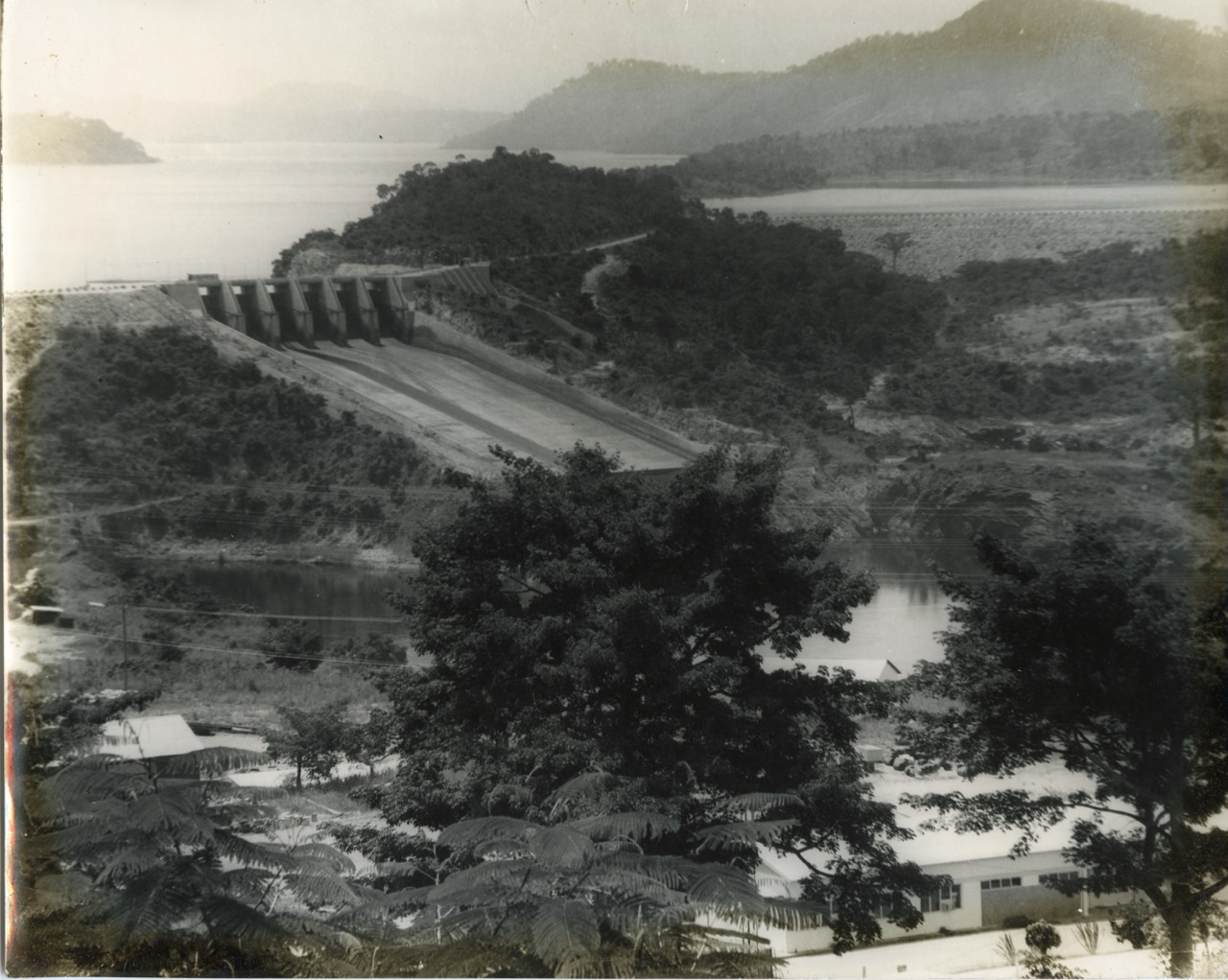
Akosombo Dam, Ghana. 1972. Photograph: James Barnor, (c) James Barnor, courtesy galerie Clémentine de la Féronnière
Designed by the American firm Kaiser Engineers and completed in 1965 under Nkrumah’s leadership, the massive hydroelectric project transformed the Volta River Basin into Lake Volta. Conceived to power Ghana’s cities and export industries, the dam also displaced nearly eighty thousand people and submerged hundreds of villages. New towns were created across the Volta through state-led resettlement efforts, though, as Prita Meier observes in a catalogue essay entitled “Monuments of Sovereignty? Postcolonial Mega-Projects and the Limits of Liberation,” many of the homes were substandard and lacked basic facilities. More fundamentally, being dispossessed from your home, disconnected from your land, and losing rights to the cultural traditions your natal terrain holds produces a level of trauma that resettlement cannot simply repair.3 Alas, the possibility of adaptation over adoption becomes harder to actualize when the vision for national progress requires communal dispossession, arguably mimicking a colonial ideology (which the exhibition’s interpretive material ultimately submits to) that places so-called advancement over citizens’ livelihood.
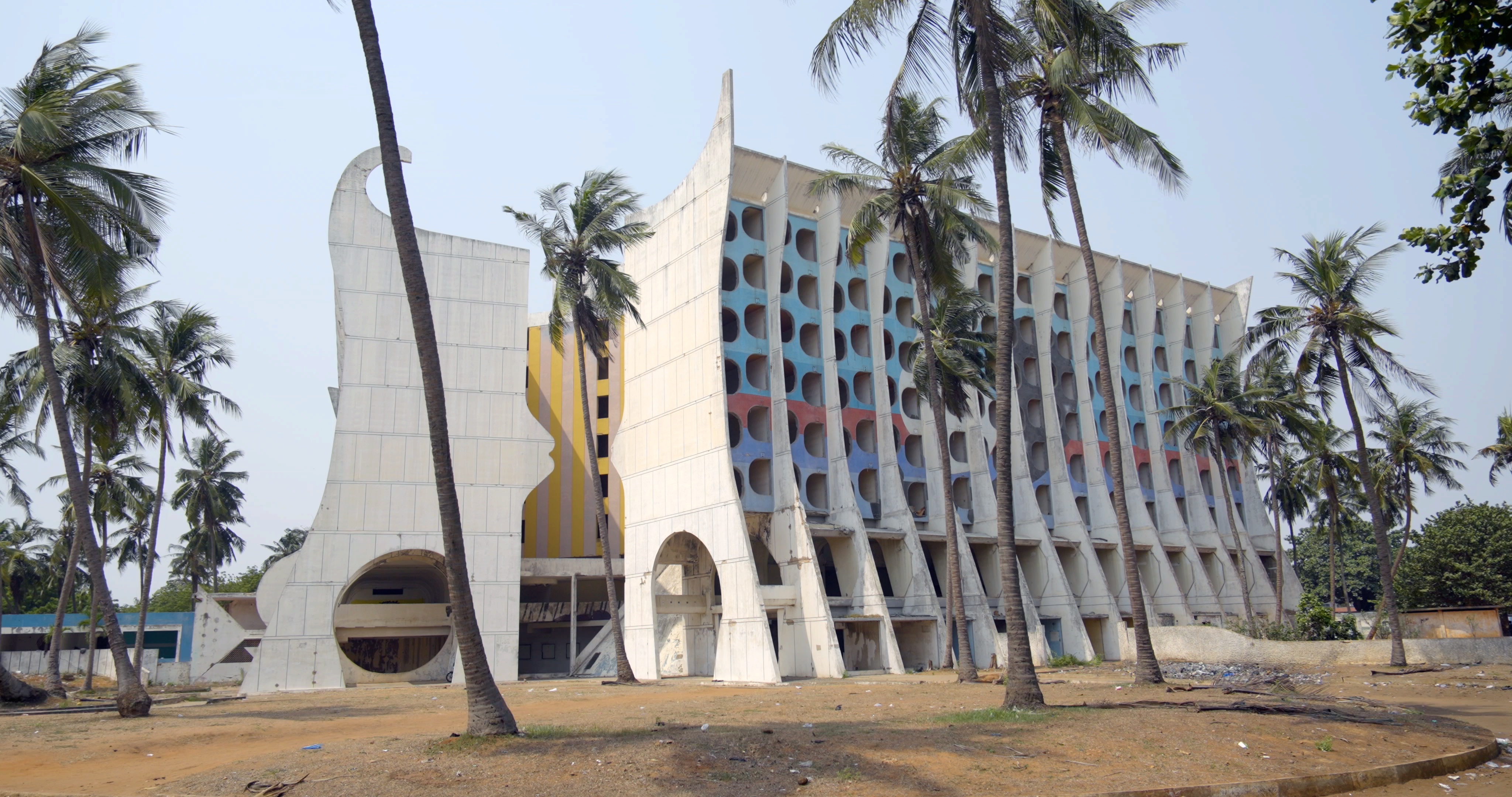
Still from documentary footage of the Hôtel de la Paix, Lomé, Togo. 2025. Film. Footage: Henry KD, commissioned by The Museum of Modern Art, New York
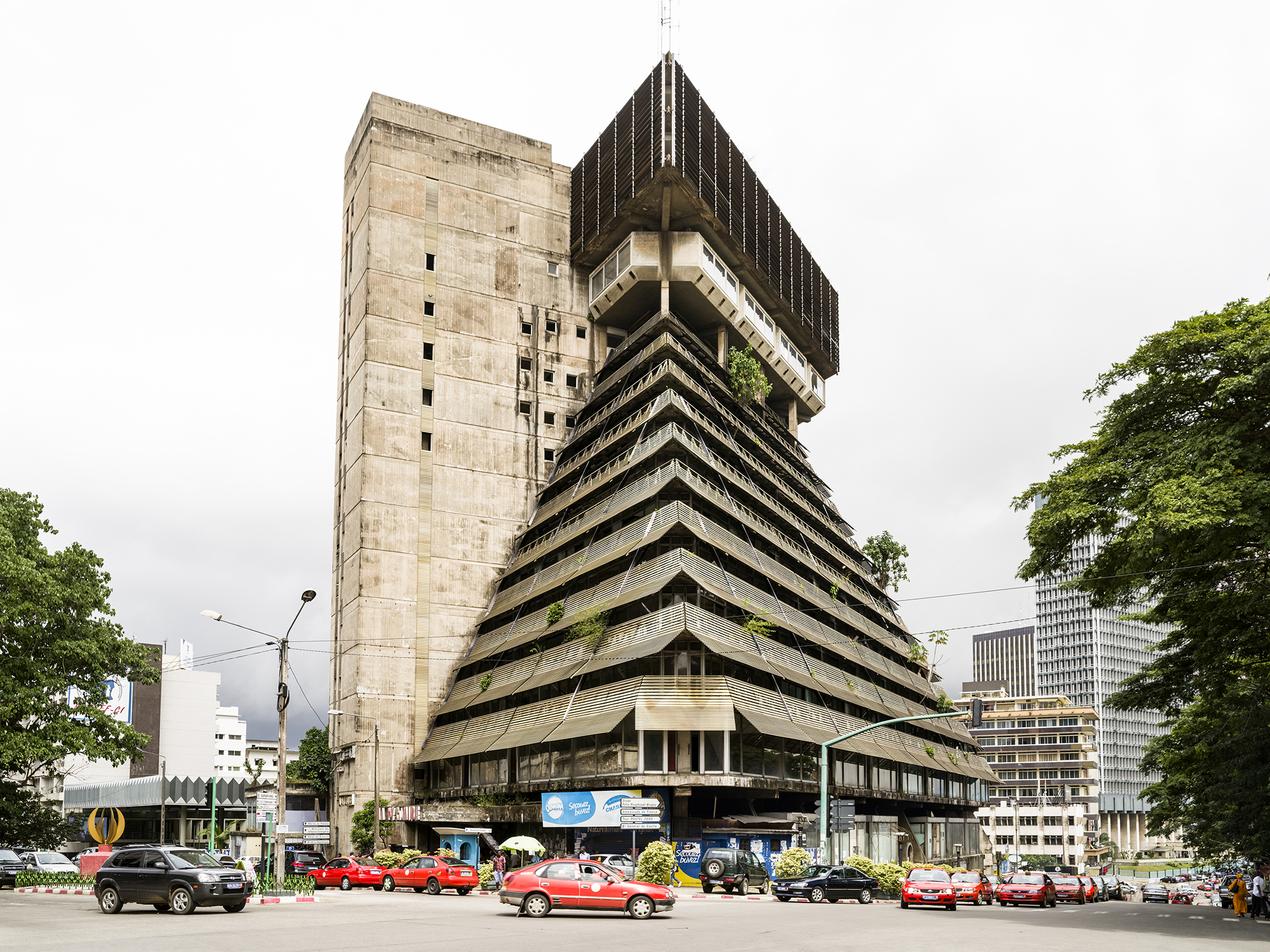
La Pyramide, Abidjan, Côte d’Ivoire. 1968–73. Rinaldo Olivieri (1931–1998). 2025. Photograph: François-Xavier Gbré
The presentation of La Pyramide in Abidjan and the Hôtel de la Paix in Lomé brought the afterlives of such projects into view. A product of the “Ivorian Miracle,” a period of rapid economic growth fueled by cocoa and coffee exports, the fifteen-story La Pyramide was designed by Italian architect Rinaldo Olivieri as a “new age” African market intended to “refine” local taste while offering “every modern comfort.” Meanwhile, the 248-room Hôtel de la Paix in Lomé was designed by French architect Daniel Chenut to gather diplomats, business people, and tourists around a shared vision of Togo’s modernity, cosmopolitanism, and its place within global circuits of exchange. The placement of their original plans alongside contemporary footage revealed how architectural meaning shifts as governments change, economies falter, and the aspirations attached to a building lose their connection to the public that surrounds it. Conceived with immense ambition in the late 1960s and early 1970s, both buildings now stand largely abandoned, and their present condition—despite curatorial interpretation as unrealized liberatory hopes—suggests the limits of architecture designed around tourism, national prestige, and elite comfort rather than sustained local and collective use. Moreover, when regarded through the scope of Nkrumah’s critique of “adoption,” the valorization of such ideas arguably points to how coloniality can persist beneath the veneer of political sovereignty.
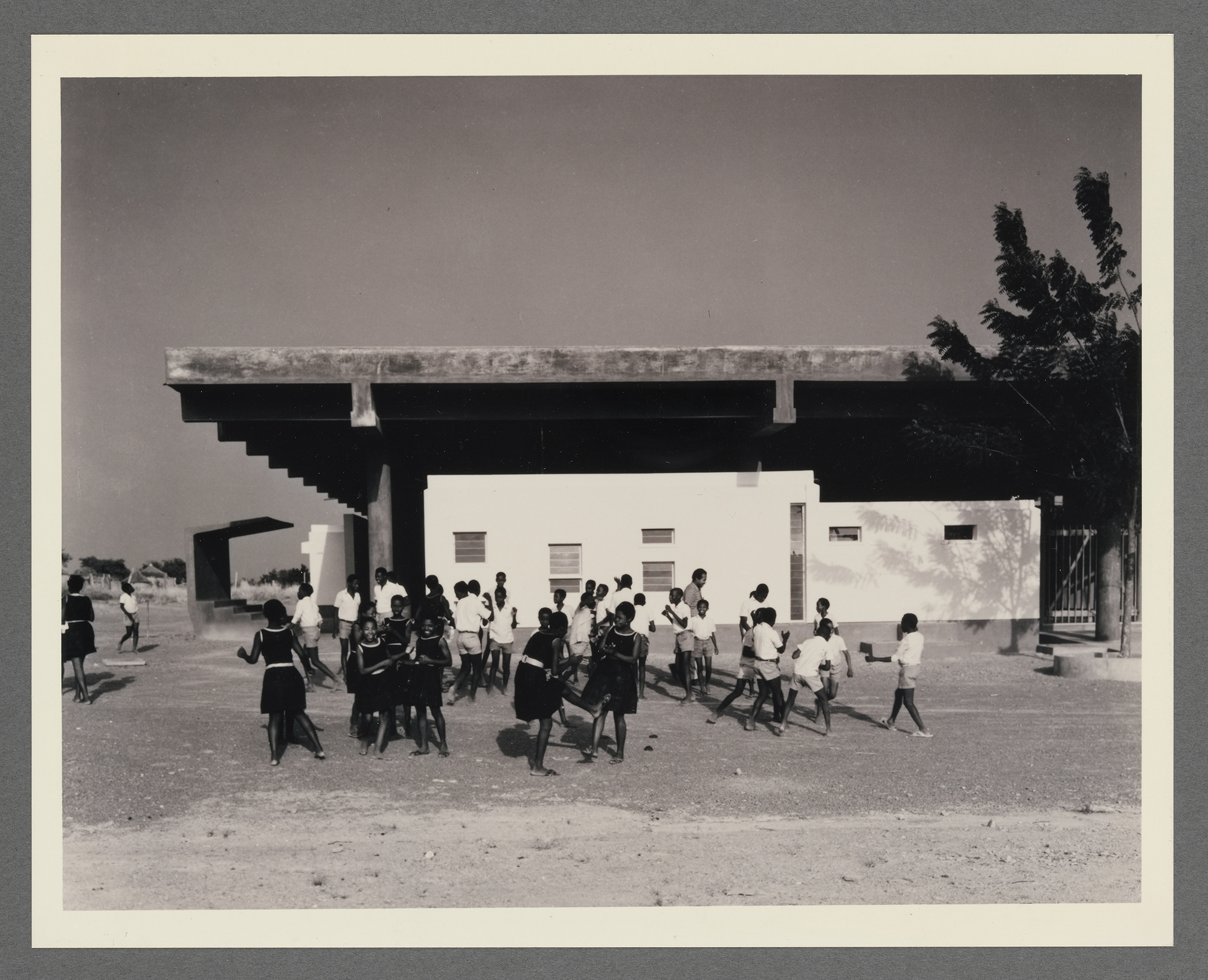
Children outside Bolgatanga Library, Ghana. December 1967. Photograph: Willis E. Bell. J. Max Bond Jr. papers, 1955–2009, Department of Drawings & Archives, Avery Architectural & Fine Arts Library, Columbia University. © Mmofra Foundation.
The Bolgatanga Regional Library in Ghana, designed by African American architect J. Max Bond Jr., offers another measure of what a holistically liberatory modernism might look like. Commissioned by the Ghana National Construction Corporation (GNCC) and completed in 1967, the Bolgatanga Regional Library is both airy and robust. Its single story form balances curved walls, sharp lines, and recessed alcoves within a functional design approach. Four primary spaces—a children’s library, adult library, lecture hall, and staff area—are unified under a broad singular roof that extends outward to shade the veranda. Bond drew the building’s spatial organization from the neighboring homes of the Fra fra community blending local design sensibilities into new forms. Its location in northern Ghana unsettles the idea that modernism must radiate from a metropolitan center, while its commitment to education locates liberation in the slower work of building local knowledge and collective capacity.
At a moment when many architectural commissions in western Africa were outsourced to foreign firms like Bond’s, his approach is significant in that it points toward a Black diasporic design sensibility, one in which knowledge and resources acquired across borders are redirected toward collective self-determination. In this sense, the library offers a compelling example of adaptation as Nkrumah describes it. Rather than reproducing foreign forms for modernism’s sake, Bond reshaped them in response to the environment and the everyday lives of those who would use the building. Its continued use today by the local community perhaps speaks to the durability of that approach.
As co-curator Okoye suggests of the political leaders responsible for commissioning the architectural sites featured in Architects of Liberation, “they were active agents in shaping how Pan-Africanism was experienced, most visibly, in response to its expectation that Africans and the diaspora, but others also, would reimagine what it meant to be African, Black, and modern at once.4” Nkrumah’s monuments, Senghor’s cultural institutions, Azikiwe’s functionalist settlements, and so on, carried a distinct political promise. And yet, as the exhibition material makes salient beyond the curatorial lens, the pursuit of these ambitions was frequently shaped by global neo-colonial dependencies (both ideologically and materially) that so often positioned “to be African, Black” and “to be … modern” as antonyms, thus binding the aforementioned leaders in the dynamic of “adoption,” as opposed to one of “adaptation” that could perhaps have protected against the tendency to dream up and actualize building projects in ways that eclipsed the everyday needs and cultural traditions of local communities. Ultimately, the curatorial choices in Architects of Liberation exhume the tensions provoked when interpreters render modernism exclusively through a Western grammar of cosmopolitanism, technological advancement, and monumental construction that continues to present itself as a universal measure of progress.
What the exhibition makes urgent, then, is the need to speculate and build beyond the instrumentalization of modernist idioms as a means of performing a flawed and perfunctory mode of freedom, and toward architecture’s broader capacity to set terms for and sustain the needs of communal life. In this case, what dictates a building’s modernism? More pressingly, what does that claim leave us to contend with about our desires for liberation? Within these propositions is the equally exigent possibility of reimagining Pan-Africanism as an iterative practice rather than a closed historical moment. Understood this way, thinking alongside the built environment of western Africa’s immediate-post-independence era offers a means of resisting the collapse of modernism and liberation into one another.
At a moment when many architectural commissions in western Africa were outsourced to foreign firms like Bond’s, his approach is significant in that it points toward a Black diasporic design sensibility, one in which knowledge and resources acquired across borders are redirected toward collective self-determination. In this sense, the library offers a compelling example of adaptation as Nkrumah describes it. Rather than reproducing foreign forms for modernism’s sake, Bond reshaped them in response to the environment and the everyday lives of those who would use the building. Its continued use today by the local community perhaps speaks to the durability of that approach.
As co-curator Okoye suggests of the political leaders responsible for commissioning the architectural sites featured in Architects of Liberation, “they were active agents in shaping how Pan-Africanism was experienced, most visibly, in response to its expectation that Africans and the diaspora, but others also, would reimagine what it meant to be African, Black, and modern at once.4” Nkrumah’s monuments, Senghor’s cultural institutions, Azikiwe’s functionalist settlements, and so on, carried a distinct political promise. And yet, as the exhibition material makes salient beyond the curatorial lens, the pursuit of these ambitions was frequently shaped by global neo-colonial dependencies (both ideologically and materially) that so often positioned “to be African, Black” and “to be … modern” as antonyms, thus binding the aforementioned leaders in the dynamic of “adoption,” as opposed to one of “adaptation” that could perhaps have protected against the tendency to dream up and actualize building projects in ways that eclipsed the everyday needs and cultural traditions of local communities. Ultimately, the curatorial choices in Architects of Liberation exhume the tensions provoked when interpreters render modernism exclusively through a Western grammar of cosmopolitanism, technological advancement, and monumental construction that continues to present itself as a universal measure of progress.
What the exhibition makes urgent, then, is the need to speculate and build beyond the instrumentalization of modernist idioms as a means of performing a flawed and perfunctory mode of freedom, and toward architecture’s broader capacity to set terms for and sustain the needs of communal life. In this case, what dictates a building’s modernism? More pressingly, what does that claim leave us to contend with about our desires for liberation? Within these propositions is the equally exigent possibility of reimagining Pan-Africanism as an iterative practice rather than a closed historical moment. Understood this way, thinking alongside the built environment of western Africa’s immediate-post-independence era offers a means of resisting the collapse of modernism and liberation into one another.
1. “Kwame Nkrumah, Speech at the All-African Peoples’ Conference, December 1958,” in The Short Century: Independence and Liberation Movements in Africa, 1945–1994, ed. Okwui Enwezor (Munich: Prestel, 2001), 366. qtd. in. Martino Stierli, “Adoption versus Adaptation; Africanization in Modern Architecture,” essay, in Architects of Liberation: Modernism in Western Africa, ed. Martino Stierli, Ikem Stanley Okoye, and Mallory Cohen (New York, New York: The Museum of Modern Art, 2026), 12-29.
2. “If we find the methods used by others are suitable to our social environments, we shall adopt or adapt them; if we find them unsuitable, we shall reject them.” Excerpt from speech by then Prime Minister of Ghana, Kwame Nkrumah, at the opening session of the All-African People's Conference in December 1958. Full transcript: https://www.scribd.com/document/889900251/All-African-people-s-conference-1958.
3. Prita Meier, “Monuments of Sovereignty? Postcolonial Mega-Projects and the Limits of Liberation,” essay, in Architects of Liberation: Modernism in Western Africa, ed. Martino Stierli, Ikem Stanley Okoye, and Mallory Cohen (New York, New York: The Museum of Modern Art, 2026), 106–13.
4. Ikem Stanley Okoye, “Pan-African Architecture and Possible Black Futures: Western African Modernism and the World,” essay, in Architects of Liberation: Modernism in Western Africa, ed. Martino Stierli, Ikem Stanley Okoye, and Mallory Cohen (New York, New York: The Museum of Modern Art, 2026), 30–47.
2. “If we find the methods used by others are suitable to our social environments, we shall adopt or adapt them; if we find them unsuitable, we shall reject them.” Excerpt from speech by then Prime Minister of Ghana, Kwame Nkrumah, at the opening session of the All-African People's Conference in December 1958. Full transcript: https://www.scribd.com/document/889900251/All-African-people-s-conference-1958.
3. Prita Meier, “Monuments of Sovereignty? Postcolonial Mega-Projects and the Limits of Liberation,” essay, in Architects of Liberation: Modernism in Western Africa, ed. Martino Stierli, Ikem Stanley Okoye, and Mallory Cohen (New York, New York: The Museum of Modern Art, 2026), 106–13.
4. Ikem Stanley Okoye, “Pan-African Architecture and Possible Black Futures: Western African Modernism and the World,” essay, in Architects of Liberation: Modernism in Western Africa, ed. Martino Stierli, Ikem Stanley Okoye, and Mallory Cohen (New York, New York: The Museum of Modern Art, 2026), 30–47.
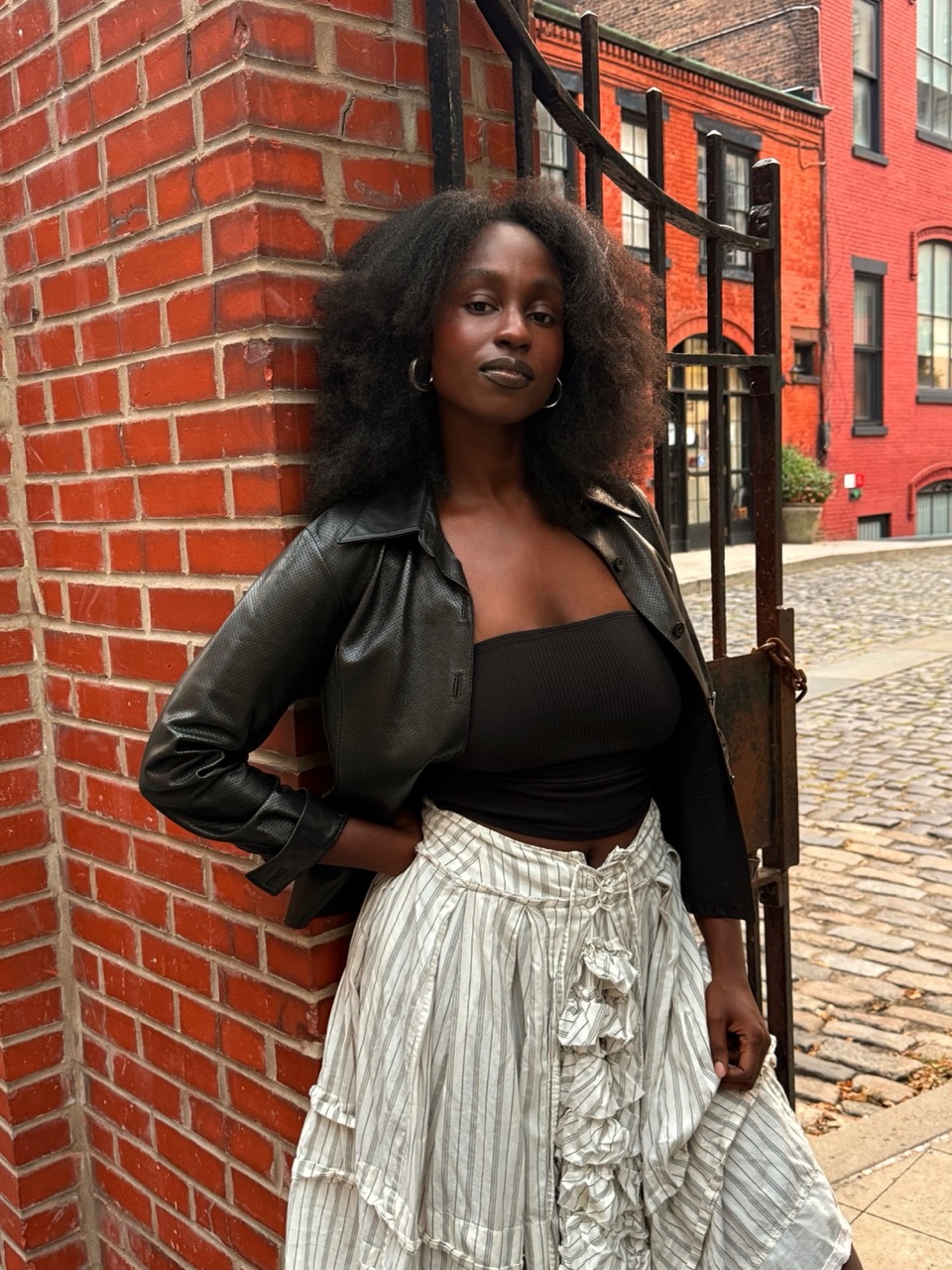
Sika Bonsu (she/her) is an artist and curator whose work is grounded in Black feminist thought. Through image, text, and exhibitions, she creates spaces that honor Black feminine wisdom and cultivate self-determined ways of knowing. She is the founder of Nuabaa Fie, a curatorial platform centering the aesthetic intelligence and lived realities of Black women.
Drawing on her Asante heritage, Bonsu’s practice is shaped by histories of migration and the shared aesthetic languages of the Black Diaspora. Her training in art history, gender studies, and museum practice informs her commitment to reimagining how institutions preserve, interpret, and value culture.
Bonsu holds a BA in Art History and Gender and Women’s Studies from Virginia Commonwealth University and an MA in Museum Studies from New York University. Her graduate research reframed abstraction through Black femininity as a practice of refusal and self-inscription within systems that have historically denied Black women’s agency and conceptual freedom.
Drawing on her Asante heritage, Bonsu’s practice is shaped by histories of migration and the shared aesthetic languages of the Black Diaspora. Her training in art history, gender studies, and museum practice informs her commitment to reimagining how institutions preserve, interpret, and value culture.
Bonsu holds a BA in Art History and Gender and Women’s Studies from Virginia Commonwealth University and an MA in Museum Studies from New York University. Her graduate research reframed abstraction through Black femininity as a practice of refusal and self-inscription within systems that have historically denied Black women’s agency and conceptual freedom.
