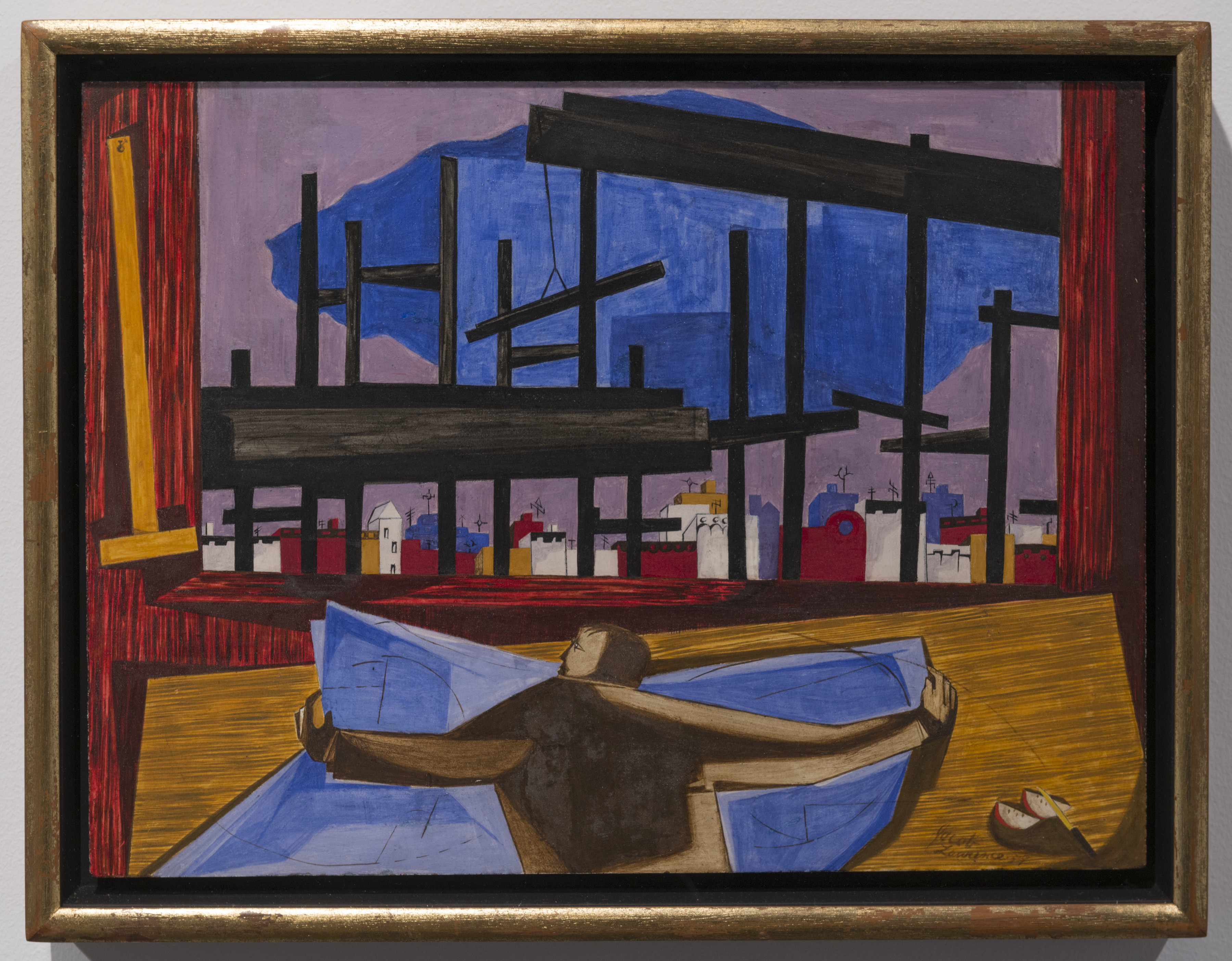
Jacob Lawrence, The Architect, 1959. Egg tempera on Masonite, 13 5/8 × 17 1/2 in. (34.5 × 44.5 cm). The Studio Museum in Harlem; gift of Mr. and Mrs. James Harithas 1982.1
The Architect
The architect surveys his blueprint. Before him, a city comes to life. He faces it as a conductor might face an orchestra. Reddish wood frames the window like a grand drape, offering a glimpse of a world that feels enormous, capacious, and yet somehow comprehensible. Like a stage set, our eyes take in what they are shown, and our minds color the rest. In the distance, low buildings—alternating constructions of red, yellow, blue, and white—bear architectural flairs as affectionate markers of character: windows askew, crooked weather vanes, protrusions and irregularities. These structures could be culled from a W. E. B. Du Bois data portrait, so bold are their colors and charged are their contents, inviting us to contemplate the countless lives held by each edifice—the histories, the relationships, the neighbors and lovers, the sweat, the music.
Jacob Lawrence’s The Architect (1959) buzzes with potential energy. With its luminous surface of egg tempera on Masonite, the work offers a vision of literal and metaphorical construction. Dangling above this community is a matrix of black steel beams that crisscross the sky. They erupt upward and outward, like armature, without occluding the vivid expanse behind them. No buildings lie flattened; rather, they look on as the jumble of beams climbs skyward, reaching, striving. The intersecting beams resemble crosses and formally echo the weather vanes on the small homes behind them. Or perhaps the weather vanes were always crosses and the crosses weather vanes—portents of nature’s swirl, heralds of God’s redemptive power, suffering and rebirth, wind and water. These totems rise toward an aureole in the gray sky, toward parted clouds and beckoning blue. A city in transition is reflected.
Born in 1917 in Atlantic City, New Jersey, Lawrence arrived in Harlem in 1930, at the age of thirteen. His New York was likewise in the throes of radical transformation. Vibrant and alive, the neighborhood was abuzz with a ferment of art and ideas. As artist and art historian Leslie King-Hammond writes in her essay “Inside-Outside, Uptown-Downtown: Jacob Lawrence and the Aesthetic Ethos of the Harlem Working-Class Community,” “The streets of Harlem—their movement, the people, the local color, and the sounds—became a bottomless source of visual and spiritual inspiration for [him].”1 A young Lawrence learned from Charles Alston and Augusta Savage, studied alongside Robert Blackburn and Gwendolyn Knight (who he later married), attended classes and rooted himself firmly in the Harlem World of community centers, arts workshops, libraries, schools, street corners, and stoops.
Steeped in the social, cultural, and political landscape of Harlem, Lawrence experienced its aspirations and contradictions from within, and, thus, his work reflected the neighborhood with lucid eyes. In that improbable city within a city, or as James Weldon Johnson called it in 1925, “a large scale laboratory experiment in the race problem,”2 he witnessed a flourishing Black community collide headfirst with the Great Depression. Glowing marquee boards announced concerts while window signs broadcasted hardship. Amid this milieu of evictions and unemployment, ever-present racial terror, jazz, riots, the Schomburg, the Apollo, and so on his paintings celebrated human movement and activity. He depicted tools and builders, people who worked with their hands, communities living for one another, a collective identity and ethos. Unflinching and direct, he traced Harlem’s contours—its triumphs and tragedies—with a steady hand. In his words, “I am part of the black community, so I am the black community speaking.” Exodus from the South, precarious Northern life, pool players and professors, transients and washerwomen, hospital beds and chain gangs and poorhouses and policemen, weddings and funerals—all of it narrated back to us from within.
Throughout the 1930s, ’40s, and ’50s, as his career evolved, Lawrence painted sweeping cultural and historical narratives, reflecting his keen interest in social, economic, and political relations, and their converging origins. His series The Life of Toussaint L’Ouverture (1936–38) colored the life of the Haitian revolutionary as an analog to the “economic slavery” plaguing Black Americans in the ’30s, and his famed The Migration Series (1940–41) illuminated the ongoing Great Migration across sixty panels. Toward the late 1950s, after his series Struggle: From the History of the American People (1954–56) was separated against his wishes, he pivoted away from a serial mode of working, instead creating one-off, stylistically experimental works that depicted contemporary life and labor. Lawrence painted The Architect in this period of distilled expression, and the work may be seen as part of his career-long interest in builders.
Given the immensity of his regard for Harlem, it comes as no surprise that, in 1976, Lawrence joined the newly established Curatorial Council of the Studio Museum in Harlem, which included Elizabeth Catlett, Benny Andrews, and Norman Lewis, among other arts professionals, and advised on the establishment of a permanent collection. While an informal collection had begun to grow in the years prior with gifts from artists looking to ensure care and stewardship for their work, the formal introduction of a permanent collection in 1977 proved an essential development. Since the 1970s, the museum’s collection has grown to represent thousands of objects from artists of African descent spanning time and place, with The Architect finding a place among them in 1982.
The arrival of Lawrence’s painting in the collection would foreshadow—by more than forty years—the deepening of my relationship with his work: in October 2025, I began working as a full-time member of the Studio Museum’s curatorial team (where I had previously served as an intern and, later, a fellow), rejoining the legion who steward the museum’s permanent collection. My return to the museum, one month before its reopening, came during a moment of flux and motility not unlike the scene Lawrence depicted in The Architect.
Founded in 1968, the Studio Museum has resided in a series of impermanent and uncertain homes wherein the vision of its founding members took root, first inhabiting a rented loft space above a liquor store at 2033 Fifth Avenue before relocating to its current address, 144 West 125th Street, in a retrofitted former bank building in the early 1980s. It was there, in the building reshaped by Harlem’s own J. Max Bond Jr., that the fledgling institution became what it is today: a home in Harlem for thoughtful exhibitions, public programs, and collection stewardship for Black artists. In 2018, this site was closed to begin construction on the museum’s new dwelling, built from scratch with the needs of an expanding world in mind. The elegant patchwork of concrete and glass—not dissimilar from the black beams that seem to levitate in front of Lawrence’s figure—that now looks out on 125th street, was seven years in the making and marks the first time in the institution’s 58-year history that it has a purpose-built home.
So, on a quiet day, amidst the hush before the roar of the grand reopening, I decided to stroll through the galleries. Aware of the momentousness of the impending occasion, I took stock of my surroundings: Faith Ringgold here, Lorna Simpson there, David Hammons everywhere. I walked through From Now: A Collection In Context, the museum’s inaugural exhibition of works from the permanent collection and moved through a thematic section called “The City.” Lorraine O’Grady, then Kori Newkirk, then Jordan Casteel, then Jacob Lawrence. The Architect stopped me in my tracks, moving beyond specificity and rising to the level of allegory. While the work is somewhat small, about the size of a toolbox, it demands attention as it illustrates the unrelenting aspirations of people building community and what it takes to see ambitions come to life in a precarious world. On the wall in that resplendent gallery, inside that monumental new structure in the heart of Harlem, the work felt prophetic.
I came to realize that The Architect is a foretelling nested in that which it foretold. The concentric realities of considering the painting’s vision of a building transforming the Harlem landscape while standing inside a building that transformed those same streets more than sixty years later reverberated like an echo. In this sense, born from decades of advocacy, sustained vision, and most importantly, the Harlem community itself, the Studio Museum’s new home sets the spirit of Lawrence’s painting in stone.
Jacob Lawrence’s The Architect (1959) buzzes with potential energy. With its luminous surface of egg tempera on Masonite, the work offers a vision of literal and metaphorical construction. Dangling above this community is a matrix of black steel beams that crisscross the sky. They erupt upward and outward, like armature, without occluding the vivid expanse behind them. No buildings lie flattened; rather, they look on as the jumble of beams climbs skyward, reaching, striving. The intersecting beams resemble crosses and formally echo the weather vanes on the small homes behind them. Or perhaps the weather vanes were always crosses and the crosses weather vanes—portents of nature’s swirl, heralds of God’s redemptive power, suffering and rebirth, wind and water. These totems rise toward an aureole in the gray sky, toward parted clouds and beckoning blue. A city in transition is reflected.
Born in 1917 in Atlantic City, New Jersey, Lawrence arrived in Harlem in 1930, at the age of thirteen. His New York was likewise in the throes of radical transformation. Vibrant and alive, the neighborhood was abuzz with a ferment of art and ideas. As artist and art historian Leslie King-Hammond writes in her essay “Inside-Outside, Uptown-Downtown: Jacob Lawrence and the Aesthetic Ethos of the Harlem Working-Class Community,” “The streets of Harlem—their movement, the people, the local color, and the sounds—became a bottomless source of visual and spiritual inspiration for [him].”1 A young Lawrence learned from Charles Alston and Augusta Savage, studied alongside Robert Blackburn and Gwendolyn Knight (who he later married), attended classes and rooted himself firmly in the Harlem World of community centers, arts workshops, libraries, schools, street corners, and stoops.
Steeped in the social, cultural, and political landscape of Harlem, Lawrence experienced its aspirations and contradictions from within, and, thus, his work reflected the neighborhood with lucid eyes. In that improbable city within a city, or as James Weldon Johnson called it in 1925, “a large scale laboratory experiment in the race problem,”2 he witnessed a flourishing Black community collide headfirst with the Great Depression. Glowing marquee boards announced concerts while window signs broadcasted hardship. Amid this milieu of evictions and unemployment, ever-present racial terror, jazz, riots, the Schomburg, the Apollo, and so on his paintings celebrated human movement and activity. He depicted tools and builders, people who worked with their hands, communities living for one another, a collective identity and ethos. Unflinching and direct, he traced Harlem’s contours—its triumphs and tragedies—with a steady hand. In his words, “I am part of the black community, so I am the black community speaking.” Exodus from the South, precarious Northern life, pool players and professors, transients and washerwomen, hospital beds and chain gangs and poorhouses and policemen, weddings and funerals—all of it narrated back to us from within.
Throughout the 1930s, ’40s, and ’50s, as his career evolved, Lawrence painted sweeping cultural and historical narratives, reflecting his keen interest in social, economic, and political relations, and their converging origins. His series The Life of Toussaint L’Ouverture (1936–38) colored the life of the Haitian revolutionary as an analog to the “economic slavery” plaguing Black Americans in the ’30s, and his famed The Migration Series (1940–41) illuminated the ongoing Great Migration across sixty panels. Toward the late 1950s, after his series Struggle: From the History of the American People (1954–56) was separated against his wishes, he pivoted away from a serial mode of working, instead creating one-off, stylistically experimental works that depicted contemporary life and labor. Lawrence painted The Architect in this period of distilled expression, and the work may be seen as part of his career-long interest in builders.
Given the immensity of his regard for Harlem, it comes as no surprise that, in 1976, Lawrence joined the newly established Curatorial Council of the Studio Museum in Harlem, which included Elizabeth Catlett, Benny Andrews, and Norman Lewis, among other arts professionals, and advised on the establishment of a permanent collection. While an informal collection had begun to grow in the years prior with gifts from artists looking to ensure care and stewardship for their work, the formal introduction of a permanent collection in 1977 proved an essential development. Since the 1970s, the museum’s collection has grown to represent thousands of objects from artists of African descent spanning time and place, with The Architect finding a place among them in 1982.
The arrival of Lawrence’s painting in the collection would foreshadow—by more than forty years—the deepening of my relationship with his work: in October 2025, I began working as a full-time member of the Studio Museum’s curatorial team (where I had previously served as an intern and, later, a fellow), rejoining the legion who steward the museum’s permanent collection. My return to the museum, one month before its reopening, came during a moment of flux and motility not unlike the scene Lawrence depicted in The Architect.
Founded in 1968, the Studio Museum has resided in a series of impermanent and uncertain homes wherein the vision of its founding members took root, first inhabiting a rented loft space above a liquor store at 2033 Fifth Avenue before relocating to its current address, 144 West 125th Street, in a retrofitted former bank building in the early 1980s. It was there, in the building reshaped by Harlem’s own J. Max Bond Jr., that the fledgling institution became what it is today: a home in Harlem for thoughtful exhibitions, public programs, and collection stewardship for Black artists. In 2018, this site was closed to begin construction on the museum’s new dwelling, built from scratch with the needs of an expanding world in mind. The elegant patchwork of concrete and glass—not dissimilar from the black beams that seem to levitate in front of Lawrence’s figure—that now looks out on 125th street, was seven years in the making and marks the first time in the institution’s 58-year history that it has a purpose-built home.
So, on a quiet day, amidst the hush before the roar of the grand reopening, I decided to stroll through the galleries. Aware of the momentousness of the impending occasion, I took stock of my surroundings: Faith Ringgold here, Lorna Simpson there, David Hammons everywhere. I walked through From Now: A Collection In Context, the museum’s inaugural exhibition of works from the permanent collection and moved through a thematic section called “The City.” Lorraine O’Grady, then Kori Newkirk, then Jordan Casteel, then Jacob Lawrence. The Architect stopped me in my tracks, moving beyond specificity and rising to the level of allegory. While the work is somewhat small, about the size of a toolbox, it demands attention as it illustrates the unrelenting aspirations of people building community and what it takes to see ambitions come to life in a precarious world. On the wall in that resplendent gallery, inside that monumental new structure in the heart of Harlem, the work felt prophetic.
I came to realize that The Architect is a foretelling nested in that which it foretold. The concentric realities of considering the painting’s vision of a building transforming the Harlem landscape while standing inside a building that transformed those same streets more than sixty years later reverberated like an echo. In this sense, born from decades of advocacy, sustained vision, and most importantly, the Harlem community itself, the Studio Museum’s new home sets the spirit of Lawrence’s painting in stone.
1. Leslie King-Hammond, “Inside-Outside, Uptown-Downtown: Jacob Lawrence and the Aesthetic Ethos of the Harlem Working-Class Community,” in Peter T. Nesbett, Michelle Dubois, Patricia Hills, eds., Over the Line: The Art and Life of Jacob Lawrence (Seattle: University of Washington Press, 2001), 77.
2. James Weldon Johnson, “Harlem: the Culture Capital,” in Alain Locke, ed., The New Negro: An Interpretation (1925), 310.
2. James Weldon Johnson, “Harlem: the Culture Capital,” in Alain Locke, ed., The New Negro: An Interpretation (1925), 310.
This essay was generously supported by Eric and Cheryl McKissack.

Simon Ghebreyesus is a writer and curator based in New York City and New Haven, Connecticut. He currently works as a Curatorial Assistant at the Studio Museum in Harlem. He received his B.A. in the History of Art from Yale University and previously held curatorial positions at the Museum of Modern Art and Pace Gallery. Ghebreyesus began his career at Artspace, New Haven.
Photo: Marcin Muchalski
Photo: Marcin Muchalski
