Photograph courtesy of the author.
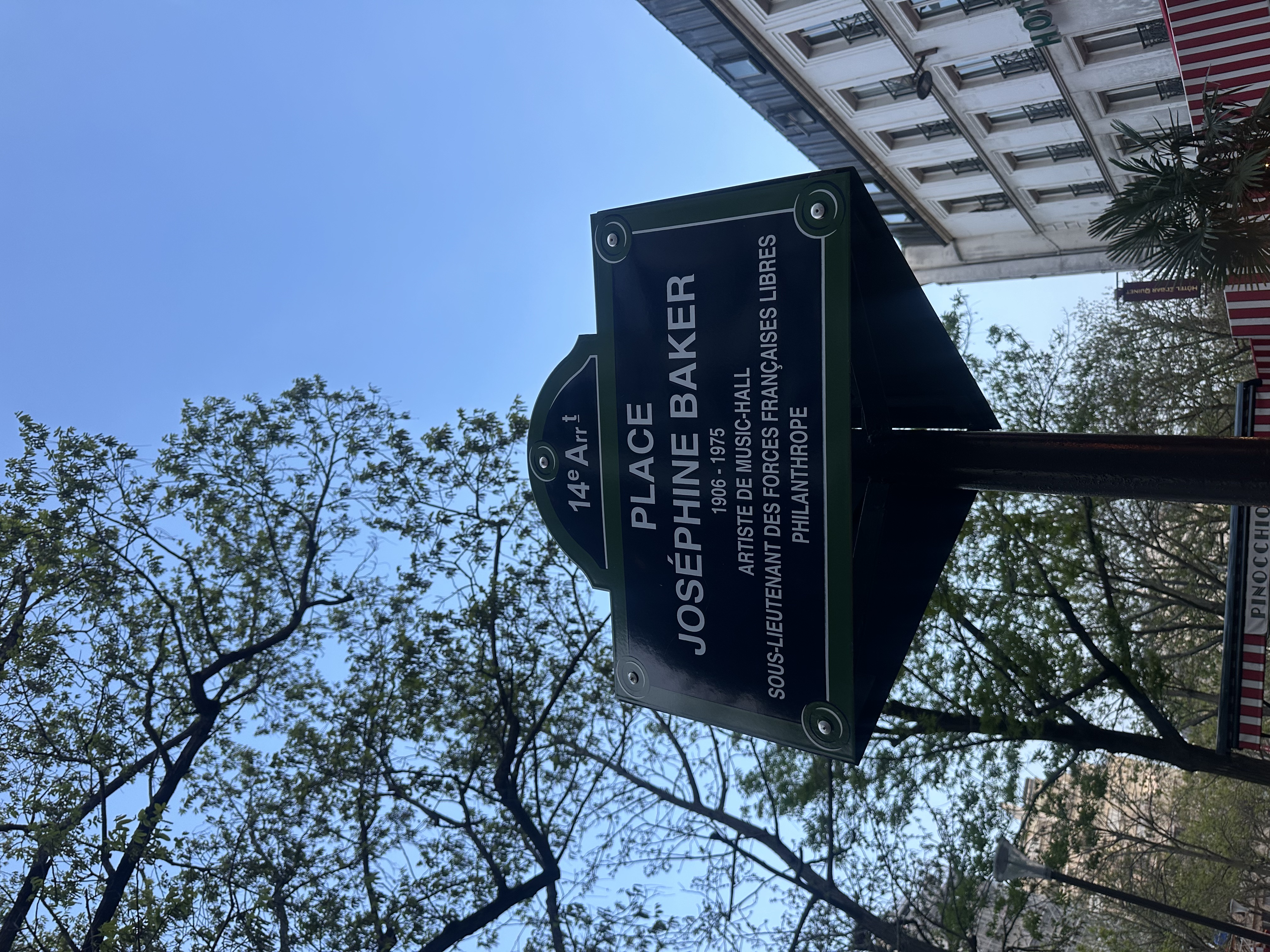
While she hails from Philadelphia, Barbara Chase-Riboud has spent most of her life in Paris, thereby connecting her to Sally Hemings and Josephine Baker in a triangle of sorts. All three women were born in America before moving to France, living as étrangers, and mothering there. In January 2026, I moved to Paris and I’m writing this from here. I now live in the 14th arrondissement, a few minutes from Place Josephine Baker. While conducting research for this essay, I also learned that Chase-Riboud and I share a birthday. Borrowing her own words about Baker on discovering they shared a street in Paris: “I thought it was this incredible sign that something was going to happen between us.” Still, there must be room for syncopation as the full dimensions of these women’s lives resist the proportionality of their parallels. In this spirit, I am thinking through Chase-Riboud, Hemings, and Baker by way of an essay and associated axonometric projection, rotating their lives around their shared axes (geographical, philosophical, and spiritual) to reveal their resonance and divergent records.
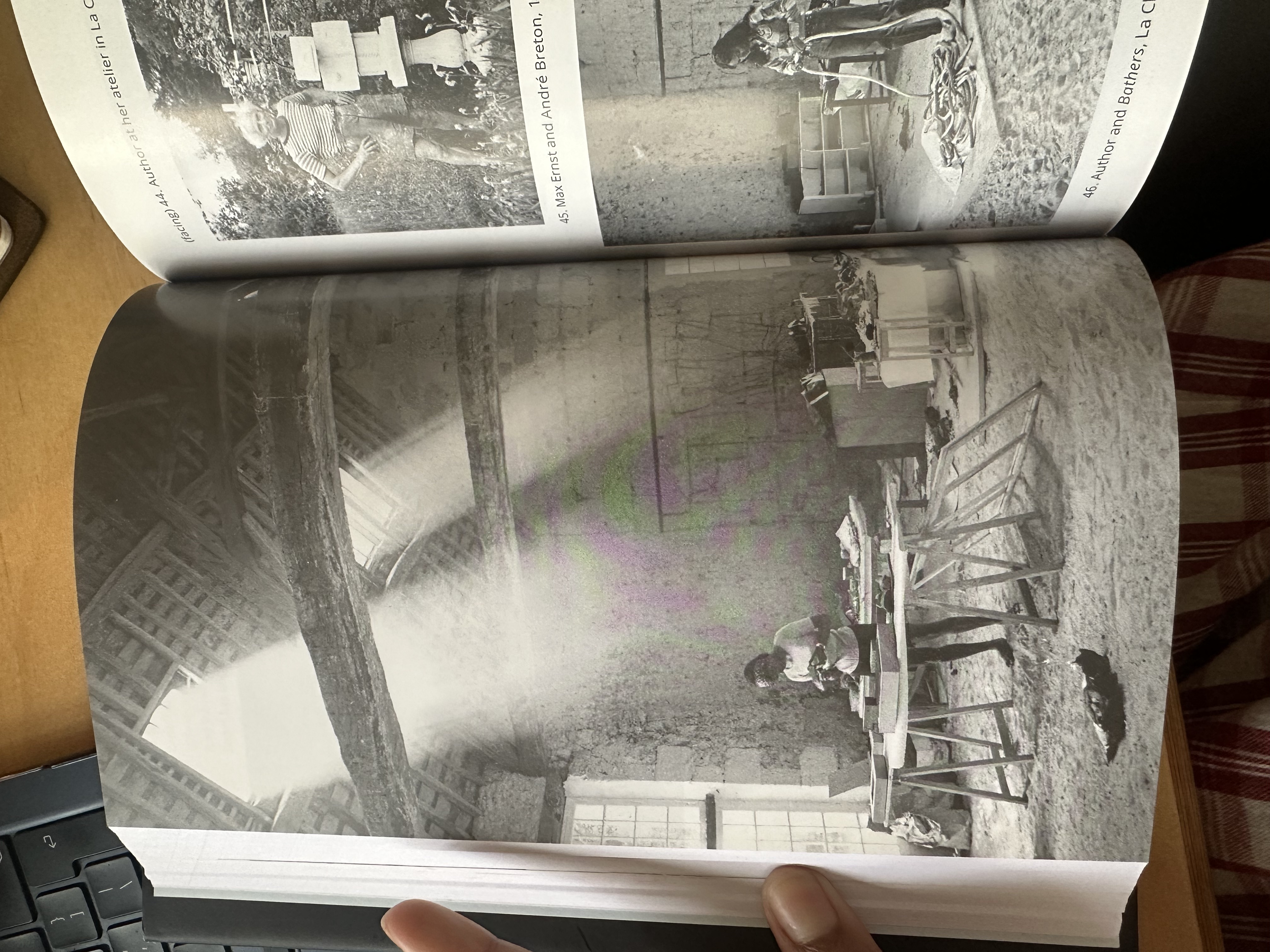
Author at her atelier in La Chenillère, 1969.
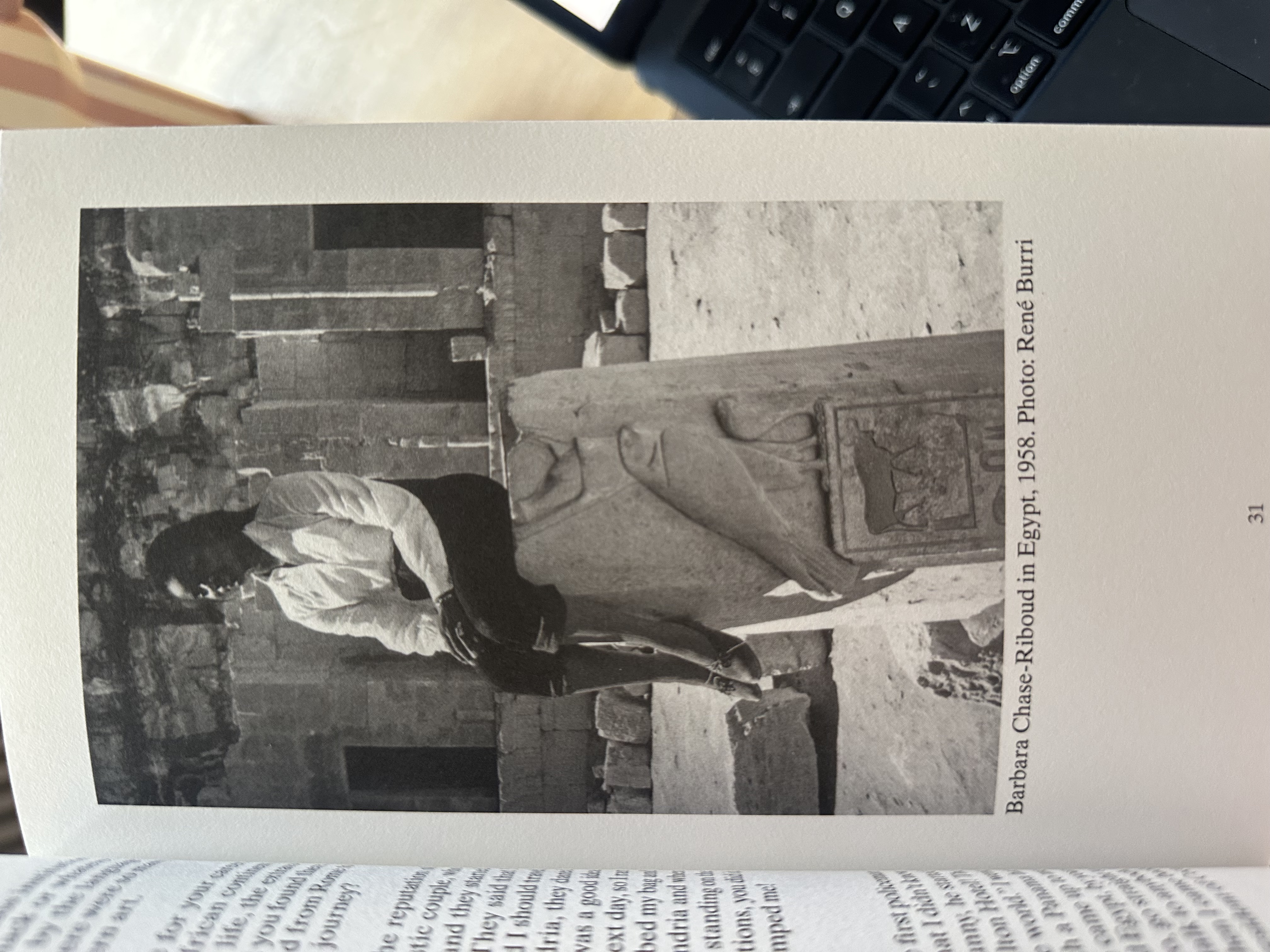
Barbara Chase-Riboud in Egypt, 1958, collection of the artist. © Photo: René Burri.
     I.

Barbara Chase-Riboud, who received an MFA from what was then Yale School of Architecture and Design, cites a trip to Egypt as a watershed moment for her, when “the cool breath of the Valley of the King’s tombs” whispered that she was fated to make architecture.1 Like the knotted and bound silk that presses against the polished aluminum frame and leaks onto the floor in her sculpture Time Womb (with cord) (1967), her destiny would also come to involve rending the ideological and material rigidity of the discipline. Across Chase-Riboud’s aestheticization and poetizing of Sally Hemings (an enslaved woman owned by Thomas Jefferson, with whom she had at least six children) and Josephine Baker (a categorical superstar: dancer, singer, actress, and spy for the French Resistance), architecture seeps into fiction, and also into sculpture. Anchored by her familiarity with the discipline, in Chase-Riboud’s work, architecture becomes a mode of thought, form, and feeling central to Hemings and Baker’s critical agency, but only once liberated from the confines of a field that has not dealt with them appropriately.

Hemings and Baker are both present in architectural discourse, yet they have been obscured by white male figures that co-opt them as property or muse—Jefferson and Adolf Loos respectively. Through such examples, we can see how preexisting methods of architectural inquiry have not adequately addressed the Black female subject; it is not that Black women have been excluded from the conversation thus far, but that when we are included it is because of our proximity to whiteness and maleness. This is grossly disfiguring. Chase-Riboud’s novel Sally Hemings, a fictionalized account of the life of Hemings and Jefferson, and her sculptures to Josephine Baker constitute an alternative architectural dialogue. To this end, looking at Time Womb (with cord) recalls the mercenary triangle that reached across the Atlantic: the geometry that signifies the reproductive, intellectual, and physical labors carried out by Black women, which established the infrastructure of transatlantic slavery and preconditioned modernism—architecturally and otherwise. Through Chase-Riboud’s work, this labor conducted by Black women (including Hemings and Baker) can be named as the architecture that it is.
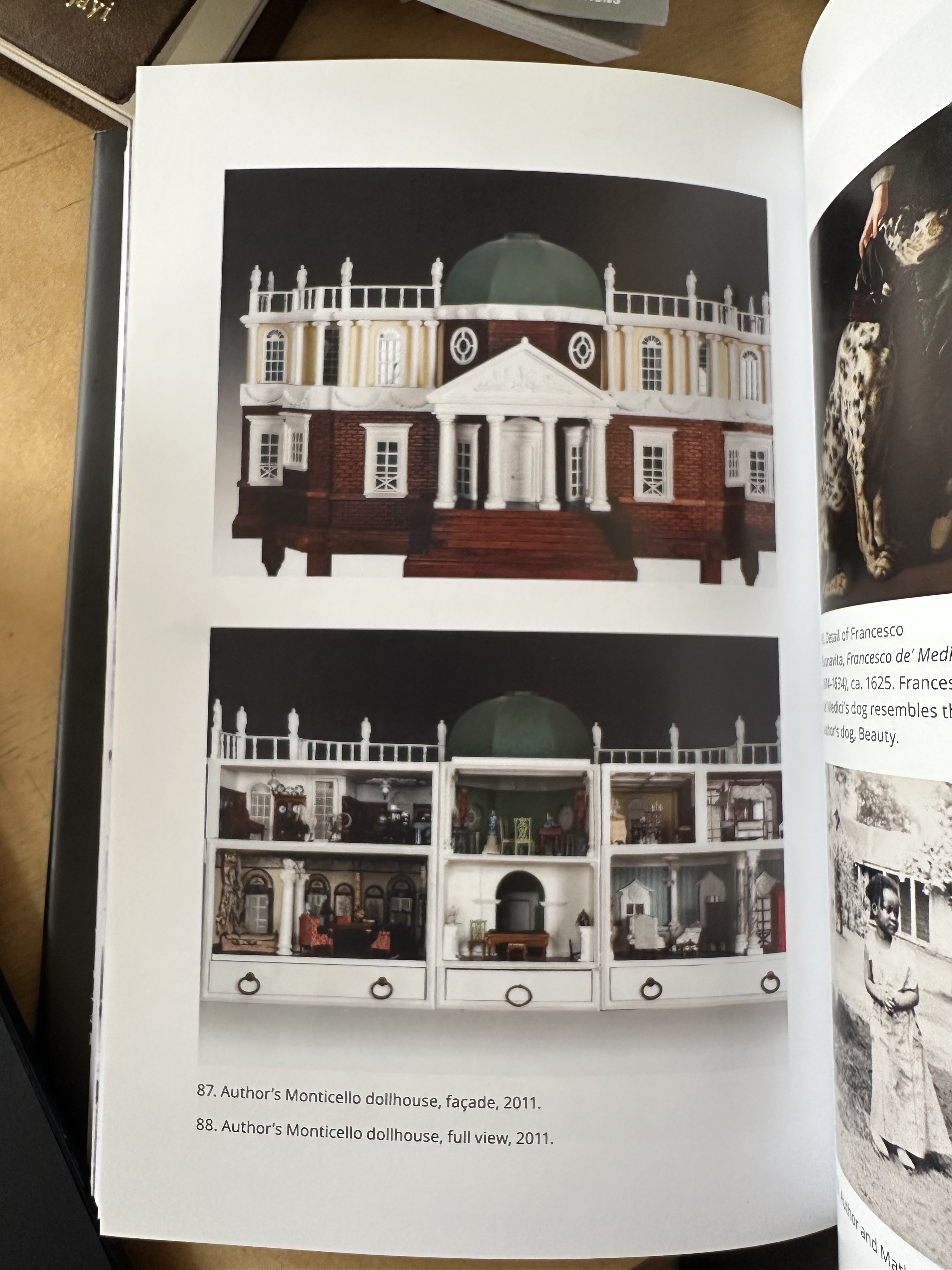
Author’s Monticello dollhouse, façade, 2011.
Author’s Monticello dollhouse, full view, 2011.
From the collection of the author.
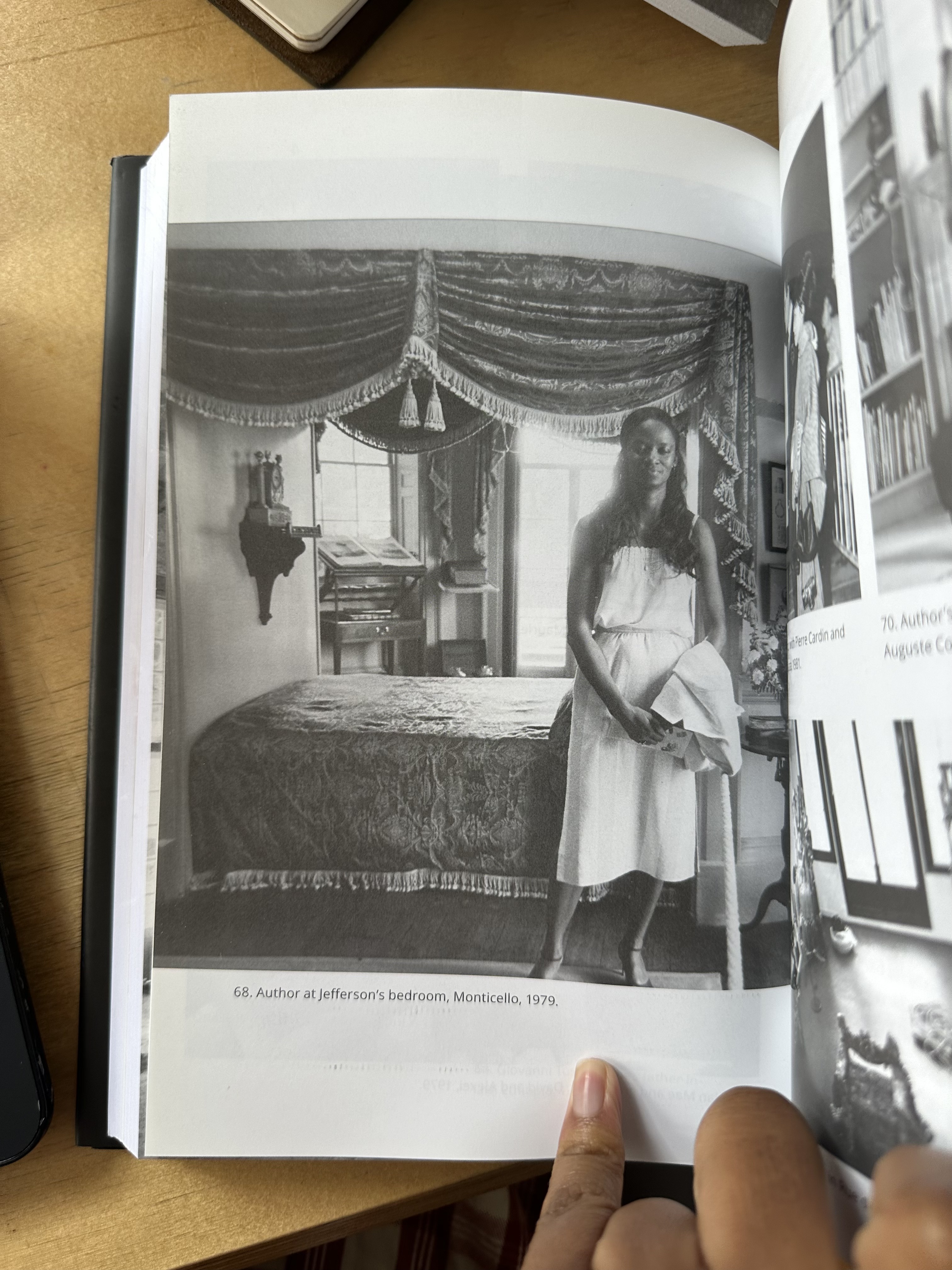
Author at Jefferson’s Bedroom, Monticello, 1979.
Photo: © Susan Wood
     II.

Sally Hemings is alluded to in Thomas Jefferson’s plans for his plantation, Monticello. When visitors approached the front entrance, they unknowingly passed by the slave quarters, which were concealed below ground, in the sides of buildings, or hidden in the tree lines. Subterranean tunnels connected the South Wing (which consisted primarily of service areas) to the main house’s cellars. From there, stairs were used to reach the main floor that housed Jefferson’s chambers. His designs purposefully reduced the visibility of the slave quarters, allowing him to “architecturally reconcile the paradox between freedom and slavery,” writes Mabel O. Wilson.2

Ultimately, the plantation—built by enslaved people—was formulated to conceal the structural violence of the site within its pastoral condition and democratic promise. Jefferson’s approach to architecture sought to disguise the presence of Black people, including his relationship with Hemings, exemplifying the tactics of spatial oppression used against and around her. In theory, her architectural place is defined by the strategic manipulations of space that imposed invisibility on her person by her white male oppressor. Less attention has been paid to her lived experience. Chase-Riboud’s debut novel, Sally Hemings, imagines how she operated amidst this repressive architectural condition and sought to make sense of herself despite her confinement. It considers the torment but also the softness that might have existed in Hemings and Jefferson’s relationship.

Of Sally Hemings, Chase-Riboud has said that “a novel has a roof and four walls and a stairway, so it’s almost architecture.”3 Like architecture, the novel is a means of organizing and structuring conceptual latitude through which a subject, or multiple, will be seen and ultimately heard. These frameworks must adapt, constantly, to meet the demands of each unique undertaking, its inhabitants, its characters, and its historical context. Chase-Riboud maintains a possessive syntax in how Hemings and Jefferson refer to themselves: “his slave,” “her master,” but she also dares to consider how Hemings might’ve held too a “hunger for things forbidden.”4 For Chase-Riboud, the novel is, unlike Monticello’s logic of concealment, an architecture that does not diminish the bounds of Hemings’s life. Instead, the spatial breadth of fiction offers her room that Jefferson’s architecture never could: space in which she might be known on her own terms.

In 1787, Hemings joined Jefferson in Paris as a servant to his daughter Martha, and it was there, according to Hemings’s son Madison, that her relationship with Jefferson first started.5 Thinking from Hemings’s imagined interiority, Chase-Riboud proffers that “late at night, when the house was silent and Paris slept, [Jefferson] would tell me of his new plans for Monticello, of changes in the Big House, of redesigned gardens and vineyards with German and French grapes…”6 Here, Chase-Riboud suggests that Hemings was privy to Jefferson’s architectural ideas before they materialized. Given her educational exposure in Paris, one can imagine that Jefferson might have trusted her intellect to a greater extent than her peers. In this telling, Hemings is not just a concubine (to borrow the word used by Madison), but a collaborator. Even if it is not true that Hemings was consulted, of which we can never know for sure, we can be certain that the clandestine nature of their relationship would have necessarily reconstituted the fabric of Monticello. The architecture, and their use of it, would have to be adjusted so their courtship could continue on their return to Virginia, undisturbed and with the utmost discretion. If Hemings did not shape Monticello directly by way of her ideas, the fact of her presence, and other enslaved workers, is, nonetheless, foundational to its structure. By way of Chase-Riboud’s novel, then, the fictive figure of a sole architectural practitioner (upon which the notion of legitimacy in discipline is traditionally premised) is compromised.

Chase-Riboud also placed her literary ambitions in architectural terms. With her book, she endeavored to walk Hemings, who prior to the novel was a largely voiceless figure, “through the front door of history.”7 Chase-Riboud’s writing sought to verify her relationship with Jefferson long before DNA evidence would confirm what Chase-Riboud already knew and wrote through earnestly. In describing how Hemings “vibrated as the subterranean presence of the eternal Black existence at the bottom of our history,”8 the artist writes Hemings in a manner that makes real not only her embodiment of a total breakdown of American mythologies—those of freedom, equality, and justice for all—but her architectural contributions too. Despite not occupying the vaulted rooms of history, Hemings forms the ground on which it is all built.

Hemings’s presence, reproductive and intellectual labor is the mute condition of the story America tells itself, and analogous to the fables of architectural modernism, which is similarly dependent on an invisible Black labor, or erasure. Chase-Riboud traverses all of this in the novel.9 She writes about how Jefferson, in his own view, “had created [Hemings] in his own image of womanly perfection, this speck of dust, this handful of clay from Monticello.”10 Here, Jefferson is not just an architect, he is also God. In her narrativization, Chase-Riboud aligns his egocentric thinking with that of the Enlightenment where false notions of Aryan supremacy, dependent on the built-in exclusion and suppression of Black life, became the drivers of modern architectural theory.11 In widening the registers of architectural discourse, Chase-Riboud’s practice serves as one model of how new critical frameworks for understanding architecture emerge when Black women’s literary and visual practices are treated as central to the production of space.

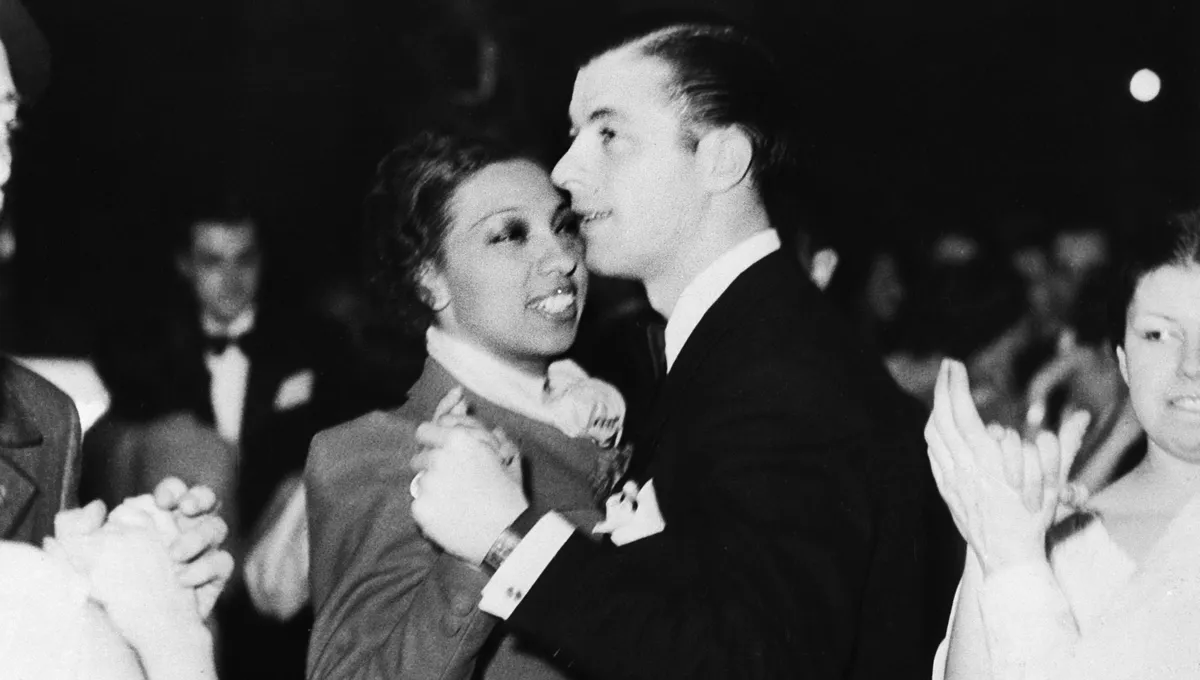
Josephine Baker et Jean Lion, à Saint-Florentin © Getty - Bettman
     III.

While modernist architect Adolf Loos anecdotally mentioned that they once met, Josephine Baker never confirmed that interaction, nor did she ever speak of the fantastically designed home that he purports she requested.12 Although the project remains unbuilt, it exists as an attempt to entrap Baker’s person and formalize the spectacle of her body—to render her both hyper- and in-visible. The house sits on a white pedestal, with the exterior surface of the top two floors fashioned in alternating horizontal strips of white and black marble, which diverged from Loos’s stringent anti-ornamental style. The stripes would have set the home apart from its hypothetical Parisian surroundings, thereby conspicuously announcing its imagined celebrity client. In “Ornament and Crime,” Loos writes, “A horizontal dash: the prone woman. A vertical dash: the man penetrating her.”13 Perhaps then Baker is the horizontal/woman to Loos’s probing vertical which extends the erotics at play throughout his unrealized project.

The design features a double-height swimming pool enclosed by a series of hallways and windows to allow a lascivious gaze on Baker’s body, positioning her where her intimacy becomes grounds for public observation. Loos exploits the latent potential of the pool because, of course, Baker’s body is never actually there. Rather, it is her very absence that gives the design its voyeuristic lure. As Farès el-Dahdah observes, Baker’s silence around the project “is that of the fetish who never replies to the fetishist’s advances.”14 In keeping mute, she does not allow herself, as a subject, to be resolved. Instead, she offers room only for conjecture and retains the truth of her person, her desires, and her sexuality despite their implication in Loos’s design. The void of Baker remains absolute. Simply put, she refuses.  

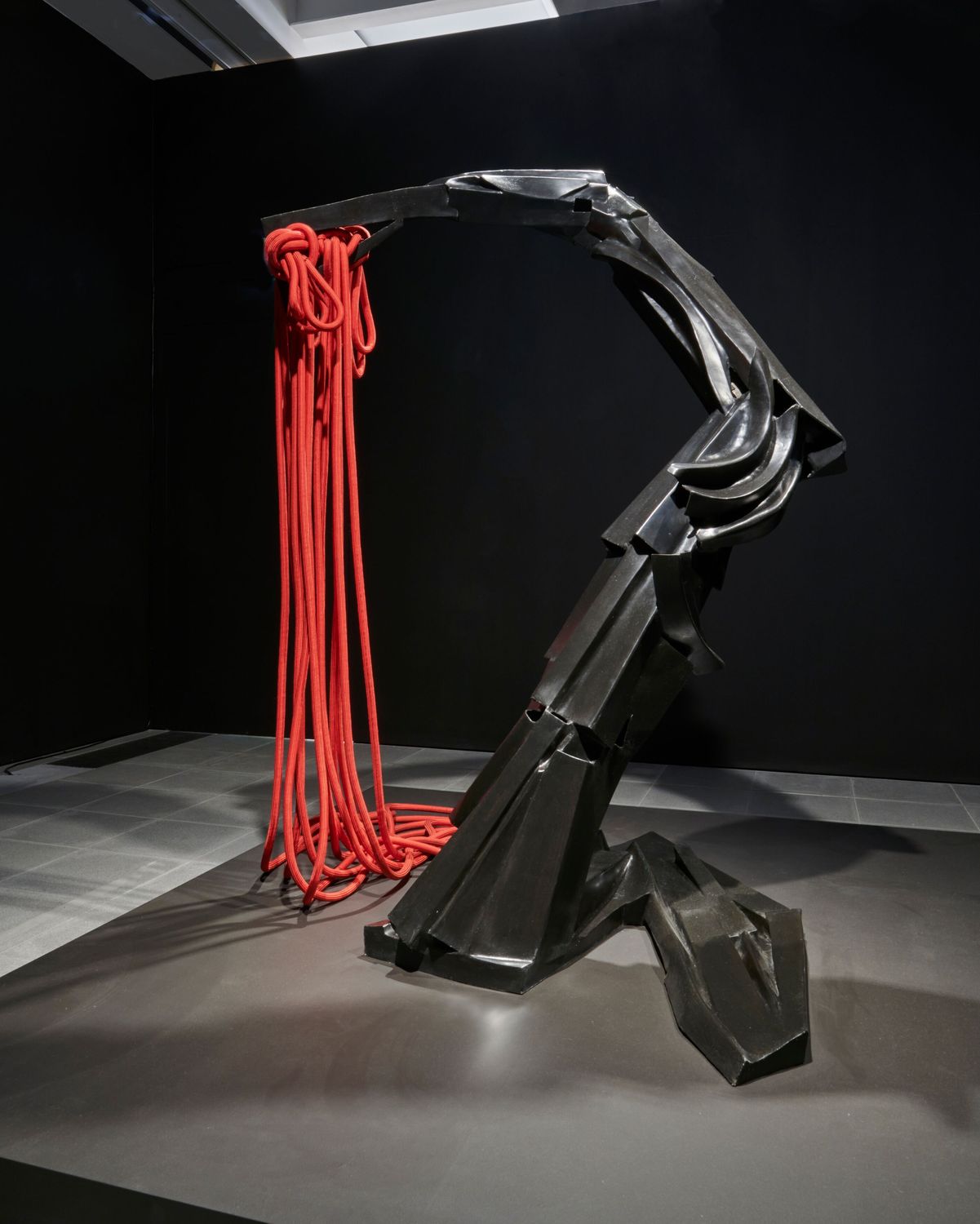
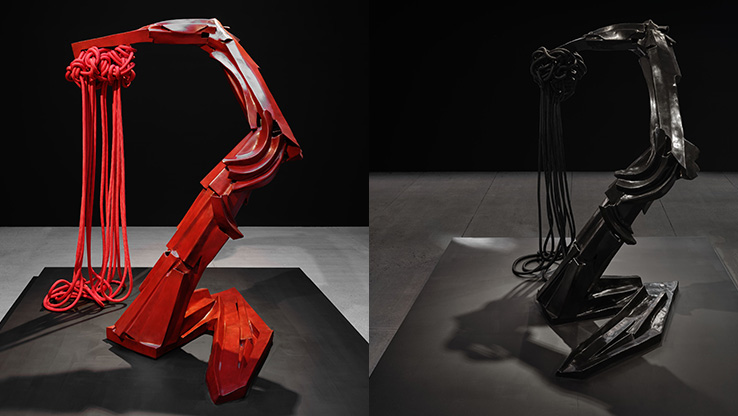
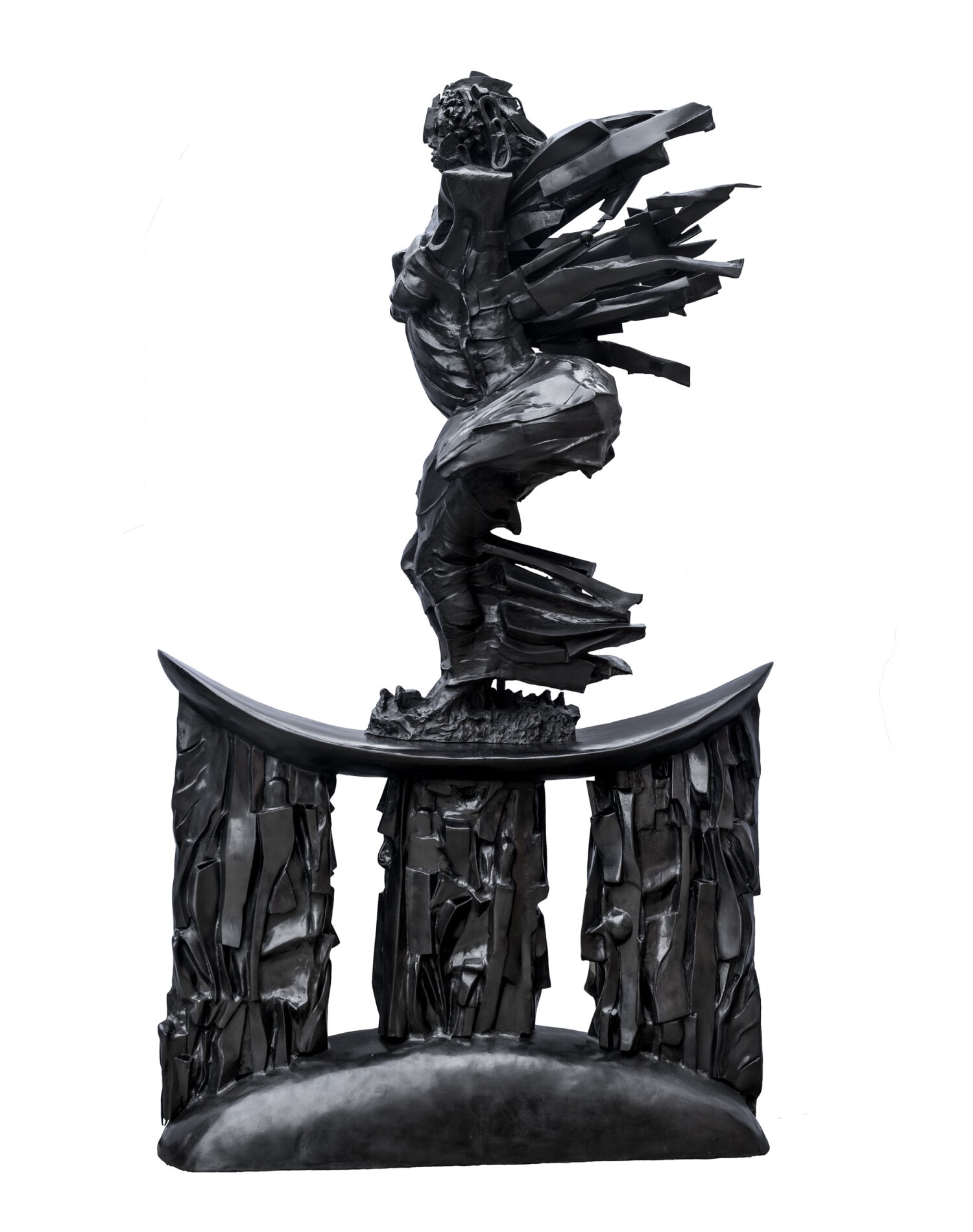
While Chase-Riboud chose to memorialize Hemings through language, she primarily sculpts Baker into space. Unlike Loos’s house where the codified and lustful ideal of Baker’s body becomes the driving force of the design, Chase-Riboud seeks to materialize Baker’s vivacity through abstraction. The first in a series of “Josephines,” La Musica Josephine Red/Black (2021), rebounds emphatically before concretizing its swaggering gesture. The rippled and patinated bronze recalls the effervescent choreography of the sculpture’s namesake, ricocheting from its stage and vigorously swinging upward, as if at each point reached she changes her mind and recoils in another direction. The bronze Josephine reaches an apex, almost like a held fist, a point of tension from which thick coils of red silk pour onto the floor in a cursive scribble. In the unraveling of its posture, rigor makes a path for liquidity. These formal constructions convey Baker’s presence without contributing to the often violent and constraining excess of her celebrity. It honors in its obscuring of her by providing aesthetic relief. The sculpture takes on an essence, and the body can finally rest.
Barbara Chase-Riboud, Josephine Red/Black, 2021
     IV.

Across her practice, Chase-Riboud demands a total subversion of architecture’s austerity. In a text she co-wrote with Sir Reginald Jackson, they exclaim: “We resolve to make sculpture dance. We’ve come to suspect frigid planes and axes.”15 Chase-Riboud and Jackson go on to declare: “No more columns tethered to a stoic grid. We must evade the architectural to extrude the gestural. Puncture planar elevations... Syncopate!”16  To syncopate is to command an interruption, force a displacement of convention or expectation. Chase-Riboud’s narration of Hemings’s life syncopates the erasing tactics of Monticello; her sculptures to and for Baker make a case for an architectural abstraction that gnaws at the rigidity of our planar commandments (the wall, the floor, and the ceiling) and syncopate an architectural narrative that exploits her celebrity while muting her vitality. These interventions derange a hegemonical architectural discourse that depends on disciplinary authoritarianism, considering instead what had to happen for architectures like Monticello and Loos’s house to become dominant and the subjects upon which architecture rests, or the diminished absences that make it possible. Through Chase-Riboud’s example, we may glean that Black women’s architectures are not only architecture, but sculptures, fictions, and poetries. The inclusion of these mediums allows us to make visible the deformation and the room for redress where architecture’s Black female subjects are concerned. Alas, a Black feminist architectural theory must syncopate, generating methods through which we might reveal and interpret multiple spatial possibilities in concert.
Sally Hemings
1.
1773: Hemings is born in Virginia.
2.
July 1787: Aged 14, Hemings arrives in Paris to accompany Thomas Jefferson’s daughter. According to her son Madison’s memoir, Hemings started her relationship with Jefferson during her 26 months in Paris and became pregnant there. Slavery was not legal on mainland French soil, and Hemings was paid a monthly wage. I wonder what she spent it on or saved it for.
3.
She began to learn French and trained in needlework, laundry, and dressmaking. “She was happier than she had ever been in her life.”17
4.
Paris offered her freedom even if she did not eventually take it in full. “Freedom, to Sally Hemings, was a vague, glimmering place no one ever returned from to prove it really existed.”18
5.
Chase-Riboud writes as though Hemings’ sexual encounter with Jefferson was an inevitability, brought to be by ambivalent intimacies that made up the libidinal economy under slavery. “Perhaps I had always known that he would claim me. Had not the same happened to my mother and my sisters?”19
6.
1789: Hemings returns ‘willingly’ to Monticello, re-enslaving herself on the condition that her children would be freed when they reach 21 years of age. Her son writes that his mother was already pregnant when she left Paris. Her choice to return is no longer a choice, but a negotiation.
7.
Upon her return from Paris, Hemings moved into a slave quarter under the South Wing of Monticello. With its sunken presence, her quarters would only be visible from Mulberry Row or the yard right in front of the wing, but she would have had direct access to Jefferson’s chambers through passages used by all enslaved people in the house.
8.
While in Paris, Hemings lived in the Hôtel de Langeac at 92 Av. des Champs-Élysées, less than a 15 minute walk away from where Baker performed.
Josephine Baker
1.
June 3, 1906: Baker is born in St. Louis, Missouri.
2.
September 1925: Baker arrives in Paris, tracing Hemings’ wake.
3.
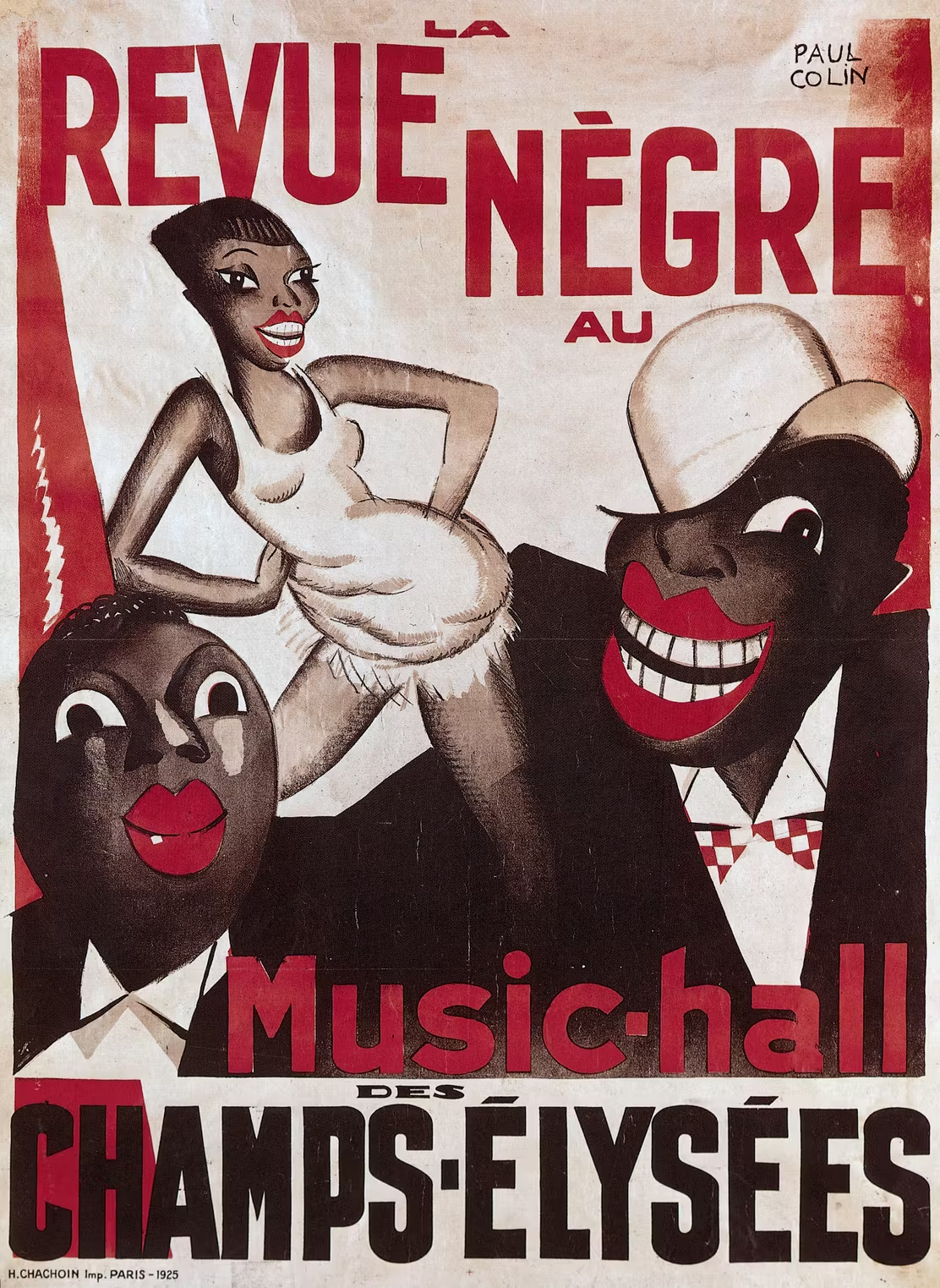
October 2 1925: She opens at La Revue nègre at Théâtre des Champs-Élysées, topless and wearing a feather skirt.
Affiche signée Paul Colin (1892-1985) pour « La Revue nègre » au Théâtre des Champs-Elysées à Paris en 1925.  IBERFOTO/ROGER-VIOLLET
4.
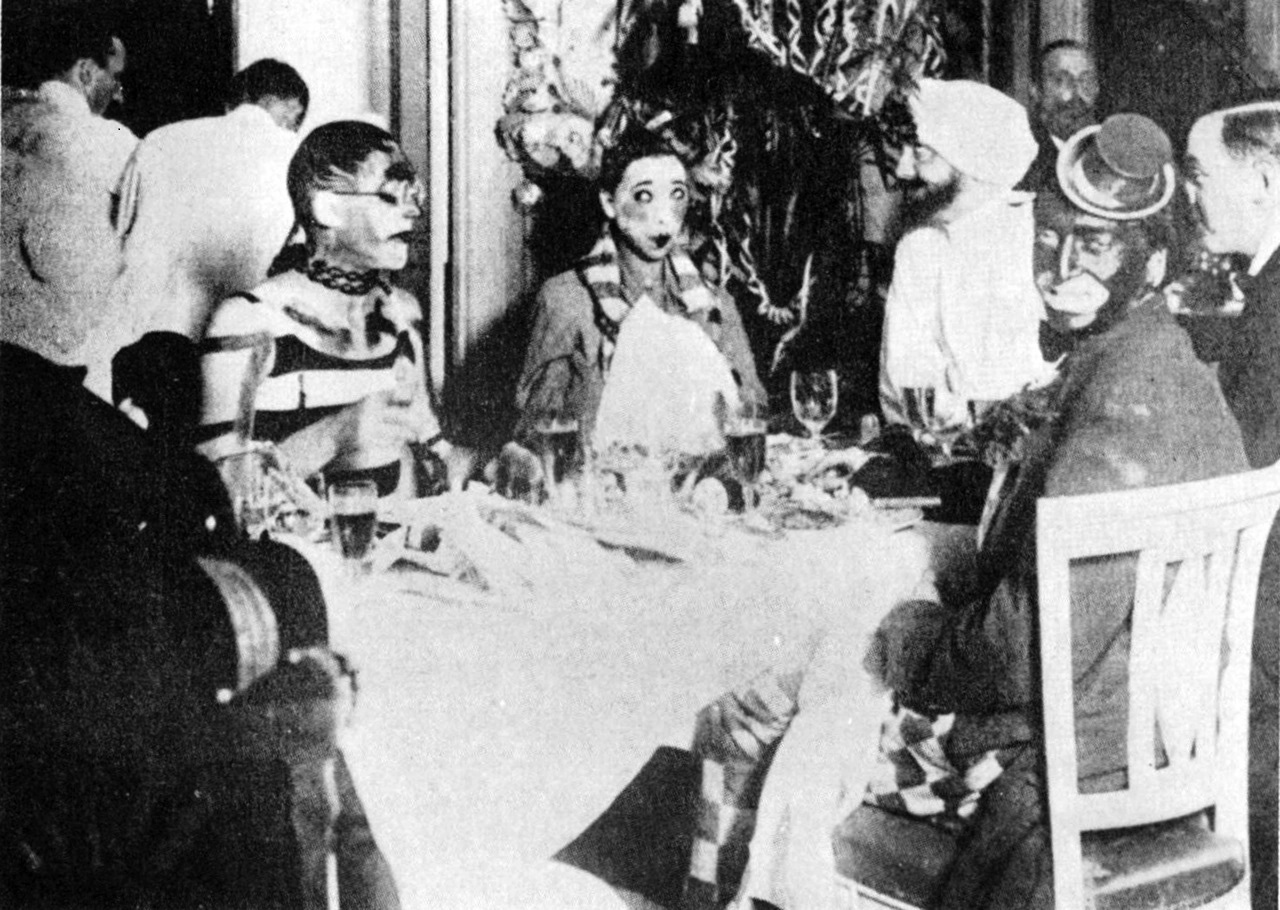
November 1929: Le Corbusier and Baker meet on board the transatlantic liner Giulio Cesar en route to São Paulo. While on board, he draws her. During a costume party on the Lutétia, Corbusier is pictured dressed as the house Loos designed, banded in black and white stripes all down his arms, with Baker, in whiteface, sat beside him. An unknown man in blackface grins disturbingly into the camera, strained in the face and repugnant in his caricature. Corbusier would soon follow suit at another costumed event, attempting to live in Baker’s skin and donning blackface. He wore a feathered skirt, pretending to be Baker, to Baker.20 In that moment, he is acutely aware of how the body does not in fact yield to man-made design, even if he would continue to preach otherwise.
5.
1937: Baker renounces her US citizenship and becomes a French national after marrying Jean Lion. She chooses to stay while Hemings did not.
Josephine Baker et Jean Lion, à Saint-Florentin © Getty - Bettman
6.
1939: During WWII, Baker is recruited by the French military to conduct espionage work. She leverages her fame to gather information which she inscribed in invisible ink on her hands, arms, and song sheets. Her hypervisibility, and the privileges such celebrity afforded, allowed her to operate without drawing unfamiliar attention. She moved in full view but remained unseen.
7.
1940: After Germany invades France, Baker leaves Paris and moves to Château Les Milandes in Southern France, a 15th-century castle far away (both ideologically and physically) from the modernist shell Loos imagined for her.
8.
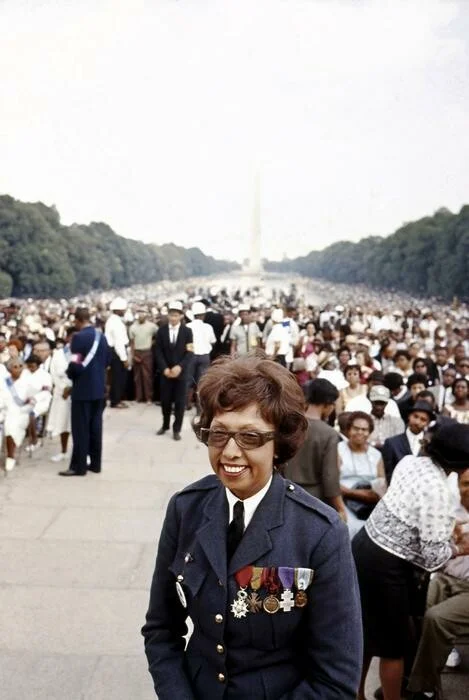
August 28, 1963: Baker speaks at the March on Washington, fully decorated in her Free French uniform and medal of the Légion d’honneur. “I want you to know that this is the happiest day in my entire life,” she proclaims.
August 28, 1963. Josephine Baker in decorated French Resistance uniform at the March on Washington, where she delivered a speech.
9.
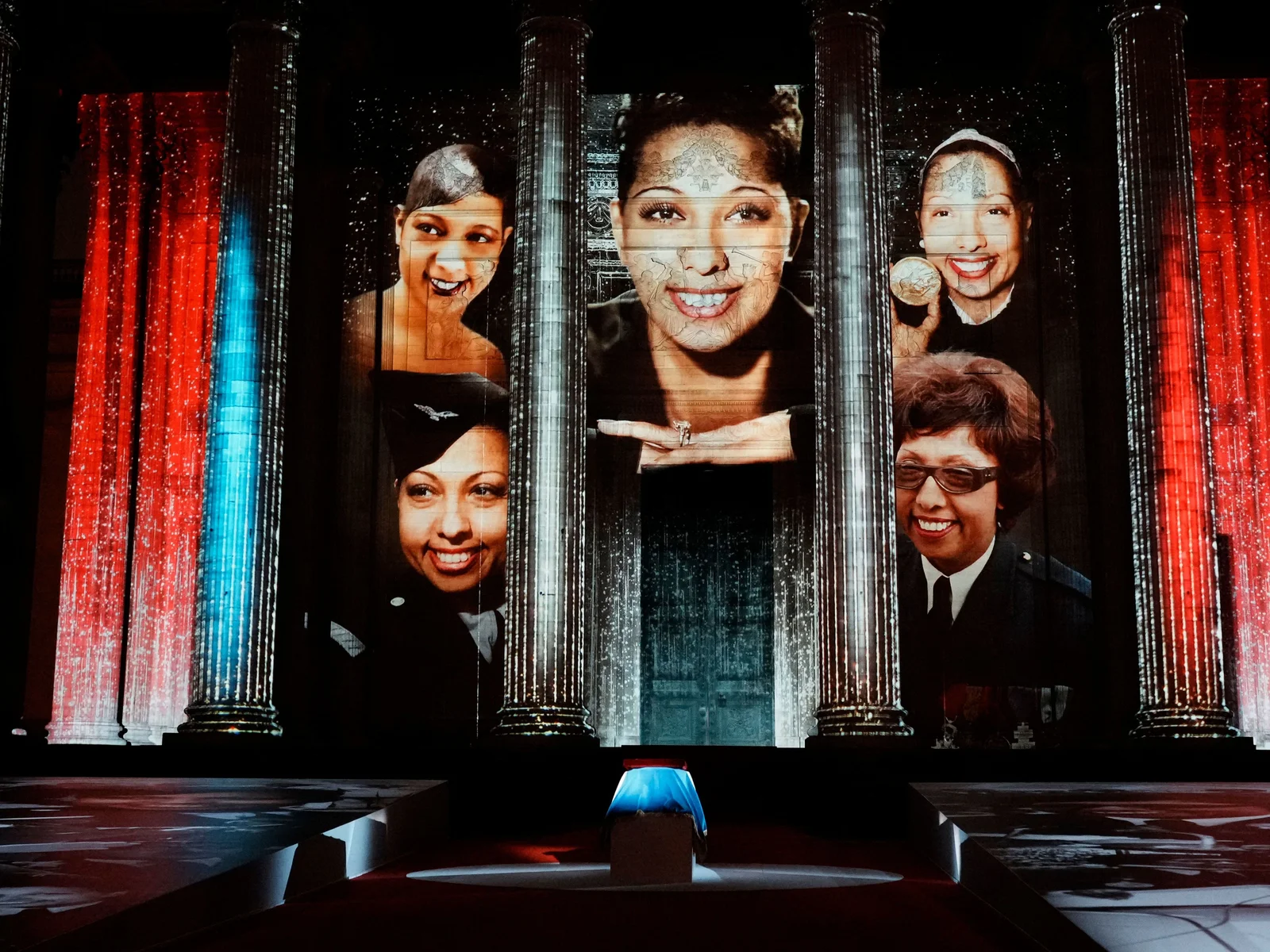
November 30, 2021: Josephine Baker is the first Black American to enter the French National Panthéon. Chase-Riboud attends Baker’s induction.
Images of Josephine Baker are projected on the Pantheon monument during a ceremony in Paris on Tuesday.
Thibault Camus/Pool/AFP via Getty Images
Barbara Chase-Riboud
1.
June 26, 1939: Riboud is born in Philadelphia, Pennsylvania.
2.
1957: Riboud travels to Rome for the John Hay Whitney Fellowship at the American Academy in Rome.
3.
During her time at the academy, Riboud finds a foundry that shows her a lost-wax technique traditionally from the Benin Empire. The method allows her to cast her bronze sculptures directly from the wax, meaning she has more control over her process rather than having to outsource the production of her work.
Author at her atelier in La Chenillère, 1969.
4.
1958: Riboud travels to Egypt after being dared by her colleagues at the Academy. Floating up the Nile, among the pyramids, sphinxes, and the temples of Luxor, architecture became her religion and sculpture her lover. “It was like a blessing or a curse: the need to define, explore, and encounter those I had never dreamed existed. This was the first but not the last time geography would devastate me.”21
Barbara Chase-Riboud in Egypt, 1958, collection of the artist. © Photo: René Burri.
5.
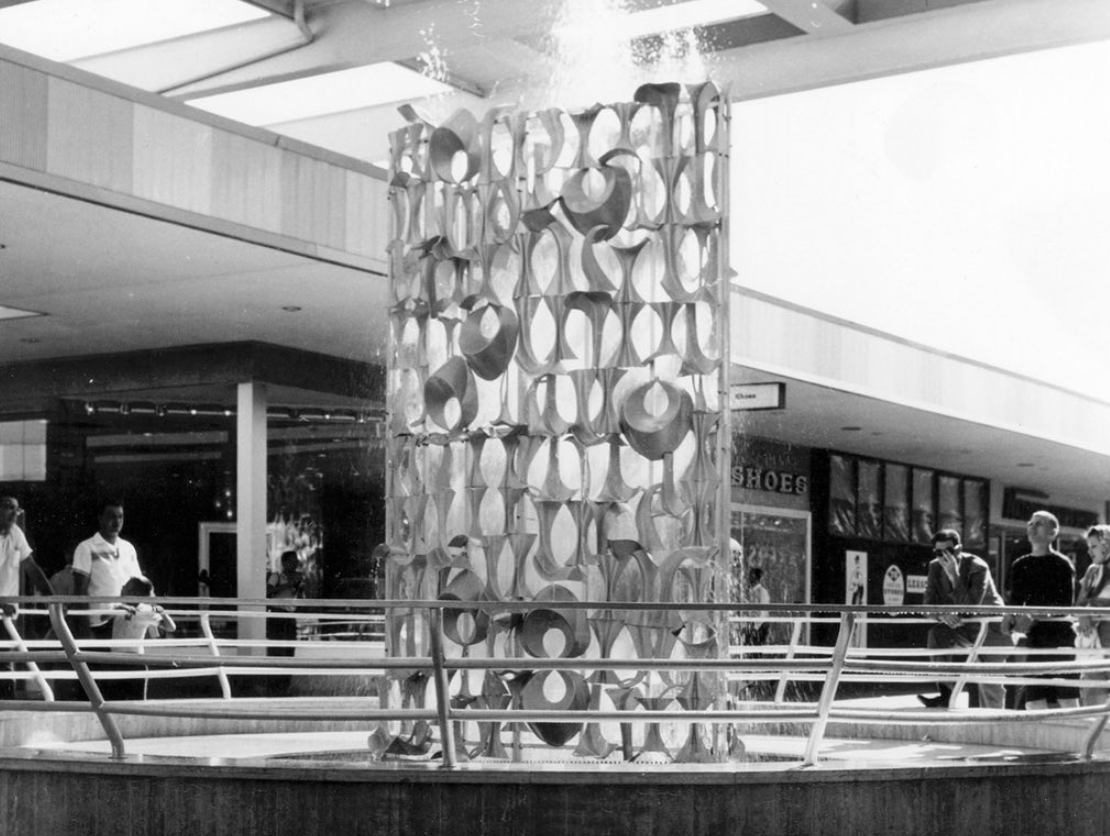
1958: Riboud becomes the first Black woman to attend Yale school of Architecture. She is taught by Philip Johnson, Joself Albers, Herbert Matter, Louis Kahn, and James Stirling. Riboud eventually enters a romantic relationship with Stirling that almost jeopardizes her degree. After completing Wheaton Plaza Fountain (1960) for her thesis, she is asked to produce a second thesis which she does in three weeks. She eventually graduates on time.22
Wheaton Plaza Fountain, 1960. Barbara Chase-Riboud, Artist. Pressed Aluminum, Water. Installed at Wheaton Plaza Mall in Wheaton MD
6.
November 29, 1960: Struggling through her relationship, Riboud takes a brief trip to Paris and has lunch with Le Corbusier.23
7.
1961:  The artist moves to Paris abandoning her relationship with Stirling. She marries photographer Marc Riboud. Her first atelier is on Rue Blomet, next to Le Bal Nègre where Baker would often perform in her early career. “When I was introduced in French society, for them I was either an African princess or Joséphine Baker,” she says“I never considered myself a political figure. I never had an ambition to lead or exemplify anything. The only thing I admired was world-class excellence. Joséphine Baker sort of symbolizes that for me...”24
8.
During a 9 year hiatus from her sculptural practice, Riboud worked as an architect.25
9.
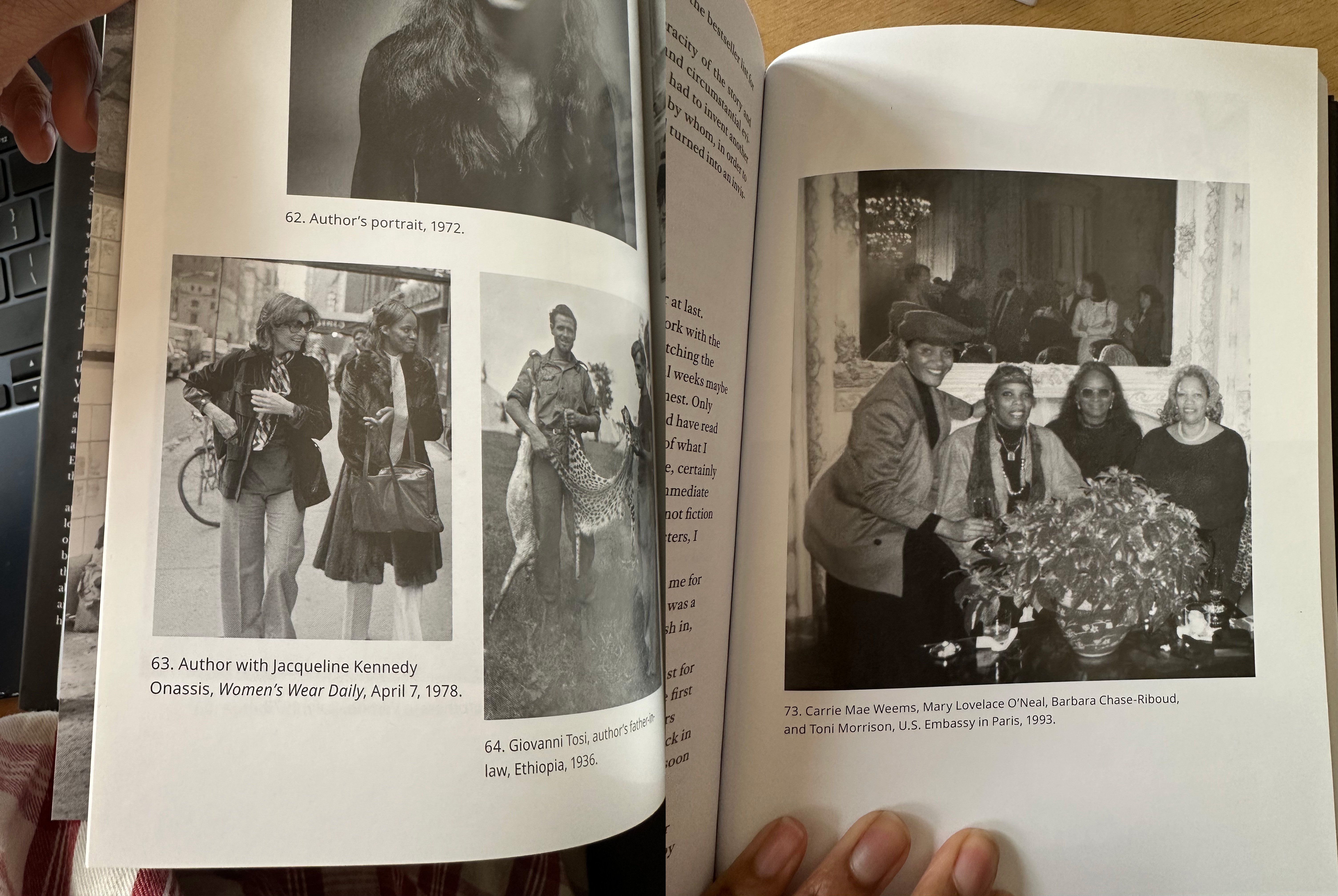
Toni Morrison edited Riboud’s first book of poetry From Memphis & Peking, and Riboud first floated the idea of an epic poem about Sally Hemings to her. Morrison wasn’t keen on the poem as a format, and it wasn’t until Riboud told the Hemings story to Jacqueline O’Nassis in 1974 that it would find its legs. O’Nassis greatly encouraged Riboud to finish the novel and its manuscript was eventually bought by Viking Press during O’Nassis’ tenure there. The former first lady became the acquiring editor of a novel about the 3rd president’s mistress. Sally Hemings was first published by Viking Press in 1979.
Author with Jacqueline Kennedy Onassis, Women’s Wear Daily, April 7, 1978.
Carrie Mae Weems, Mary Lovelace O’Neal, Barbara Chase-Riboud, and Toni Morrison, U.S. Embassy in Paris, 1993.
10.
Chase-Riboud has said: “When I went to Monticello for the first time, there was a tiny staircase leading to this mysterious little room over top of Jefferson’s bed, which was fascinating to me because their explanation for its purpose was so stupid and so silly. This became the famous “Hemings room” that tourists asked to see and led to the staircase being torn out. I thought to myself, there’s got to be another reason. It was simply because, as an architect and as a graduate of Yale’s architectural school, I know something about building, and I know something about structure, and I know something about where things go. This was not pure speculation on my part, as there is a photo of a black butler standing in the doorway of the stairwell and a caption speculating on the reason for the staircase in an issue of National Geographic magazine from the early 1930s.”26
11.
April 9, 1975: Riboud meets Baker at her final performance at the Bobino Theater.
12.
1998: Riboud completes Africa Rising, a towering bronze monument to Sarah Baartman, commissioned for the Ted Weiss Federal Building following the discovery of an 18th-century African American burial ground beneath its site. Baartman was a Khoikhoi woman exhibited across Europe for her body type. The ‘attraction’ of her person is demonstrative of the colonial commodification of African people that would mature into the negrophilic fetishisation of Black culture that fed Josephine Baker’s early fame. Baker was the Black Venus to Baartman’s Hottentot Venus. Riboud’s sculpture articulates the contours of a body exploited as a sexual curiosity. Yet it does so without strict corporeal resemblance. Instead, she draws on her design education to fashion an architectural environment that syncopates the violence of its building container.
13.
2021: Barbara Chase-Riboud completes her first Josephine:  La Musica Josephine Red/Black.
Barbara Chase-Riboud, Josephine Red/Black, 2021
14.
2022: Barbara Chase-Riboud completes her final two Josephines: JOSEPHINE RED/RED and JOSEPHINE BLACK/BLACK.
Thomas Barratt © Barbara Chase-Riboud - Courtesy of the artist and Hauser & Wirth
14.
September 16, 2023: The first retrospective of Riboud in over 40 years, and the largest ever, opens at The Pulitzer Arts Foundation, in Baker’s hometown.
Barbara Chase-Riboud. Africa Rising II © Barbara Chase-Riboud
1. Barbara Chase-Riboud, I Always Knew: A Memoir, (Princeton: Princeton University Press, 2022), 31.
2. Mabel O. Wilson, “Notes on the Virginia Capitol Nation, Race, and Slavery in Jefferson’s America,” in Race and Modern Architecture: A Critical History from the Enlightenment to the Present, (Pittsburgh, Pa.: University of Pittsburgh Press, 2020), 42.
3. Hauser & Wirth – Art Gallery, “Barbara Chase-Riboud: Monuments of the Mind,” A Film by RAVA Films, December 20, 2023, video, 2:42-2:54, https://www.youtube.com/watch?v=bedNJF-3RI.
4. Barbara Chase-Riboud, Sally Hemings, (London: Virago, 2002), 126.
5. S.F. Wetmore, Interview with Madison Hemings, son of Sally Hemings and Thomas Jefferson, “Life Among the Lowly, No. 1,” Pike County (Ohio) Republican, 1873.
6. Chase-Riboud, Sally Hemings, 147.
7. Chase-Riboud, I Always Knew, 266.
8. Ibid, 336
9. The connection between architectural modernism and erasure is exemplified in the post-war clearances of Black communities disguised as urban renewal projects. See Linnentown in Athens, Georgia; Lafayette Park in Detroit, Michigan; Mecca Flats in Chicago, Illinois.
10. Chase-Riboud, Sally Hemings, 146.
11. Irene Cheng, “Structural Racialism in Modern Architectural Theory.” In Race and Modern Architecture: A Critical History from the Enlightenment to the Present, edited by Irene Cheng, Charles L. Davis, and Mabel O. Wilson, 134–52. University of Pittsburgh Press, 2020. https://doi.org/10.2307/j.ctv11cwbg7.11.145.
12. In her memoir, Claire Beck, Loos’s third wife, writes that Loos claimed to have met Baker multiple times, once offering, unbidden, to draw her “the most beautiful plan in the world,” at a party. Claire Beck Loos, Adolf Loos: A Private Portrait, ed. Carrie Paterson (Los Angeles: DoppelHouse Press, 2011), 5-7.
13. Adolf Loos, “Ornament and Crime,” in Programs and Manifestoes on 20th-Century Architecture, ed. Ulrich Conrads, trans. Michael Bullock (Cambridge, MA: MIT Press, 1970), 19.
14. Farès el-Dahdah and Stephen Atkinson, “The Josephine Baker House: For Loos’s Pleasure,” Assemblage, no. 26 (1995): 73–87. https://doi.org/10.2307/3171418, 76.
15. Barbara Chase-Riboud and Sir Reginald Jackson, “From Malcolm to Josephine: A Manifesto for Sculpture in Pursuit of Futurism,” wall essay, Barbara Chase-Riboud: Infinite Folds (Serpentine North Gallery, London, 11 October 2022 — 10 April 2023).
16. Ibid.
17. Chase-Riboud, Sally Hemings, 118.
18. Chase-Riboud, Sally Hemings, 111.
19. Chase-Riboud, Sally Hemings, 122.
20. Catherine Slessor, “Loos and Baker: a house for Josephine,” The Architectural Review, March 5, 2018.
21. Chase-Riboud, I Always Knew, 31-32.
22. Désanges, Chase-Riboud, Interview with Barbara Chase-Riboud, 36-37.
23. Chase-Riboud, I Always Knew, 68.
24. Désanges, Chase-Riboud, Interview with Barbara Chase-Riboud, 43.
25. Ibid, 44.
26. Barbara Chase-Riboud interviewed by Melanie Masterton Sherazi, “Sally Hemings’s Staircase: On Biofiction’s Afterlives,” in Conversations with Biographical Novelists edited by Michael Lackey, (London: Bloomsbury Publishing, 2018), 72.
This essay was generously supported by an August gift, so that we may name what has been built and acknowledge the hand that made it, Evermore.
Oluwatobiloba Ajayi is a London-based artist and writer with a BA in Architecture from Princeton University and an MA in History of Art from the Courtauld Institute of Art, where she specialised in post-war Black British art. Her research examines representations of architecture in Black feminist art and writing. Her writing has appeared in The Architectural Review, The Brooklyn Rail, and Worms, among others. Recent group exhibitions include Amphiphrasis (words as objects): Oluwatobiloba Ajayi and Theresa Hak Kyung Cha at the Broodthaers Society of America (2024) and Manifold Lagos at Alára (2024). She was previously writer-in-residence at AWARE (Archive of Women Artists, Research and Exhibitions), Studio Richter Mahr, and Aspex Portsmouth. She is an incoming PhD student at the Slade School of Fine Art and is currently working on a book-length project.
Back
Essay
Axonometric
Projection