Jessica Lynne, Amarie Cemone Gipson, and Stevona Elem-Rogers offer tributes to bell hooks’s seminal text Art on My Mind: Visual Politics.
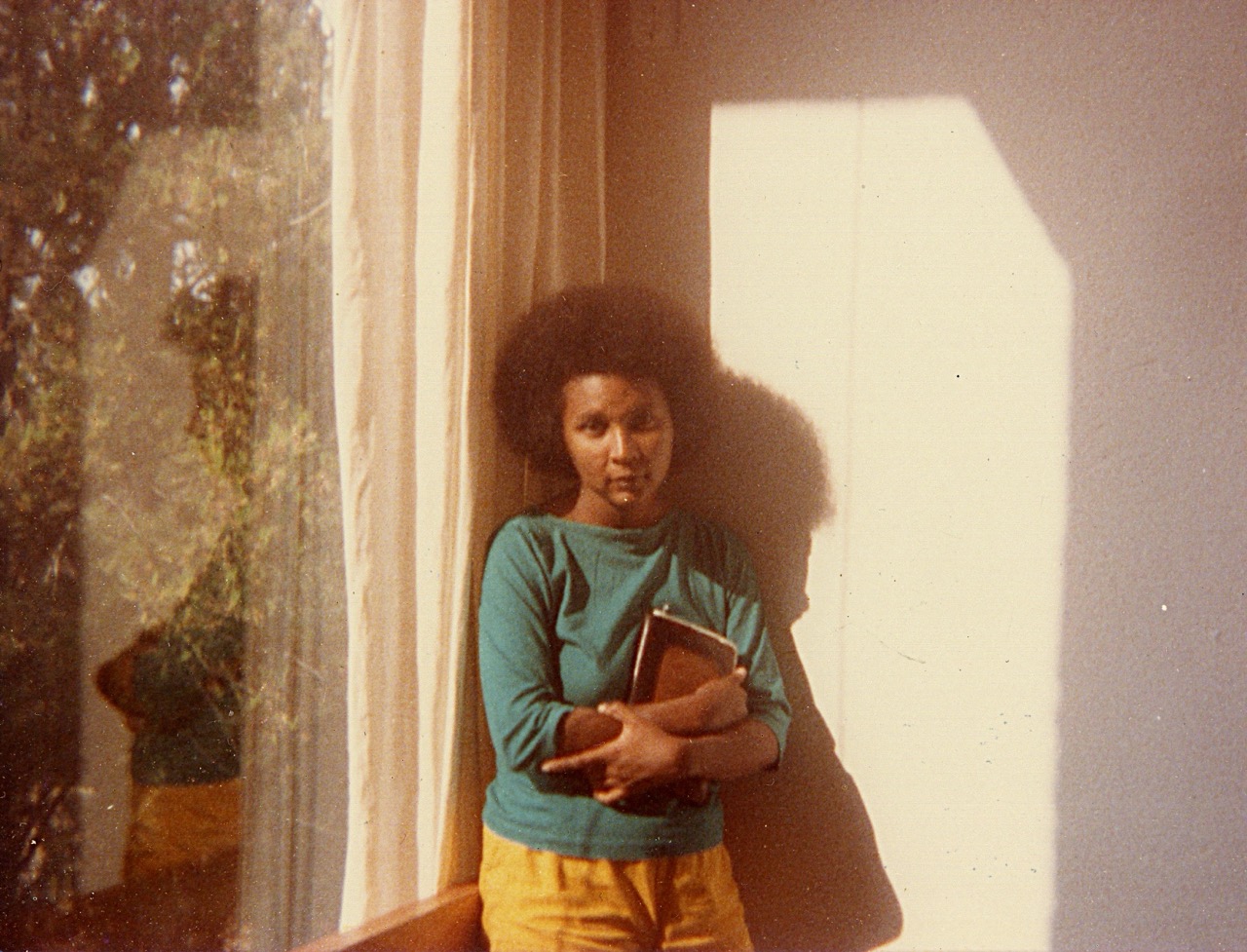
Gloria Jean Watkins (bell hooks) as a young adult, circa 1970. Courtesy of Berea College Special Collections and Archives
The Enduring Legacy of Art on My Mind
I find it difficult to imagine that I would have ever become a critic of any kind without a text I have carried with me for almost twenty years: Art on My Mind: Visual Politics by bell hooks.
When I first read her, I was a college student in the late aughts with little conception of the art critic as a vocation, as a position, as a role of utility. My community was (and still is) one full of artists working across many modes and expressions, and what mattered to me, what I thought I might be able to offer back to this creative cypher of mine, looked something like storytelling. I wanted everyone to know about the minds of these people who were changing me, and I wanted to talk back to their work in a manner both serious and distinct.
Art on My Mind was assigned reading in a class taught by the writer Carley Moore. It was a book that shook me alive because like anyone young and searching, I could see a lineage, and I was trying to find my place in it.
The essay collection emerged from hooks’s frustration with what she named as a “dearth of critical writing” by Black writers on visual culture because she declares art as a necessary ground from which sociopolitical transformation grows. Broadly, hooks contends that there can be no serious consideration of aesthetic conditions and thereby, possibilities of political insurgence, without the voices of Black art critics. We are vital to a “culture of resistance” which the visual is connected to and implicated in, especially those of us who are not from privileged class backgrounds. (hooks was always thinking about class.)
In hooks’s world sense, criticism is not frivolous or inconsequential. It becomes necessary to reconstitute epistemological frameworks that are already informed by and embedded within the cultural production we consume—visual politics. Art was on her mind, hooks writes in the collection’s eponymously titled essay, and the same was true for me when I first read this book. Criticism, I thought, could be a meaning-making tool, despite all I needed to still learn about it as a genre, as a task, as a way of living. And here was this Black southerner, like me, who was making it all the more attractive.
Part of that attraction also had to do with her approach. This is a collection that is vulnerable, turning away from the lauded myth of objectivity, living somewhere below the realm of pure theory. Another way to say this is to say that Art on My Mind is unafraid of the personal. hooks demonstrates how an awareness of herself sharpens via attention to art—the photograph, in particular—and I have held onto this lesson since my very first reading. Through study, close looking and listening at both vernacular traditions and non, she revises her perception of familial legacies, kinship ties, and the body, her body even. I am still troubled yet impressed, for example, by her recounting of how a photograph made of her by Lyle Ashton Harris during a time of illness was exhibited without her approval but still enabled her to embrace her changed physical form with tenderness. How delicate a confession.
Now, I’m working on my own essay collection over which hooks’s provocation of the “I” looms large. I understand with greater clarity that the doing of criticism is not divorced from the doing of politics—all the ways in which I might act and transgress against the forces of, as hooks has taught many of us elsewhere, white-supremacist capitalist patriarchy. In what ways does my own writing refuse and deny the lie of dominance? How have artists taught me to think radically about the world? What truths are revealed in the intimate encounter with an image, a painting, or a long cherished quilt? These are but some of the questions that have come before me as I’ve read Art on My Mind again and again. In twenty more years, I wonder what new questions will reveal themselves.
When I first read her, I was a college student in the late aughts with little conception of the art critic as a vocation, as a position, as a role of utility. My community was (and still is) one full of artists working across many modes and expressions, and what mattered to me, what I thought I might be able to offer back to this creative cypher of mine, looked something like storytelling. I wanted everyone to know about the minds of these people who were changing me, and I wanted to talk back to their work in a manner both serious and distinct.
Art on My Mind was assigned reading in a class taught by the writer Carley Moore. It was a book that shook me alive because like anyone young and searching, I could see a lineage, and I was trying to find my place in it.
The essay collection emerged from hooks’s frustration with what she named as a “dearth of critical writing” by Black writers on visual culture because she declares art as a necessary ground from which sociopolitical transformation grows. Broadly, hooks contends that there can be no serious consideration of aesthetic conditions and thereby, possibilities of political insurgence, without the voices of Black art critics. We are vital to a “culture of resistance” which the visual is connected to and implicated in, especially those of us who are not from privileged class backgrounds. (hooks was always thinking about class.)
In hooks’s world sense, criticism is not frivolous or inconsequential. It becomes necessary to reconstitute epistemological frameworks that are already informed by and embedded within the cultural production we consume—visual politics. Art was on her mind, hooks writes in the collection’s eponymously titled essay, and the same was true for me when I first read this book. Criticism, I thought, could be a meaning-making tool, despite all I needed to still learn about it as a genre, as a task, as a way of living. And here was this Black southerner, like me, who was making it all the more attractive.
Part of that attraction also had to do with her approach. This is a collection that is vulnerable, turning away from the lauded myth of objectivity, living somewhere below the realm of pure theory. Another way to say this is to say that Art on My Mind is unafraid of the personal. hooks demonstrates how an awareness of herself sharpens via attention to art—the photograph, in particular—and I have held onto this lesson since my very first reading. Through study, close looking and listening at both vernacular traditions and non, she revises her perception of familial legacies, kinship ties, and the body, her body even. I am still troubled yet impressed, for example, by her recounting of how a photograph made of her by Lyle Ashton Harris during a time of illness was exhibited without her approval but still enabled her to embrace her changed physical form with tenderness. How delicate a confession.
Now, I’m working on my own essay collection over which hooks’s provocation of the “I” looms large. I understand with greater clarity that the doing of criticism is not divorced from the doing of politics—all the ways in which I might act and transgress against the forces of, as hooks has taught many of us elsewhere, white-supremacist capitalist patriarchy. In what ways does my own writing refuse and deny the lie of dominance? How have artists taught me to think radically about the world? What truths are revealed in the intimate encounter with an image, a painting, or a long cherished quilt? These are but some of the questions that have come before me as I’ve read Art on My Mind again and again. In twenty more years, I wonder what new questions will reveal themselves.
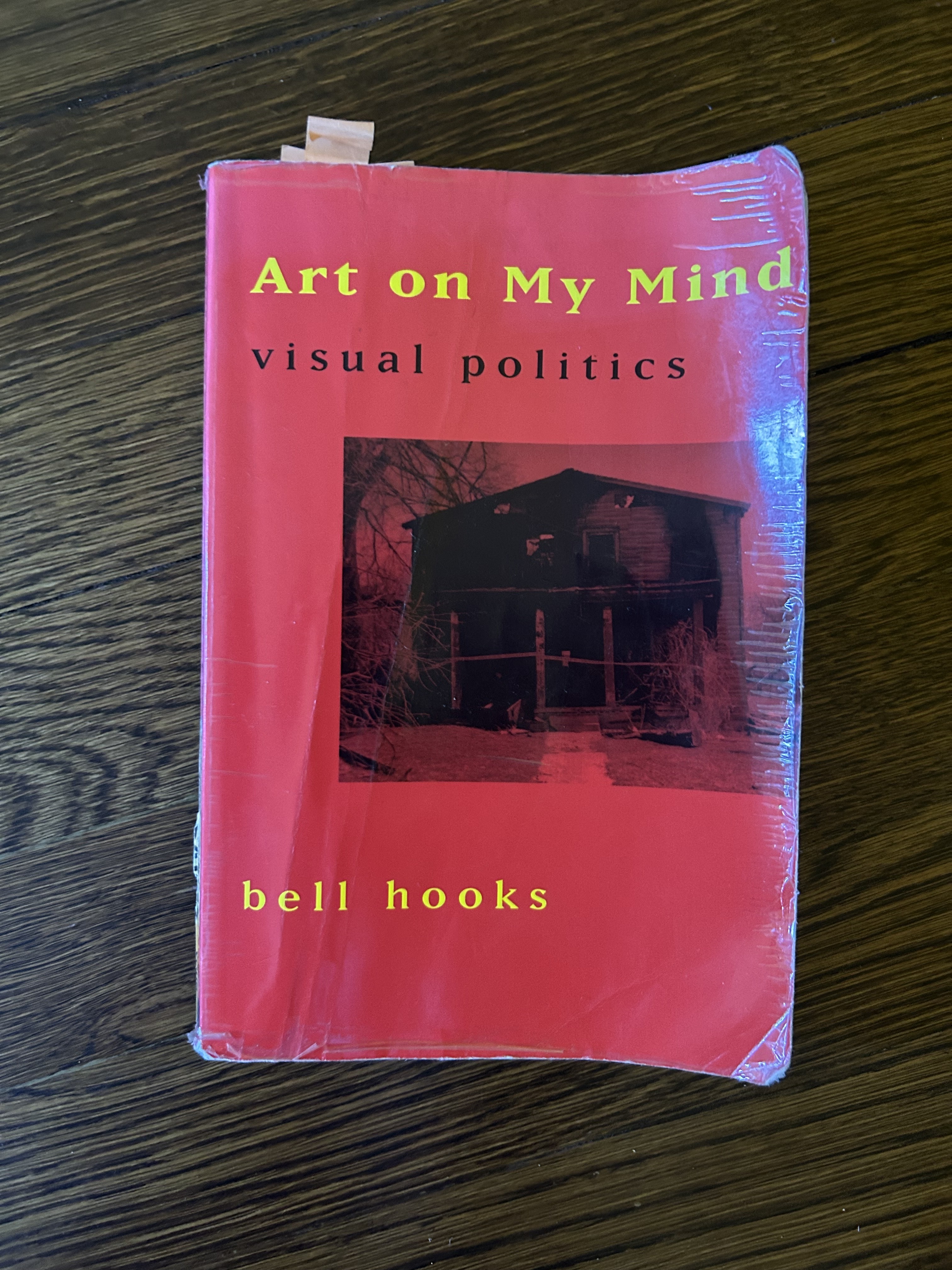
Author’s copy of Art on My Mind that has been annotated throughout the years.
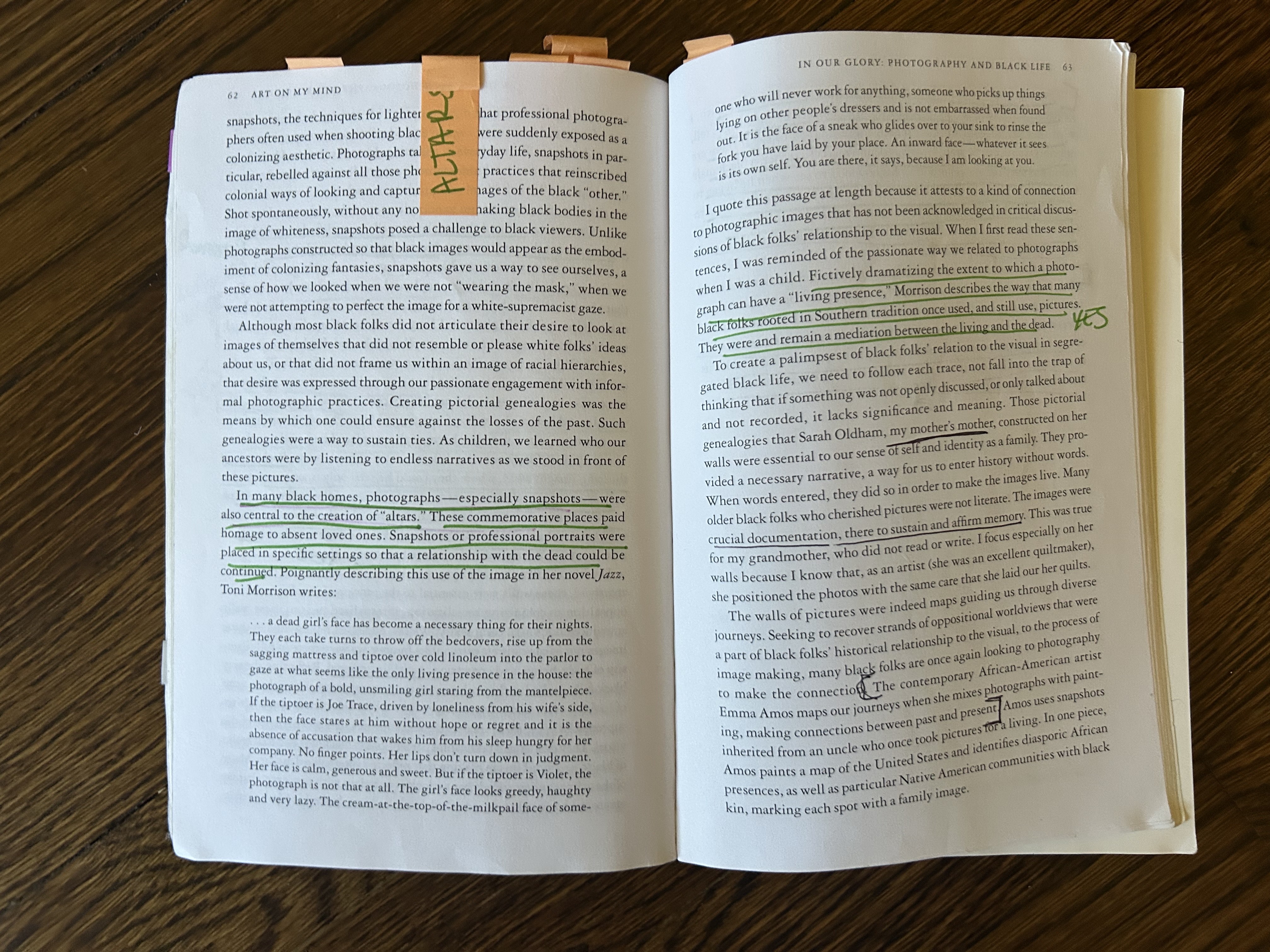
Author’s copy of Art on My Mind that has been annotated throughout the years.
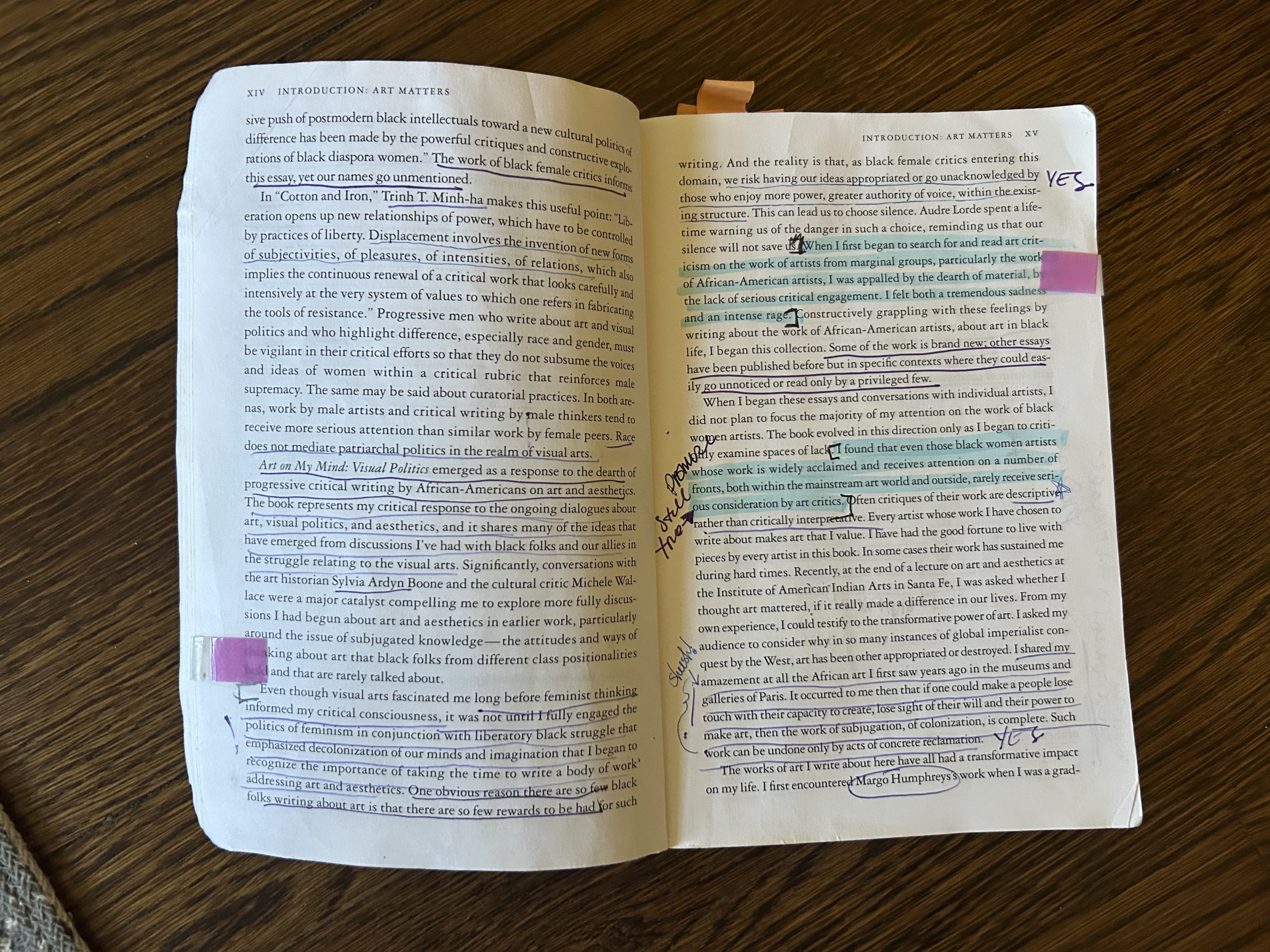
Author’s copy of Art on My Mind that has been annotated throughout the years.
To Be Up-Close
No text has grounded my practice more foundationally than bell hooks’s Art on My Mind: Visual Politics. The recommendation came to me a decade ago by way of a guiding light, sister-friend, and the first Black woman critic I’ve ever known up close: Jessica Lynne. I was an eager undergraduate scholar, budding writer, and the only Black person in my art history courses, determined to find (or make) space for myself in the field. hooks welcomed me into the world of Black feminist theory and helped me better comprehend what I was getting myself into.
Art on My Mind was first published by The New Press on June 1, 1995, to address the lack of critical writing on Black visual art and artists. Across twenty-two texts spanning urgent essays and interviews, hooks beckons the reader to recognize how the visual arts are “essential to our collective well-being.”1 hooks goes on to frame the act of communing with works of visual art as a necessary “terrain of defamiliarization,” articulating how art “may take what we see/know and make us look at it in a new way.”2 She encourages us to challenge ourselves, to resist the need for art to represent what we know, and expand our imaginations through a critical lens. Embodying a Black radical feminist tradition, hooks reminds us that we can create a new world when we not only make room for the unfamiliar but run toward it and pull it close enough to embrace (and risk) what it may unlock within.
In conversations with artists like Alison Saar, Carrie Mae Weems, and Emma Amos, hooks demonstrates another mode of up closeness: a methodology of art criticism that emphasizes the importance of relationship building and going directly to the source to witness the intimate process of creation. Collapsing the gulf between “subject” and “object,” both hooks and Lynne have modeled, for me, a commitment to growing alongside artists. To think out loud alongside them, document the development of their practices, study and question them, to support their exhibitions, celebrate their wins, and advocate for them both publicly and privately. To be a critic, in the hooks lineage, is to invest in thought partnership and kinship.
The intimate approach to art criticism illuminated throughout Art on My Mind (as well as in how the book passed through Lynne’s hands to mine, making its way into the inner sanctum of my writing life) is also exemplified by how hooks makes clear the necessity of looking closely. Of paying deep attention to the intricate details of an artwork; not merely for scrutiny’s sake but in pursuit of “a revolution in vision,” an insistence on slowness, a renewed way of seeing.3 As our focus continues to be fractured by the velocity of capitalism, as our world becomes increasingly more visual and written literacy rates sharply decline, hooks’s seminal text is a call to action for us all, reminding us today, as it did when it was first published, how paramount it is that we keep art on our minds.
Art on My Mind was first published by The New Press on June 1, 1995, to address the lack of critical writing on Black visual art and artists. Across twenty-two texts spanning urgent essays and interviews, hooks beckons the reader to recognize how the visual arts are “essential to our collective well-being.”1 hooks goes on to frame the act of communing with works of visual art as a necessary “terrain of defamiliarization,” articulating how art “may take what we see/know and make us look at it in a new way.”2 She encourages us to challenge ourselves, to resist the need for art to represent what we know, and expand our imaginations through a critical lens. Embodying a Black radical feminist tradition, hooks reminds us that we can create a new world when we not only make room for the unfamiliar but run toward it and pull it close enough to embrace (and risk) what it may unlock within.
In conversations with artists like Alison Saar, Carrie Mae Weems, and Emma Amos, hooks demonstrates another mode of up closeness: a methodology of art criticism that emphasizes the importance of relationship building and going directly to the source to witness the intimate process of creation. Collapsing the gulf between “subject” and “object,” both hooks and Lynne have modeled, for me, a commitment to growing alongside artists. To think out loud alongside them, document the development of their practices, study and question them, to support their exhibitions, celebrate their wins, and advocate for them both publicly and privately. To be a critic, in the hooks lineage, is to invest in thought partnership and kinship.
The intimate approach to art criticism illuminated throughout Art on My Mind (as well as in how the book passed through Lynne’s hands to mine, making its way into the inner sanctum of my writing life) is also exemplified by how hooks makes clear the necessity of looking closely. Of paying deep attention to the intricate details of an artwork; not merely for scrutiny’s sake but in pursuit of “a revolution in vision,” an insistence on slowness, a renewed way of seeing.3 As our focus continues to be fractured by the velocity of capitalism, as our world becomes increasingly more visual and written literacy rates sharply decline, hooks’s seminal text is a call to action for us all, reminding us today, as it did when it was first published, how paramount it is that we keep art on our minds.
1. bell hooks, “Art on My Mind,” in Art on My Mind: Visual Politics (The New Press, 1995), 3.
2. Ibid, 4. Italics added by author.
3. Michele Wallace, “‘Why Are There No Great Black Artists?’ The Problem of Visuality in African-American Culture,” in Black Popular Culture, ed. Gina Dent (Bay Press, 1992), quoted in bell hooks, “Introduction: Art Matters,” in Art on My Mind: Visual Politics, xvi.
2. Ibid, 4. Italics added by author.
3. Michele Wallace, “‘Why Are There No Great Black Artists?’ The Problem of Visuality in African-American Culture,” in Black Popular Culture, ed. Gina Dent (Bay Press, 1992), quoted in bell hooks, “Introduction: Art Matters,” in Art on My Mind: Visual Politics, xvi.
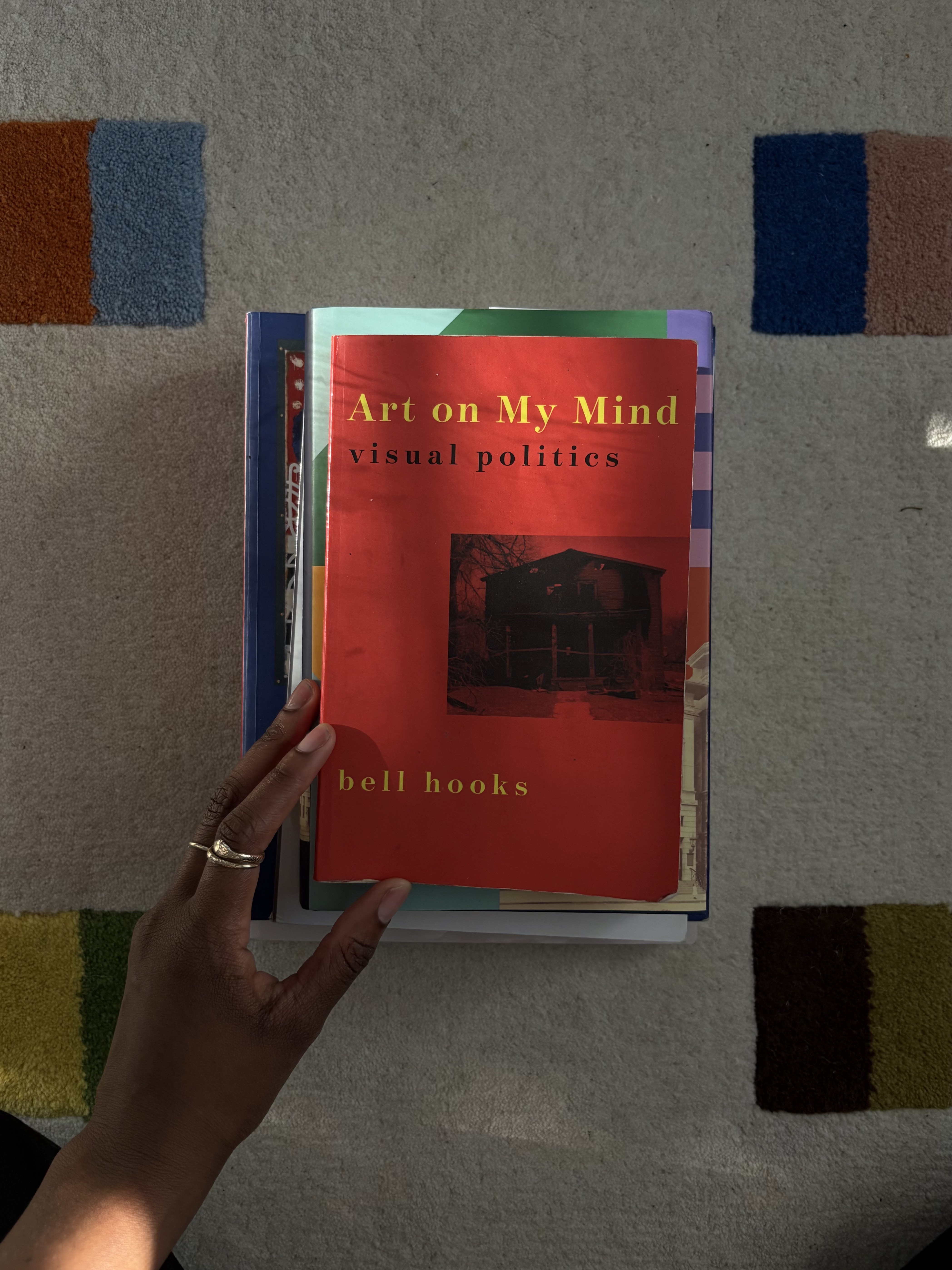
Author’s hand caressing the cover of her copy of Art on My Mind
1. bell hooks, “Art on My Mind,” in Art on My Mind: Visual Politics (The New Press, 1995), 3.
2. Ibid, 4. Italics added by author.
3. Michele Wallace, “‘Why Are There No Great Black Artists?’ The Problem of Visuality in African-American Culture,” in Black Popular Culture, ed. Gina Dent (Bay Press, 1992), quoted in bell hooks, “Introduction: Art Matters,” in Art on My Mind: Visual Politics, xvi.
2. Ibid, 4. Italics added by author.
3. Michele Wallace, “‘Why Are There No Great Black Artists?’ The Problem of Visuality in African-American Culture,” in Black Popular Culture, ed. Gina Dent (Bay Press, 1992), quoted in bell hooks, “Introduction: Art Matters,” in Art on My Mind: Visual Politics, xvi.
Re-membering Art on My Mind, bell hooks, and Dollbaby
One thing I know to be true is that bell hooks enters your life when you are on the verge of transformation.
When I longed to more fully inhabit my Black womanness, Sisters of the Yam appeared. When I craved to teach with greater tenderness, Teaching to Transgress arrived. When I needed to learn the art of loving myself and others, All About Love was waiting.
This year, for the first time, I have dared to call myself an artist. So it feels inevitable that Art on My Mind: Visual Politics landed in my lap, bringing together two ancestors who have shaped my sense of self close: hooks herself and my auntie Joyce Elem.
Joyce, known in our family as Dollbaby for her youthful beauty and sweetness, was born in 1952—the same year as hooks. While hooks was conjuring this book of essays and interviews about Black art, imagination, and the politics of representation, Dollbaby was out in the world living it: creating, organizing, and nurturing Black artistic life. Maybe she even read hooks herself. I like to imagine she did.
Dollbaby died of pancreatic cancer in 1999, at just forty-seven. I was fourteen. As I grew into myself, my family kept returning to the same refrain: You are just like Dollbaby. For years, I thought they were referring to the free spirit we shared and our mutual hunger for travel, books, sister-friends, and all things Black. I heard free spirit. It never occurred to me that they might have been naming something else, and it was Art on My Mind that changed the frame. While my family never used the word artist, I do believe they had been recognizing that sensibility in both Dollbaby and I all along. Art was not separate from Dollbaby’s freedom; it was one of the ways she practiced it. Likewise, what I understand as freedom forms an artistic way of being.
It was hooks’s dialogue with Alison Saar that helped me understand the similarities my family had been noticing. Reflecting on the artistic legacy Saar received from her parents, hooks describes “a thread that’s woven through our lives that pulls us toward things.”1 My family had placed that same thread in my hands, carried through images, objects, and stories. By refusing to let death erase Dollbaby, they led me toward her—and, inevitably, toward myself.
They pressed pieces of her life into my hands: beaded earrings from distant lands, a wooden sculpture by sacred geometrist Vandorn Hinnant, a cognac-gold Nefertiti watch, and a deep purple leather binder, lovingly assembled by her friends, heavy with photographs, letters, and mementos from decades of community building in Winston-Salem, North Carolina—or what folklorist Michelle Lanier calls AfroCarolina. Inside that regal binder is my favorite photograph of her.
When I longed to more fully inhabit my Black womanness, Sisters of the Yam appeared. When I craved to teach with greater tenderness, Teaching to Transgress arrived. When I needed to learn the art of loving myself and others, All About Love was waiting.
This year, for the first time, I have dared to call myself an artist. So it feels inevitable that Art on My Mind: Visual Politics landed in my lap, bringing together two ancestors who have shaped my sense of self close: hooks herself and my auntie Joyce Elem.
Joyce, known in our family as Dollbaby for her youthful beauty and sweetness, was born in 1952—the same year as hooks. While hooks was conjuring this book of essays and interviews about Black art, imagination, and the politics of representation, Dollbaby was out in the world living it: creating, organizing, and nurturing Black artistic life. Maybe she even read hooks herself. I like to imagine she did.
Dollbaby died of pancreatic cancer in 1999, at just forty-seven. I was fourteen. As I grew into myself, my family kept returning to the same refrain: You are just like Dollbaby. For years, I thought they were referring to the free spirit we shared and our mutual hunger for travel, books, sister-friends, and all things Black. I heard free spirit. It never occurred to me that they might have been naming something else, and it was Art on My Mind that changed the frame. While my family never used the word artist, I do believe they had been recognizing that sensibility in both Dollbaby and I all along. Art was not separate from Dollbaby’s freedom; it was one of the ways she practiced it. Likewise, what I understand as freedom forms an artistic way of being.
It was hooks’s dialogue with Alison Saar that helped me understand the similarities my family had been noticing. Reflecting on the artistic legacy Saar received from her parents, hooks describes “a thread that’s woven through our lives that pulls us toward things.”1 My family had placed that same thread in my hands, carried through images, objects, and stories. By refusing to let death erase Dollbaby, they led me toward her—and, inevitably, toward myself.
They pressed pieces of her life into my hands: beaded earrings from distant lands, a wooden sculpture by sacred geometrist Vandorn Hinnant, a cognac-gold Nefertiti watch, and a deep purple leather binder, lovingly assembled by her friends, heavy with photographs, letters, and mementos from decades of community building in Winston-Salem, North Carolina—or what folklorist Michelle Lanier calls AfroCarolina. Inside that regal binder is my favorite photograph of her.
.jpg)
SASSY Ladies Book Club Meeting (Dollbaby)
She’s sitting barefoot on a cream couch at the center of a warm, wood-paneled room, her toes gently brushing the carpet. Her sister-friends gather around her, glowing in shades of marigold and honeybee yellow. Books and papers are scattered across their laps and the coffee table. In front of her, an ebony bust of a Black woman rises—her braided crown, full mouth, and proud nose reflect the faces in the room. What strikes me most is that Dollbaby isn’t posed beside the art. She’s mid-thought, fully present inside it.
Throughout Art on My Mind, hooks argues that Black visual politics have long been forged in rooms like this—spaces where Black people construct images of ourselves beyond the white, colonizing gaze. She reminds us that imagination is among the first things domination seeks to possess. At the heart of the book is a vital question: What becomes possible when Black people refuse to surrender ours?
By day, Dollbaby was a financial analyst at R.J. Reynolds. She called the arts and theatre mere “enjoyments,” but by every other measure, they were her calling. A natural organizer, she presided over the SASSY (Sophisticated, Artistic, Spiritual, Stylish, Youthful) Ladies Book Club, served as treasurer of the North Carolina Black Repertory Company, and coordinated volunteers for the National Black Theatre Festival for eight years. She traveled the world collecting art, loved the written word, and shared her creative eye with Black-led efforts. She also mentored young people as a Big Sister, passing on her love of art and culture. As she told the Winston-Salem Chronicle, “we have to foster the growth of our youth.”2
Before reading Art on My Mind, I would not have called Dollbaby an artist. Now I wonder why I trusted the title on her paycheck more than the evidence of her life. Throughout the text, hooks refuses the idea that art is only what gets professionalized, exhibited, or sold. She finds it in looking, collecting, arranging, gathering, dreaming—in the daily work of making beauty manifest. Likewise, for Dollbaby, her art was the world she made possible—and the room she made for others inside it.
Once I saw Dollbaby clearly by way of hooks’s book, I saw the women who came before her too—my great-grandmother Jewel Elem coaxing an award-winning garden from Alabama’s red clay, my grandmother Lois Elem hand-stitching a quilt for every grandchild before college. In my family, beauty was never frivolous. It was how we transformed the terms of living.
Still, when I said I wanted to be a poet, my family urged me to be practical—teach English, earn a living, write on the side. So for nearly two decades, I did. My African imagination followed me into institutions, where I created spaces for other people to dream. But there, imagination had to be translated into programs, partnerships, deliverables, and outcomes. I learned to treat my own artistic practice as something to reach for only after the “real” work was done. I resented that order, even as I kept obeying it.
Somewhere in the margins of Art on My Mind, I scribbled: 700,000 Black women pushed out of the workforce. Last year, I became one of them. Having my livelihood pulled out from under me was frightening. But beneath the fear was something I was almost afraid to admit: I felt free.
hooks writes of art as a place where we learn what it means to be sovereign. Without an institution to name me, I was suddenly given what the creative process had always demanded of me: time. With it returned a question Nikky Finney posed in her National Book Award acceptance speech: “What about the possibility of one day making a poem?”
“Poem” here is not just literal. The question is larger: What if I shaped my life around imagination, instead of squeezing it in at the edges?
In writing about Lorna Simpson’s Waterbearer (1986), hooks considers the Black woman as “the keeper of history, the griot.”3 Simpson’s vinyl lettering reads: “They asked her to tell what happened, only to discount her memory.” Dollbaby and I are both Aquarians—the water bearers. I smile at the coincidence, but I take the task seriously: I will not discount her memory.
And because of bell, I now look differently at that photograph of Dollbaby in her glory. What I once saw as a family keepsake is also an image of inheritance—a blueprint for claiming the artist in myself. hooks writes that “the word remember (re-member) evokes the coming together of severed parts, fragments becoming a whole.”4 That is what I am doing now: re-membering Dollbaby.
I am no longer satisfied with simply seeing her; I want to know her whole, beyond the corporate title that made her life legible, without separating work from pleasure or profession from art. I want to know Dollbaby as Dollbaby—the absolute authority of her own life.
“To want to know is to transgress,” hooks writes. “To tell the truth is to transgress.”5
In conversation with hooks, Carrie Mae Weems proclaims, “I’m an artist trying to figure out how to do this shit.”6
Me too, I think. Dollbaby as well.
The thread my family placed in my hands all those years ago pulls taut.
You are just like Dollbaby.
I give thanks.
Throughout Art on My Mind, hooks argues that Black visual politics have long been forged in rooms like this—spaces where Black people construct images of ourselves beyond the white, colonizing gaze. She reminds us that imagination is among the first things domination seeks to possess. At the heart of the book is a vital question: What becomes possible when Black people refuse to surrender ours?
By day, Dollbaby was a financial analyst at R.J. Reynolds. She called the arts and theatre mere “enjoyments,” but by every other measure, they were her calling. A natural organizer, she presided over the SASSY (Sophisticated, Artistic, Spiritual, Stylish, Youthful) Ladies Book Club, served as treasurer of the North Carolina Black Repertory Company, and coordinated volunteers for the National Black Theatre Festival for eight years. She traveled the world collecting art, loved the written word, and shared her creative eye with Black-led efforts. She also mentored young people as a Big Sister, passing on her love of art and culture. As she told the Winston-Salem Chronicle, “we have to foster the growth of our youth.”2
Before reading Art on My Mind, I would not have called Dollbaby an artist. Now I wonder why I trusted the title on her paycheck more than the evidence of her life. Throughout the text, hooks refuses the idea that art is only what gets professionalized, exhibited, or sold. She finds it in looking, collecting, arranging, gathering, dreaming—in the daily work of making beauty manifest. Likewise, for Dollbaby, her art was the world she made possible—and the room she made for others inside it.
Once I saw Dollbaby clearly by way of hooks’s book, I saw the women who came before her too—my great-grandmother Jewel Elem coaxing an award-winning garden from Alabama’s red clay, my grandmother Lois Elem hand-stitching a quilt for every grandchild before college. In my family, beauty was never frivolous. It was how we transformed the terms of living.
Still, when I said I wanted to be a poet, my family urged me to be practical—teach English, earn a living, write on the side. So for nearly two decades, I did. My African imagination followed me into institutions, where I created spaces for other people to dream. But there, imagination had to be translated into programs, partnerships, deliverables, and outcomes. I learned to treat my own artistic practice as something to reach for only after the “real” work was done. I resented that order, even as I kept obeying it.
Somewhere in the margins of Art on My Mind, I scribbled: 700,000 Black women pushed out of the workforce. Last year, I became one of them. Having my livelihood pulled out from under me was frightening. But beneath the fear was something I was almost afraid to admit: I felt free.
hooks writes of art as a place where we learn what it means to be sovereign. Without an institution to name me, I was suddenly given what the creative process had always demanded of me: time. With it returned a question Nikky Finney posed in her National Book Award acceptance speech: “What about the possibility of one day making a poem?”
“Poem” here is not just literal. The question is larger: What if I shaped my life around imagination, instead of squeezing it in at the edges?
In writing about Lorna Simpson’s Waterbearer (1986), hooks considers the Black woman as “the keeper of history, the griot.”3 Simpson’s vinyl lettering reads: “They asked her to tell what happened, only to discount her memory.” Dollbaby and I are both Aquarians—the water bearers. I smile at the coincidence, but I take the task seriously: I will not discount her memory.
And because of bell, I now look differently at that photograph of Dollbaby in her glory. What I once saw as a family keepsake is also an image of inheritance—a blueprint for claiming the artist in myself. hooks writes that “the word remember (re-member) evokes the coming together of severed parts, fragments becoming a whole.”4 That is what I am doing now: re-membering Dollbaby.
I am no longer satisfied with simply seeing her; I want to know her whole, beyond the corporate title that made her life legible, without separating work from pleasure or profession from art. I want to know Dollbaby as Dollbaby—the absolute authority of her own life.
“To want to know is to transgress,” hooks writes. “To tell the truth is to transgress.”5
In conversation with hooks, Carrie Mae Weems proclaims, “I’m an artist trying to figure out how to do this shit.”6
Me too, I think. Dollbaby as well.
The thread my family placed in my hands all those years ago pulls taut.
You are just like Dollbaby.
I give thanks.
.jpg)
Photograph of Stevona's copy of Art on My Mind
1. bell hooks, “Talking Art with Alison Saar,” in Art on My Mind: Visual Politics (The New Press, 1995), 31.
2. Samantha McKenzie, “NC Black Theater volunteers dedicate time and support: Believing in the continuance of black theater in Winston-Salem,” Winston-Salem Chronicle, January 30, 1992. https://newspapers.digitalnc.org/lccn/sn85042324/1992-01-30/ed-1/seq-34/#words=Elem+Joyce.
3. hooks, “Facing Difference: The Black Female Body,” in Art on My Mind: Visual Politics, 94.
4. hooks, “In Our Glory: Photography and Black Life,” in Art on My Mind: Visual Politics, 64.
5. hooks, “Being the Subject of Art,” in Art on My Mind: Visual Politics, 134–135.
6. hooks, “Talking Art with Carrie Mae Weems,” in Art on My Mind: Visual Politics, 92.
2. Samantha McKenzie, “NC Black Theater volunteers dedicate time and support: Believing in the continuance of black theater in Winston-Salem,” Winston-Salem Chronicle, January 30, 1992. https://newspapers.digitalnc.org/lccn/sn85042324/1992-01-30/ed-1/seq-34/#words=Elem+Joyce.
3. hooks, “Facing Difference: The Black Female Body,” in Art on My Mind: Visual Politics, 94.
4. hooks, “In Our Glory: Photography and Black Life,” in Art on My Mind: Visual Politics, 64.
5. hooks, “Being the Subject of Art,” in Art on My Mind: Visual Politics, 134–135.
6. hooks, “Talking Art with Carrie Mae Weems,” in Art on My Mind: Visual Politics, 92.

Jessica Lynne is a writer, editor, and art critic. She is a founding editor of ARTS.BLACK, an online journal of art criticism from Black perspectives. Her writing has been featured in publications such as Artforum, The Believer, Frieze, The Los Angeles Times, The Nation, and Oxford American. Jessica is a recipient of a 2025 Rabkin Prize which celebrates the creative and intellectual contributions of visual arts writers, and was host of the limited-series podcast, Harlem is Everywhere. She is currently the editorial director of The Black Embodiments Studio.
Alongside Taylor Renee Aldridge, she is co-editor of the forthcoming publication, Situation Critical: A Century of Black Arts Criticism which will be co-published by ARTS.BLACK and CARA (Center for Art, Research, and Alliances) in Spring 2027.
Photo by Laurent Chevalier
Alongside Taylor Renee Aldridge, she is co-editor of the forthcoming publication, Situation Critical: A Century of Black Arts Criticism which will be co-published by ARTS.BLACK and CARA (Center for Art, Research, and Alliances) in Spring 2027.
Photo by Laurent Chevalier

Amarie Cemone Gipson is a Houston-based cultural worker dedicated to fostering literacy around Black art and cultural production through critical writing, librarianship, and public programming. She has held curatorial assistant and fellowship positions at several American art institutions, including The Studio Museum in Harlem, the Art Institute of Chicago, and the Museum of Fine Arts, Houston. A published writer and editor, she received AICA-USA’s Irving Sandler Award for New Voices in Art Criticism in 2024. Gipson is the founder of The Reading Room HTX, an independent reference library and site for intellectual gathering based in Houston, Texas. Anchored by a growing collection of 1,000+ books on Black visual art and culture, the library hosts free educational programs designed to promote visual literacy, foster critical thinking, and nurture curiosity.
Photo by Ashton Holmes
Photo by Ashton Holmes

Stevona Elem-Rogers (Stevie, like Wonder!) is a writer, educator, and cultural worker bearing witness to Black life with tenderness, clarity, and the South rolling off her tongue. Raised in Titusville, a Birmingham neighborhood founded by self-emancipated people, she was shaped by beautifiers, storytellers, and grassroots strategists whose freedom dreams still guide her work. She is the founder of Black Women Are For Grown-Ups, a social arts project championed by Nikki Giovanni and Sonia Sanchez that honors Black women’s full humanity, and the author of its companion chapbook, BWAFGU., archived at the Amistad Research Center. She co-founded Black Education for New Orleans and Black Is Brilliant, a Harvard-recognized ecosystem celebrating Black educators as creative and intellectual leaders. Her writing has appeared in The New York Times,i-D, and her Essence cover story “Dear New Orleans” marked the Essence Festival’s 30th anniversary. For two decades, she has been writing, world-building, and wobblin’ to Cash Money Records in New Orleans.
Photo by Ryan "phlegm" Gilbert
Photo by Ryan "phlegm" Gilbert
