What becomes notable when Libra charts are refracted through the sign’s analytical reservoirs?
Libra (September 23–October 22) is the seventh sign in the zodiac. With the planet Venus as its ruler and the scales of justice as its symbol, Libra is attributed meanings related to ethics (such as justice, balance, symmetry, fairness) and to aesthetics (such as beauty, harmony, diplomacy, charm), and is associated with partnership, relationships, and equilibrium. Below, I experiment with the meanings associated with the sign by reading the birth charts of John Coltrane, Amiri Baraka, and Faith Ringgold all of whom were born under a Libra sun) through a methodology that merges four analytical reservoirs: cosmological, figural, elemental, and numerical correspondences.
Reading Libra charts through these four reservoirs obtains a more complex description than the usual take on Libra types. Each reservoir approaches Libra from a distinct region of signification; but rather than try to combine them to produce a unified interpretation, I look for how they refract the chart in such a way that attends to how other features of the chart inflect the Libra associations.
Cosmologically: Here the referents are female figures from three cosmologies, namely Themis (the Greek goddess of Justice), Venus (the Roman goddess of Beauty), and Ọ̀ṣun (the Yorùbá Ọ̀rìṣà of Generativity): Themis, who can be related to the Roman goddess Iustitia, names an order under which relations, action, judgement, obligation, and distributions acquire a proper form. Venus, the Roman equivalent to the Greek Aphrodite, named the goddess of love and beauty, is associated with fertility, harmony, generativity, attraction, and relation. Ọ̀ṣun, the Yorùbá goddess, is associated with fertility, childbirth, sexuality, beauty, prosperity, diplomacy, intelligence, healing, divination, political and social efficacy, as well as water and sweetness.
Elementally: Learning, thinking, and exchanging ideas are traditionally considered the correspondences for air signs. Each air sign, however, represents a distinct moment in the act of thinking. Each represents a distinct moment in the act of thinking. The first is the gathering and communication of ideas (Gemini), the second is the relating and considering of what has been gathered (Libra), and the third is the integration and abstraction of those ideas (Aquarius). From this perspective, the traits associated with Libra gain another significance: they become descriptors for the process of thinking itself. Here I have in mind how the image of the scale invites us to consider things in relation to one another, to measure each singular thing by another singular thing, and not against a universal metric. In this sense, then, we consider how Libra’s relating and considering can at times operate like Gemini (gathering and communicating ideas) and at others like Aquarius (integrating and abstracting ideas). . Furthermore, the keywords typically associated with Libra (equity, beauty, harmony) can be approached as corresponding to modalities of thinking in relation, such as judging, appreciating, and reconciling.
Figurally: The focus here is on how the chart itself looks from the perspective of the astrologer. Libra sits at the beginning of the top half of the astrological chart, directly opposite Aries, the first cardinal sign. It is difficult not to read into this positioning what can unfold with respect to relationships and partnerships—well, dualities in general. If you read the chart as the unfolding of a trajectory, in Libra the event or existent under analysis enters the relational dimension of existence, and finds itself once more existent among others. One-on-one partnerships or relationships are the first instance of the collective moment and given the face-to-face set up—in which themes like position, orientation, encounter, and confrontation are crucial—the need for balance, for taking the other person(s) into account when considering what to do or say also becomes vital.
Numerically: As the seventh and a cardinal sign, one would expect Libra to be read as a signifier of the many spiritual associations of the number seven. In Western numerology, it is associated with analysis, investigation, solitude, contemplation, hidden knowledge, philosophy, research, spirituality. The general meaning is about the search for what is not immediately apparent. This association with the different modalities of knowing, such as intuition and investigation or understanding and contemplation, coheres well with the elemental correspondences of Libra.
So, what becomes notable when John Coltrane’s, Amiri Baraka’s, and Faith Ringgold’s charts are refracted through these four reservoirs?
Reading Libra charts through these four reservoirs obtains a more complex description than the usual take on Libra types. Each reservoir approaches Libra from a distinct region of signification; but rather than try to combine them to produce a unified interpretation, I look for how they refract the chart in such a way that attends to how other features of the chart inflect the Libra associations.
Cosmologically: Here the referents are female figures from three cosmologies, namely Themis (the Greek goddess of Justice), Venus (the Roman goddess of Beauty), and Ọ̀ṣun (the Yorùbá Ọ̀rìṣà of Generativity): Themis, who can be related to the Roman goddess Iustitia, names an order under which relations, action, judgement, obligation, and distributions acquire a proper form. Venus, the Roman equivalent to the Greek Aphrodite, named the goddess of love and beauty, is associated with fertility, harmony, generativity, attraction, and relation. Ọ̀ṣun, the Yorùbá goddess, is associated with fertility, childbirth, sexuality, beauty, prosperity, diplomacy, intelligence, healing, divination, political and social efficacy, as well as water and sweetness.
Elementally: Learning, thinking, and exchanging ideas are traditionally considered the correspondences for air signs. Each air sign, however, represents a distinct moment in the act of thinking. Each represents a distinct moment in the act of thinking. The first is the gathering and communication of ideas (Gemini), the second is the relating and considering of what has been gathered (Libra), and the third is the integration and abstraction of those ideas (Aquarius). From this perspective, the traits associated with Libra gain another significance: they become descriptors for the process of thinking itself. Here I have in mind how the image of the scale invites us to consider things in relation to one another, to measure each singular thing by another singular thing, and not against a universal metric. In this sense, then, we consider how Libra’s relating and considering can at times operate like Gemini (gathering and communicating ideas) and at others like Aquarius (integrating and abstracting ideas). . Furthermore, the keywords typically associated with Libra (equity, beauty, harmony) can be approached as corresponding to modalities of thinking in relation, such as judging, appreciating, and reconciling.
Figurally: The focus here is on how the chart itself looks from the perspective of the astrologer. Libra sits at the beginning of the top half of the astrological chart, directly opposite Aries, the first cardinal sign. It is difficult not to read into this positioning what can unfold with respect to relationships and partnerships—well, dualities in general. If you read the chart as the unfolding of a trajectory, in Libra the event or existent under analysis enters the relational dimension of existence, and finds itself once more existent among others. One-on-one partnerships or relationships are the first instance of the collective moment and given the face-to-face set up—in which themes like position, orientation, encounter, and confrontation are crucial—the need for balance, for taking the other person(s) into account when considering what to do or say also becomes vital.
Numerically: As the seventh and a cardinal sign, one would expect Libra to be read as a signifier of the many spiritual associations of the number seven. In Western numerology, it is associated with analysis, investigation, solitude, contemplation, hidden knowledge, philosophy, research, spirituality. The general meaning is about the search for what is not immediately apparent. This association with the different modalities of knowing, such as intuition and investigation or understanding and contemplation, coheres well with the elemental correspondences of Libra.
So, what becomes notable when John Coltrane’s, Amiri Baraka’s, and Faith Ringgold’s charts are refracted through these four reservoirs?
John Coltrane—Hamlet, North Carolina, on September 23, 1926, 5PM EDT
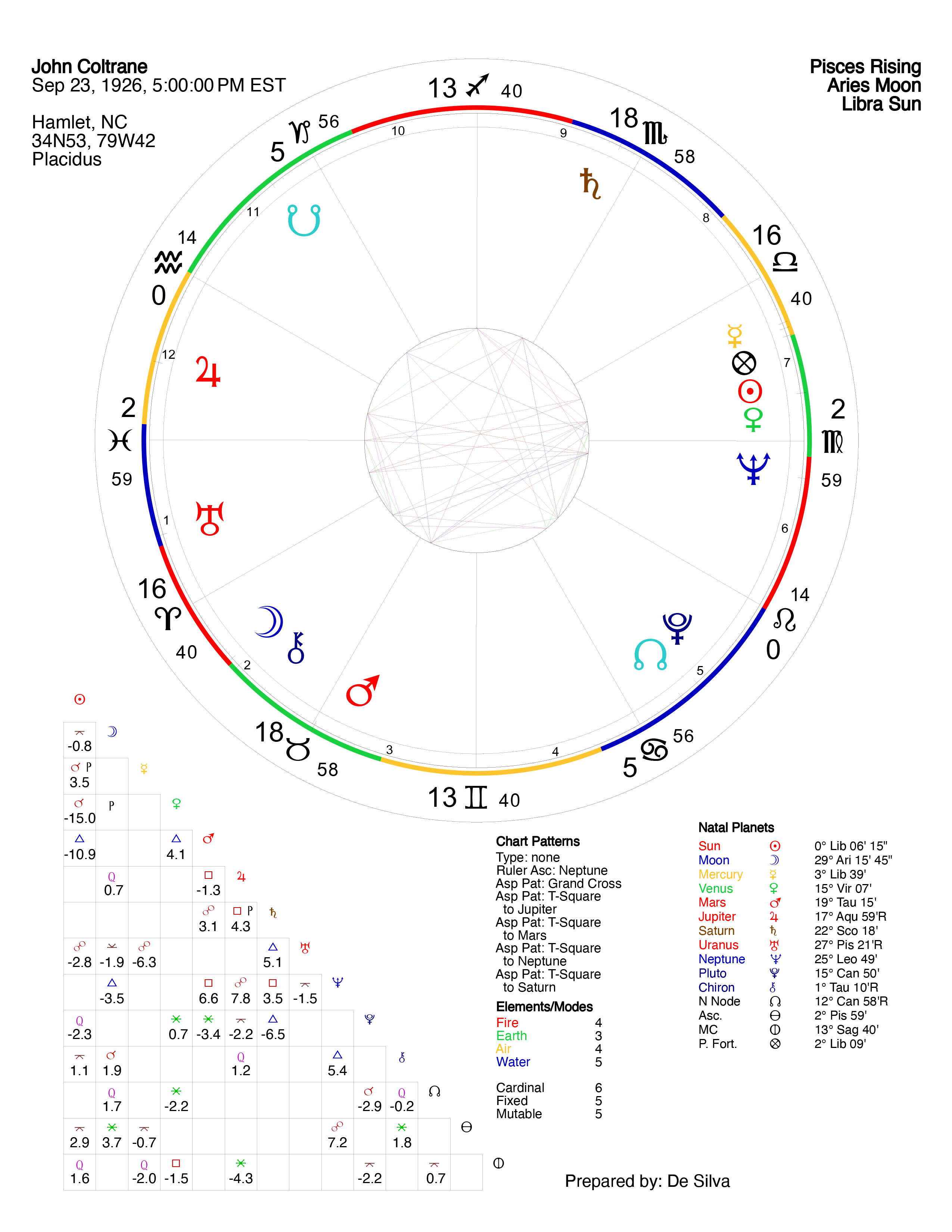
Charts prepared by author using TimePassages © 2026 AstroGraph Software, Inc. All rights reserved.
If I had to choose a Libra descriptor for him, it would be Harmony. Important here is not only that Coltrane is a Libra Sun, but also that the latter and its ruler, Venus, are in the 7th house of committed partnerships. His busy 7th house suggests a propensity for the handling of unbearable tensions and contradictions. Cosmologically, features of his chart, such as Virgo on the cusp of the 7th house, where Venus, Sun, and Mercury are found, indicate something that could be called a careful, controlled, and painstaking approach to artistic creation with others. Though all three figures—Themis, Venus, and Ọ̀ṣun—resonate with this chart, Venus’s conjunction with the Sun in the 7th house makes Venus herself more prominent. Figurally, some features that facilitate that encounter operate as means for the actualization of Libra traits. Elementally, Libra’s Air qualities are at work, not in terms of relating ideas but in the very process of creation, in which relating and considering (7th house Venus and Sun) and integrating (Jupiter in Aquarius in the 12th house and Uranus in Pisces in the 1st house) operate. Numerically, his busy 7th house and other features of the chart (in particular the Pisces Ascendant) indicate the capacity to create, which manifests the points of tension (solitude / partnership, withdrawal / engagement, etc.) associated with the number 7. Harmonizing, which might as well be another name for ensemble improvisation, I find, captures his chart’s orientation.
Amiri Baraka (LeRoi Jones)—Newark, New Jersey, on October 7, 1934, 5:15AM EST
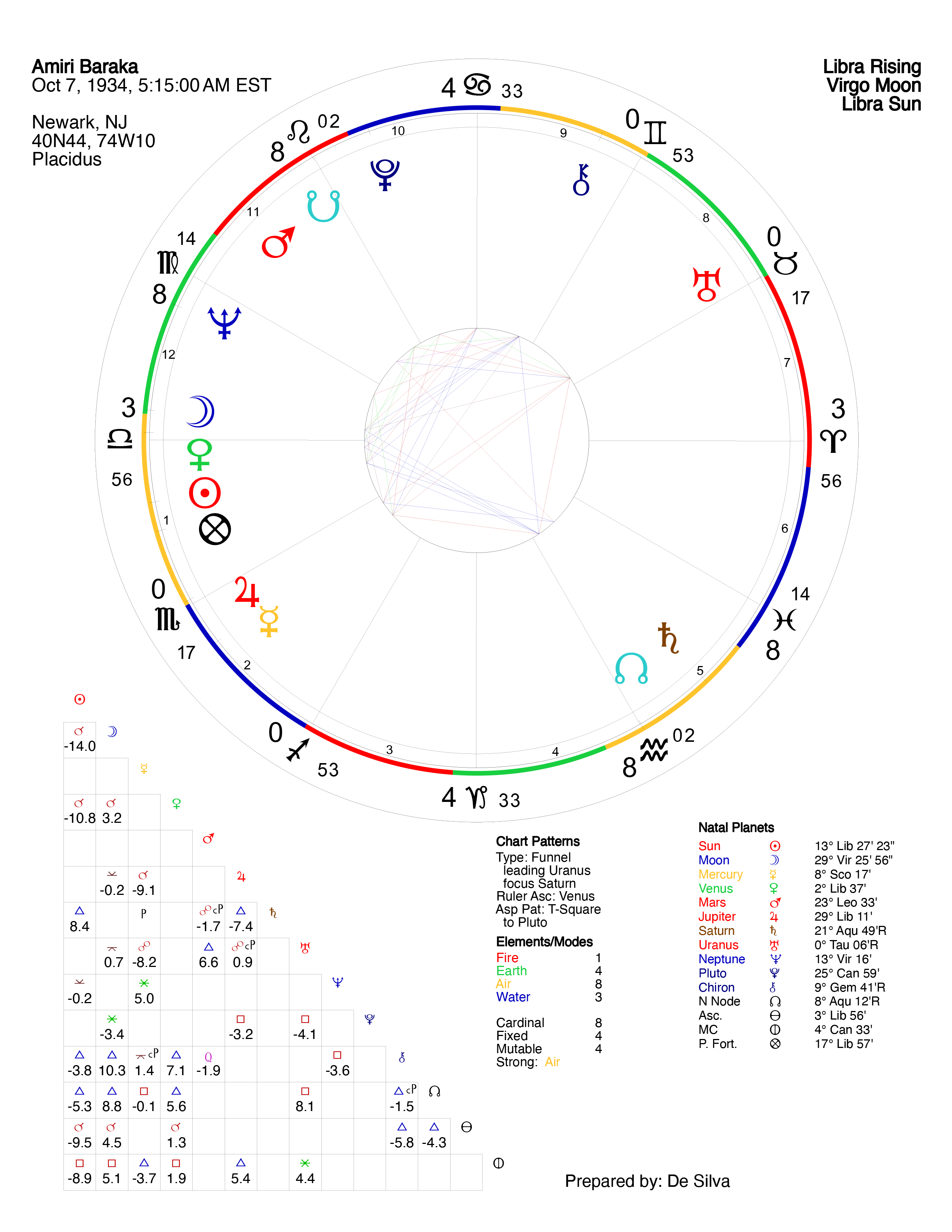
Charts prepared by author using TimePassages © 2026 AstroGraph Software, Inc. All rights reserved.
Equity, as signified by the Scales of Justice, is the hidden message in Baraka’s natal chart. That is the case because what Libra communicates about two existents in a relationship or partnership appears, here, as occurring in the one person. Cosmologically, it recalls all three key figures and forces: Themis is associated with political, anti-capitalist, and social justice-oriented work; Venus governs emotional connections (conjunct Moon) and appearance in the world (Ascendant); and Ọ̀ṣun (Jupiter in the 1st house) adds efficacy to the poetical and political creations. Elementally, Venus is at work, relating ideas through communicating (12th house Virgo Moon conjunct with the Libra Ascendant), which indicates someone with the ability to access collective emotional undercurrents at the most general level and manifest them through artistic presentation. That Baraka is a poet should not come as a surprise. Figurally, the key descriptor is confrontation, which I read in the T-Square involving Jupiter (Libra 1st house), Uranus (Taurus 7th house), and Pluto (Cancer 10th house), in which the key planet, Pluto, rules Scorpio (where Mercury the communicator is found), and as such connects with the Virgo Moon, which is ruled by Mercury. This would appear as verbal impulsiveness, provocative speech, and forthrightness. Numerically speaking, the points of tension which might distinguish between a charming and agreeable person and a cutting and contrary personality account for both Libra’s qualities and the number 7’s relation to understanding and investigation. A deeper consideration captures how Baraka’s Virgo Moon and Scorpio Mercury do not allow anything they scrutinize to remain standing or keep its material integrity.
Faith Ringgold—Harlem, New York, on October 8, 1930
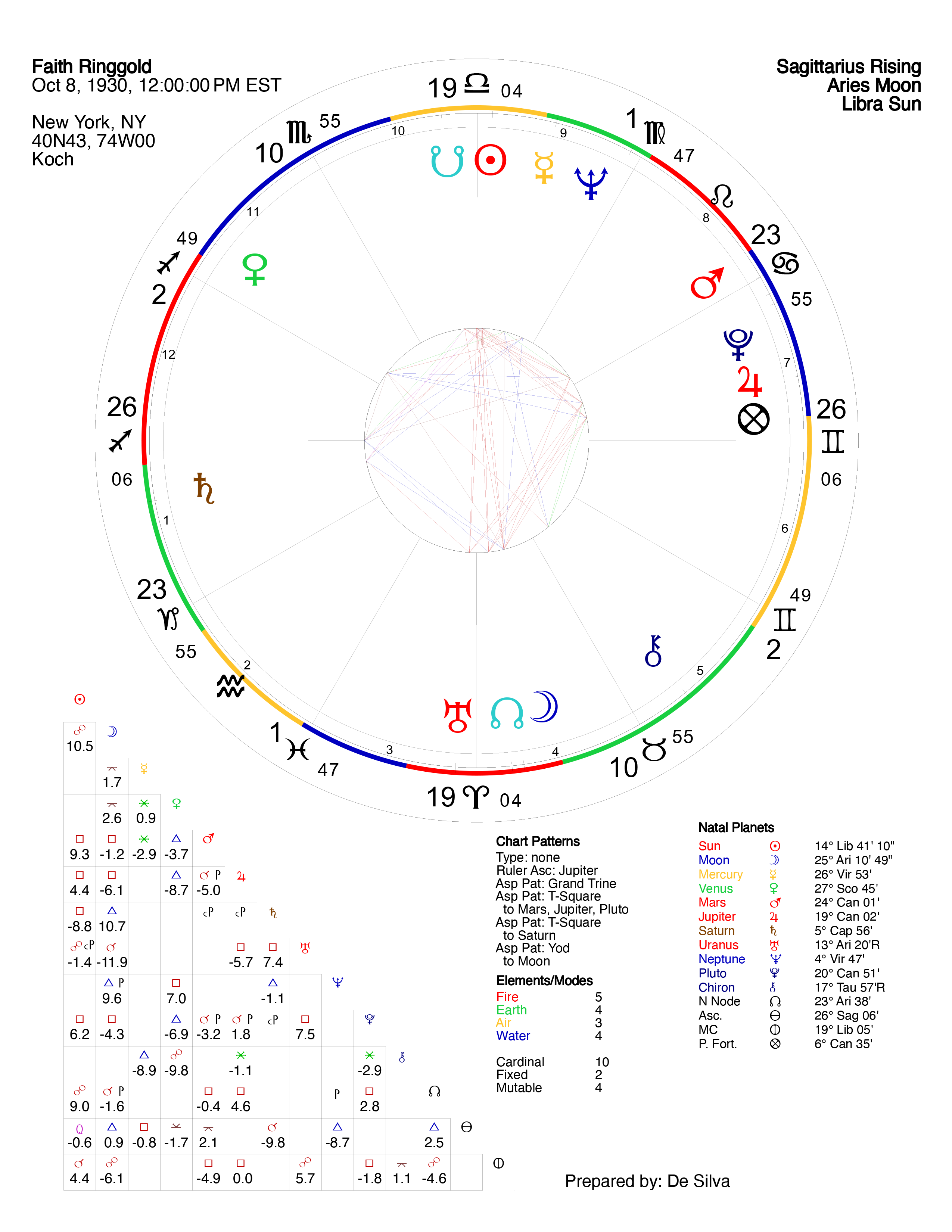
Charts prepared by author using TimePassages © 2026 AstroGraph Software, Inc. All rights reserved.
At the heart of Ringgold’s natal chart is the question: What if, instead of being that about which everyone tacitly agrees, beauty were the site of staging a confrontation with what it means and who’s got it? Cosmologically, Ọ̀ṣun is the figure that most immediately resonates with Ringgold’s placements precisely because of Ringgold’s efficacy in regard to a commitment to social justice (as exemplified not only by her artistic practice but also her organizing efforts), indicated by a Libra Sun opposed to an Aries Uranus and Aries Moon while squared with a Jupiter-Pluto conjunction. This configuration gives intensity, a refusal to yield to the conventional and an unwillingness to leave the underlying structures intact, particularly in relation to social injustices. Elementally, the Sun’s aspects indicate Libra’s task of relating through abstracting as well as innovating—Sun square Jupiter in Cancer suggests expansion and square Pluto, deepening, while the opposition to Uranus yields an intellectual orientation toward the new, unconventional, and progressive ideas and ideals. Figurally, Ringgold’s Scorpio Venus images a confrontation in which we have one (Venus) facing off with the main forces of the Zodiac (Moon, Mercury, Mars, Neptune, Pluto), to which it is opposed or squared. That opposition could occur at the level of form, content, or materials (such as Ringgold’s quilts, which are both stories and paintings). Lastly, through the numerical reservoir, Venus’s many conflations indicate an activation of one side of the points of tension—what can manifest as partnerships, relationships, and dealing with institutions—in which the intensity of the Scorpio Venus wins over the sign’s orientation to reconciliation and contemplation.

The artist and philosopher Denise Ferreira da Silva is the Samuel Rudin Professor in the Humanities and Co-Director of the Critical Racial & Anti-Colonial Study Co-Laboratory at New York University and adjunct professor at the Monash University School of Art, Architecture, and Design (Australia). Her artistic and academic work reflect and speculate on themes and questions crucial to contemporary philosophy, aesthetics, political theory, black thought, feminist thought, and historical materialism.
She is the author of Toward a Global Idea of Race (University of Minnesota Press, 2007), The Impagavel Divide (Workshop of Political Imagination and Living Commons, 2019), Unpayable Debt (Stenberg / MIT Press, 2022), and co-editor (with Paula Chakravartty) of Race, Empire, and the Crisis of the Subprime (Johns Hopkins University Press, 2013)
Her artwork includes the films Serpent Rain (2016), 4Waters-Deep Implicancy (2018), Soot Breath / Corpus Infinitum (2020), and Ancestral Claims/Ancestral Clouds (2023) in collaboration with Arjuna Neuman; and the relational artistic practices Poethical Readings and Sensing Salon, in collaboration with Valentina Desideri. She has performed shows and lectures in important artistic spaces, such as the Pompidou Centre (Paris), Whitechapel Gallery (London), MASP (São Paulo), Guggenheim (New York), and MoMa (New York). She also wrote and created for publications for major art events (Liverpool Biennale, 2017; São Paulo Biennale, 2016; 2023 Venice Biennale, 2017 and Documenta 14, São Paulo Biennale, 2023) and published in art spaces such as Canadian Art, Texte Zur Kunst, and E-Flux
Photo by Minco van der Weide
She is the author of Toward a Global Idea of Race (University of Minnesota Press, 2007), The Impagavel Divide (Workshop of Political Imagination and Living Commons, 2019), Unpayable Debt (Stenberg / MIT Press, 2022), and co-editor (with Paula Chakravartty) of Race, Empire, and the Crisis of the Subprime (Johns Hopkins University Press, 2013)
Her artwork includes the films Serpent Rain (2016), 4Waters-Deep Implicancy (2018), Soot Breath / Corpus Infinitum (2020), and Ancestral Claims/Ancestral Clouds (2023) in collaboration with Arjuna Neuman; and the relational artistic practices Poethical Readings and Sensing Salon, in collaboration with Valentina Desideri. She has performed shows and lectures in important artistic spaces, such as the Pompidou Centre (Paris), Whitechapel Gallery (London), MASP (São Paulo), Guggenheim (New York), and MoMa (New York). She also wrote and created for publications for major art events (Liverpool Biennale, 2017; São Paulo Biennale, 2016; 2023 Venice Biennale, 2017 and Documenta 14, São Paulo Biennale, 2023) and published in art spaces such as Canadian Art, Texte Zur Kunst, and E-Flux
Photo by Minco van der Weide
