Slivers of Existence
Eschatological (relating to death, judgment, and the final destiny of the soul and of humankind): It’s a word the late writer and artist, Greg Tate, used back in 2016 to describe Kanye West’s “Ultralight Beam” while assessing the spirit of his close friend Arthur Jafa’s career-shifting work Love is the Message, The Message is Death (2016). Jafa’s piece is a supercut of moments he saw as significant flashes of the Black American story: pre-fame Biggie Smalls freestyling on a Brooklyn corner, the LAPD’s brutal beatdown of Rodney King in 1991, voguing competitions, blackface actors in D.W. Griffith’s The Birth of a Nation, collective swag surf demonstrations, Bobby Seale, Beyoncé, Obama singing “Amazing Grace” at a funeral for the victims of Dylann Roof’s racialized terrorist attack in Charleston, South Carolina, and more. “There is at work here a poetic convergence of sublimated rage, lyrical image-making, ethnic Pop-ism, scar-tissued ‘fleshmemories’ and horrifically zeitgeist-citizen reporting,” Tate wrote. “A retelling of the myriad ways Black lives are victimized by state-sanctioned terrorism and yet somehow continue to resist with style, joy, sex, smarts, footwork and snark.” It’s the last time he publicly engaged with a new work from Jafa, his beloved brother of four decades.
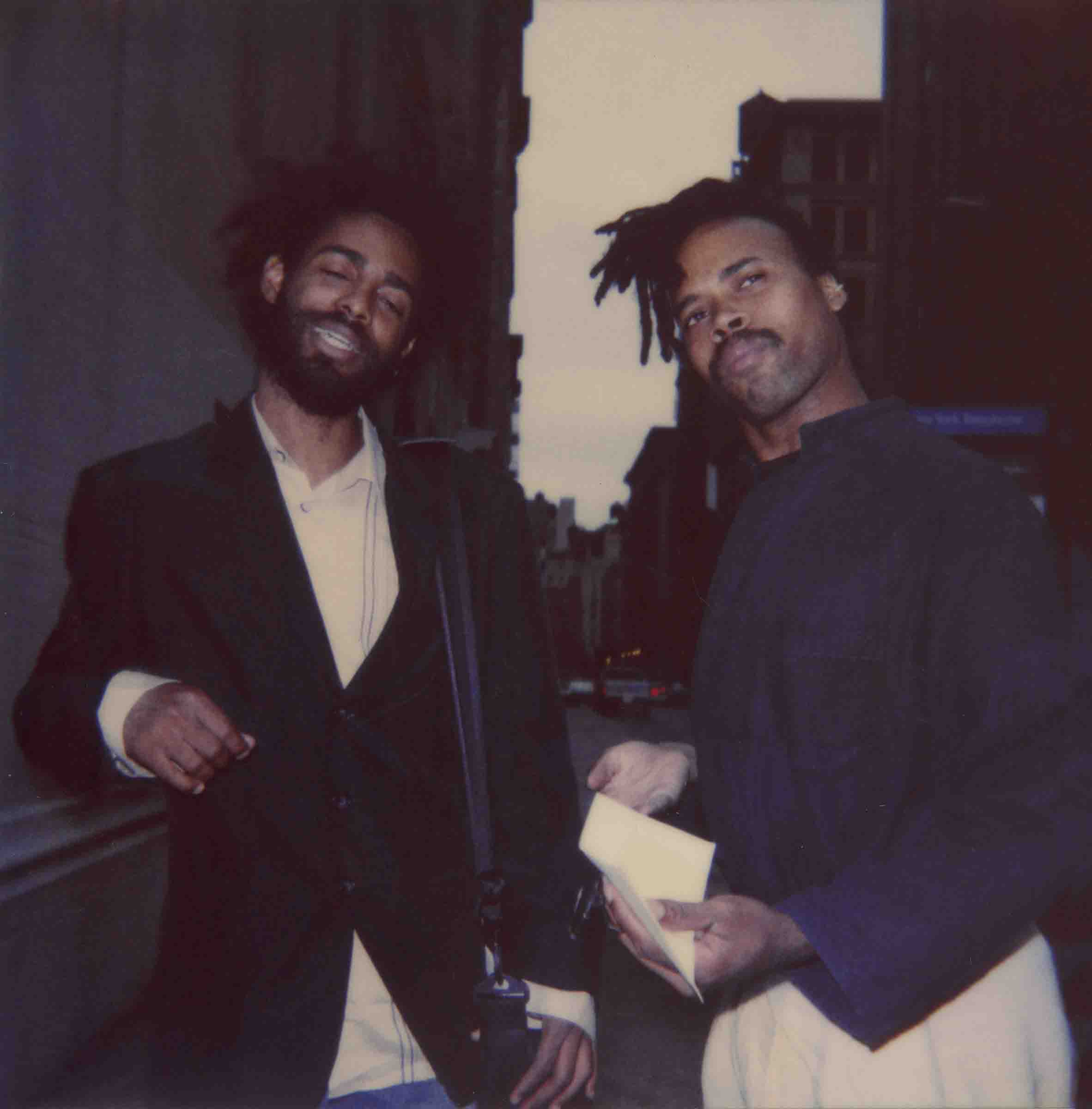
Arthur Jafa and Greg Tate
© Arthur Jafa. Courtesy of the artist.
© Arthur Jafa. Courtesy of the artist.
Five years later, in 2021, Tate passed away in New York City from reported cardiac arrest. From the early ’80s and on, he helped lay the foundation for how to substantively and stylistically approach music criticism, especially for Black writers of the hip-hop generation. He wrote in an old school jazz cat kind of voice descendant of the Blaxploitation films he enjoyed during his formative years, often acknowledging that he was the unc in the room trying to get a sense of what young people throughout the country were creating to contend with their subjugation and how that aligned (or didn’t) with Black artists from previous generations. He once lamented Michael Jackson’s post-Thriller music and physical transformation as a “loathsome conception of the black experience, you’re either a criminal stereotype or one of the Beautiful People. Having sold the world pure pop pleasure on Thriller, Jackson returns on Bad to sell his own race hatred.” He celebrated Public Enemy’s criticism of the American empire while calling them out for a narrow-minded fantasy of Black liberation which shunned queer people and settled for shortsighted antisemitism. And he embraced artists from The Continent like Nigeria’s King Sunny Adé as catalysts for Pan-African connectedness throughout the diaspora. As a young man trying to understand what an effective Black cultural critic looked and sounded like, he was a North Star—exceptional at walking the tightrope that is calling artists and their art into question while still being able to praise what they do well, with an endless well of reference material to contextualize it all. His wit and intellect may have contributed to his friendship with Jafa, but the two were acutely aware of each other’s genius way before the wider world took notice.
The two met—reluctantly at first—as students at Howard University but once they clicked in the late ’70s, Jafa said they didn’t go a day without speaking. While memorializing Tate during an interview on their mutual friend Helga Davis’s eponymous podcast in 2023, Jafa recalls the moment he was informed of his friend’s death: “My legs buckled under me. … At one point I was gonna say [he was] my soulmate but I was just like [he was] the straight up love of my life. … It made me think a lot about existence when he passed. I told my son, ‘I’ve come to the conclusion that life, as we understand it, is a narrowly dimensionalized sliver of existence.’” That is what’s largely explored in Jafa’s 2022 short film dedicated to Tate, aptly titled, LOML.
It’s best not to arrive at the tribute with expectations as I did. From what I know of Jafa’s work and process, he obsessively catalogs images from physical ephemera, publications, and social media. He’s made a practice from stitching together these finds—often in ways that wouldn’t align at first glance—to provoke and activate something cathartic in his audience. That’s what I, as a Tate fan, was looking for in LOML: never-before-seen footage of the writer perusing a scene from a film he liked or disliked, intimate photos of him as a father or grandfather rather than a public figure, secretly recorded phone conversations between him and Jafa shooting the shit. I thought those personal vignettes would have been interspersed with clips of performances from artists Tate admired, in true Jafa fashion. Maybe I was too prescriptive in my desires. LOML features none of those things, and it’s ultimately more transfixing for it. In its eleven minutes of runtime, you don’t really see anything. The screen remains largely black while miniature flashes of light periodically move through the frame. That light, in this context, feels akin to the “sliver of existence” Jafa told his son about upon Tate’s passing. But, for what it withholds visually, LOML, like Love is the Message, utilizes music as its emotional engine.
The two met—reluctantly at first—as students at Howard University but once they clicked in the late ’70s, Jafa said they didn’t go a day without speaking. While memorializing Tate during an interview on their mutual friend Helga Davis’s eponymous podcast in 2023, Jafa recalls the moment he was informed of his friend’s death: “My legs buckled under me. … At one point I was gonna say [he was] my soulmate but I was just like [he was] the straight up love of my life. … It made me think a lot about existence when he passed. I told my son, ‘I’ve come to the conclusion that life, as we understand it, is a narrowly dimensionalized sliver of existence.’” That is what’s largely explored in Jafa’s 2022 short film dedicated to Tate, aptly titled, LOML.
It’s best not to arrive at the tribute with expectations as I did. From what I know of Jafa’s work and process, he obsessively catalogs images from physical ephemera, publications, and social media. He’s made a practice from stitching together these finds—often in ways that wouldn’t align at first glance—to provoke and activate something cathartic in his audience. That’s what I, as a Tate fan, was looking for in LOML: never-before-seen footage of the writer perusing a scene from a film he liked or disliked, intimate photos of him as a father or grandfather rather than a public figure, secretly recorded phone conversations between him and Jafa shooting the shit. I thought those personal vignettes would have been interspersed with clips of performances from artists Tate admired, in true Jafa fashion. Maybe I was too prescriptive in my desires. LOML features none of those things, and it’s ultimately more transfixing for it. In its eleven minutes of runtime, you don’t really see anything. The screen remains largely black while miniature flashes of light periodically move through the frame. That light, in this context, feels akin to the “sliver of existence” Jafa told his son about upon Tate’s passing. But, for what it withholds visually, LOML, like Love is the Message, utilizes music as its emotional engine.
Arthur Jafa
LOML (52 Walker Version), 2024
Film Stills
© Arthur Jafa. Courtesy of the artist and Gladstone.
LOML (52 Walker Version), 2024
Film Stills
© Arthur Jafa. Courtesy of the artist and Gladstone.
Two songs do the talking for Jafa in the piece, both of which are distorted to create a slowed down, harrowing effect. The first is “Someone In The Dark,” a Michael Jackson song featured on the E.T. companion album in 1982. Jackson was obviously channeling a child (a repeated shield against allegations of his own transgressions that we’ll have to discuss another time) who developed a deep admiration for an alien. But when you swap him out for Jafa and E.T. out for Tate, lyrics like, “All alone wishing on stars / Waiting for you to find me / One sweet night, I knew I would see / A stranger who’d be my friend,” illustrate Jafa’s inclination that their connection was divine in nature. And while that’s playing, faint ad-libs and flashes of the hook from the Teddy Pendergrass-featuring “I Miss You” by Harold Melvin & The Blue Notes (1972) populate the space.
If you’re an early ’90s millennial like myself, your introduction to “I Miss You” may come from it being sampled on Jay-Z’s “This Can’t Be Life” in the year 2000—the first beat a then-unknown Kanye West provided Jay before becoming the troubled pop culture juggernaut whose work would add texture to Jafa’s artistic breakout nearly 20 years later. Though Harold Melvin & co’s initial motivation was alcohol-induced heartbreak, Kanye’s interpretation of a painful look in the rearview allowed Jay-Z the space to what-if his own success, placing himself back in a time where he thought he’d never get to realize his dreams of being a full-time artist. I can’t help but to imagine Jafa and Tate occasionally shared moments that made them nostalgic for their lives as early twentysomethings in D.C. with a burning desire to shake the world up, wondering if they’d ever actually make it happen—which only makes the void left in Tate’s absence more palpable.
The truth of it all, is that LOML is a haunting experience. After watching it on loop for about an hour, at times I thought I saw the dead stare of a lone eyeball looking back at me. At other points, a soul writhing through the frame. And, most times, nothing. But that feels like the most honest depiction of experiencing the loss of someone you couldn’t imagine life without. You might, as MJ sang on “Someone In The Dark,” look out into the stars for answers and the person you’re grieving could transmit a message back. A light in the room will flicker. A branch will fall off of a tree. Your eyes’ reaction to a shadow might create the illusion of someone being with you in an otherwise empty room. And sometimes you’re just left with yourself, the memories you have of them, and the sobering reality that they’re never coming back.
If you’re an early ’90s millennial like myself, your introduction to “I Miss You” may come from it being sampled on Jay-Z’s “This Can’t Be Life” in the year 2000—the first beat a then-unknown Kanye West provided Jay before becoming the troubled pop culture juggernaut whose work would add texture to Jafa’s artistic breakout nearly 20 years later. Though Harold Melvin & co’s initial motivation was alcohol-induced heartbreak, Kanye’s interpretation of a painful look in the rearview allowed Jay-Z the space to what-if his own success, placing himself back in a time where he thought he’d never get to realize his dreams of being a full-time artist. I can’t help but to imagine Jafa and Tate occasionally shared moments that made them nostalgic for their lives as early twentysomethings in D.C. with a burning desire to shake the world up, wondering if they’d ever actually make it happen—which only makes the void left in Tate’s absence more palpable.
The truth of it all, is that LOML is a haunting experience. After watching it on loop for about an hour, at times I thought I saw the dead stare of a lone eyeball looking back at me. At other points, a soul writhing through the frame. And, most times, nothing. But that feels like the most honest depiction of experiencing the loss of someone you couldn’t imagine life without. You might, as MJ sang on “Someone In The Dark,” look out into the stars for answers and the person you’re grieving could transmit a message back. A light in the room will flicker. A branch will fall off of a tree. Your eyes’ reaction to a shadow might create the illusion of someone being with you in an otherwise empty room. And sometimes you’re just left with yourself, the memories you have of them, and the sobering reality that they’re never coming back.

Lawrence Burney is a writer, editor, critic, and the founder of True Laurels, an independent magazine covering Baltimore’s music and culture scene. His work has appeared in publications such as New York Magazine, GQ, Washington Post, and Pitchfork. He has also held positions as an editor at The Fader, a staff writer at VICE, and an editor/reporter at The Baltimore Banner. His first book, No Sense in Wishing, a collection of essays, was published in July 2025 via Atria Books. No Sense In Wishing was named a Best Book of 2025 by Kirkus, The New Yorker, and New York Magazine. The book was also named the 2026 recipient of One Maryland One Book, a statewide collective reading initiative which places it in the hands of students, educators, and culture workers throughout Maryland. Burney’s second book Sing Back To Me—a narrative history and critical assessment of electronic dance music made across the Black Atlantic—will also be published by Atria Books in 2028. Burney can be found on Instagram and X @TrueLaurels.
Photo by SHAN Wallace
Photo by SHAN Wallace
