The black poetry of Yohji Yamamoto and Kerry James Marshall
Like so many people, I’ve long admired the work of Kerry James Marshall and Yohji Yamamoto and their glorious expressions of craft, artistry, and identity. Both men have opened my eyes to the complexity of being the subject of a stranger’s gaze. They have taught me a great deal about what it means to be regarded, not as part of a group or as an aside, but as a central character in the world’s story.
Both the artist and the designer reflect on the experience of moving through the world simultaneously invisible and under heightened scrutiny. Yet, biographically, these two creators could not be more unalike. Mr. Marshall entered this world in 1955 in Birmingham, Alabama; Mr. Yamamoto was born in Tokyo in 1943. With more than 5,000 miles separating them, one grew up in the thick of the Civil Rights movement with its still unrealized dreams and shattered hopes and the other came of age in the aftermath of the destruction wrought by World War II.
As a designer, Mr. Yamamoto has chosen black as the central element of his color palette. The hue invites sustained focus on the expressiveness of his clothes and the uniqueness of the wearers. Mr. Marshall paints his subjects in shades of inky black as a statement of individual identity, “to reveal things that are hidden; to see the unseen,” he has said. His lofty goal has been to wield the aesthetic language of Western portraiture to celebrate the beauty, power, and dignity of Black people, both extraordinary and mundane, who have historically and strategically been relegated to the edges of the frame—if they are there at all.
“What I’ve always strove to do… is to make work that at once acknowledged a debt to the work that had already been made, and at the same time, try to extend the dialogue, the discourse, in terms of representation in particular,” he continued, “so that it included and incorporated images of Blackness that operated at the same level, and with the same kind of power and sophistication.” My affection for Mr. Marshall’s work is less intellectual and more emotional. I’m drawn to the way he has distilled Blackness into something rich, mesmerizing, and unabashed. Blackness has depth and lyricism. His brushstrokes highlight how misguided it is to believe that people disappear in the shadows. They remain who they have always been. If we allow our gaze to adjust, those people come into focus.
At a glance, the people who populate Mr. Marshall’s paintings can appear flat, as though they have been depicted without nuance. I had that experience when I encountered an image from his Lost Boys series in 2022. He collaborated with designer Grace Wales Bonner and a detail from Lost Boys: AKA Black Sonny (1993) was reprinted on a T-shirt in support of Study and Struggle, a Mississippi-based collective fighting toward abolition. Initially, Black Sonny seemed little more than a few brushstrokes of black paint. But once I gave this portrait my time and care, my eyes calibrated to the complexity and painterly tenderness on display.
In each of Mr. Marshall’s compositions a truth is slowly revealed. His subjects are layered. They are compelling. They are splendid. Look closely and you can make out the texture of their intricately styled hair. Look closely and you can see the distinctive curve of a nose and the rise of full lips. In Mr. Marshall’s work, I see gentleness and audacity. I see Black men, women, and children at the center of cultural relevance. I see their unquestioned social standing. They are not merely featured in a painting; they fill the canvas. They are the stars, the bit players, and everything in between.
Both the artist and the designer reflect on the experience of moving through the world simultaneously invisible and under heightened scrutiny. Yet, biographically, these two creators could not be more unalike. Mr. Marshall entered this world in 1955 in Birmingham, Alabama; Mr. Yamamoto was born in Tokyo in 1943. With more than 5,000 miles separating them, one grew up in the thick of the Civil Rights movement with its still unrealized dreams and shattered hopes and the other came of age in the aftermath of the destruction wrought by World War II.
As a designer, Mr. Yamamoto has chosen black as the central element of his color palette. The hue invites sustained focus on the expressiveness of his clothes and the uniqueness of the wearers. Mr. Marshall paints his subjects in shades of inky black as a statement of individual identity, “to reveal things that are hidden; to see the unseen,” he has said. His lofty goal has been to wield the aesthetic language of Western portraiture to celebrate the beauty, power, and dignity of Black people, both extraordinary and mundane, who have historically and strategically been relegated to the edges of the frame—if they are there at all.
“What I’ve always strove to do… is to make work that at once acknowledged a debt to the work that had already been made, and at the same time, try to extend the dialogue, the discourse, in terms of representation in particular,” he continued, “so that it included and incorporated images of Blackness that operated at the same level, and with the same kind of power and sophistication.” My affection for Mr. Marshall’s work is less intellectual and more emotional. I’m drawn to the way he has distilled Blackness into something rich, mesmerizing, and unabashed. Blackness has depth and lyricism. His brushstrokes highlight how misguided it is to believe that people disappear in the shadows. They remain who they have always been. If we allow our gaze to adjust, those people come into focus.
At a glance, the people who populate Mr. Marshall’s paintings can appear flat, as though they have been depicted without nuance. I had that experience when I encountered an image from his Lost Boys series in 2022. He collaborated with designer Grace Wales Bonner and a detail from Lost Boys: AKA Black Sonny (1993) was reprinted on a T-shirt in support of Study and Struggle, a Mississippi-based collective fighting toward abolition. Initially, Black Sonny seemed little more than a few brushstrokes of black paint. But once I gave this portrait my time and care, my eyes calibrated to the complexity and painterly tenderness on display.
In each of Mr. Marshall’s compositions a truth is slowly revealed. His subjects are layered. They are compelling. They are splendid. Look closely and you can make out the texture of their intricately styled hair. Look closely and you can see the distinctive curve of a nose and the rise of full lips. In Mr. Marshall’s work, I see gentleness and audacity. I see Black men, women, and children at the center of cultural relevance. I see their unquestioned social standing. They are not merely featured in a painting; they fill the canvas. They are the stars, the bit players, and everything in between.

Kerry James Marshall, School of Beauty, School of Culture, 2012. Acrylic on canvas. © Kerry James Marshall. Courtesy the artist and David Zwirner, London
In his School of Beauty, School of Culture (2012, currently on view in Kerry James Marshall: The Histories at Musée d’Art Moderne de Paris until January 24, 2027), the figures are silhouetted against a raucous color palette of apple green walls, a tangerine floor, and heart-shaped mirrors outlined in gold filigree. And in the reflection of an upstage full-length mirror, there’s the flash of a camera. There are pictures within pictures within pictures. Black women primp and delight in their own image. They’re dolled up in formfitting striped trousers, cleavage-bearing shirts, vivid jackets, and heels that are made for posing rather than walking.
Everyone seems to be in some stage of joyful preparation, readying themselves for the public square. But for a time, in the intimate space of Mr. Marshall’s salon, they’re reveling in their own beauty—and their culture—without judgment or disclaimers. I appreciate his confidence, his determination, that his subject’s humanity requires no explanation. His kin will know what it means to fellowship at the beauty parlor. And those who don’t should be honored to have been offered a glimpse of the joy.
Just as Mr. Marshall has a rigorous understanding of his discipline, Mr. Yamamoto is well-versed in fashion history, particularly the Western canon that has guided designers for centuries. His knowledge of Christian Dior’s Bar jacket has allowed him to deconstruct it. His familiarity with bespoke suiting helped guide him down a path toward silhouettes that are loose and free, but not shapeless. He is a rebel and a rogue who tells colorful tales in shades of black.
“Black is modest and arrogant at the same time,” Mr. Yamamoto once said. “Black can swallow light, or make things look sharp. But above all black says this: ‘I don’t bother you—don't bother me!’” He was talking about fashion, of course, but I love the way his assessment of black captures both an aesthetic and an attitude. For Mr. Yamamoto, black was not mournful or sad. It was powerful and audacious. He was not subordinate to the long-standing ideas about what was desirable, valuable, or appropriate. When Mr. Yamamoto debuted as a designer in Paris in 1981, he came with his own history in fashion—a dedication passed along by his dressmaker mother and technical skills refined at Bunka Fashion College. If he was an outsider, it was only because someone else had determined precisely where the boundaries lay.
He arrived in the era of high ostentation, a time when the goal of committed capitalists was to make sure that those who gazed upon them, did so with awe and envy. Being rich might have been the ultimate end they were all chasing, but being the center of the public’s attention—by looking very, very rich—made success that much more satisfying. The fashion industry was more than happy to accommodate that dynamic.
Mr. Yamamoto’s debut collection subverted all the assumptions about wealth and femininity. Instead of crafting clothes that placed a multitude of demands on a woman’s body—a slender waist, delicately rounded hips, long legs—he created clothes that simply allowed her body to exist, comfortably, clearly, and unbothered. Although some editors and retailers found his sensibility dour or nihilistic, many more were entranced. In the earliest days of his arrival in Paris, people recognized that fashion had shifted. Black was not oppressive. It was liberating.
Black allows shapes and silhouettes to shine. It nods to his preference for giving women the sobriety and strength embedded in menswear. It evokes his interest in punks and in the dignity and tenacity of his widowed mother. In choosing black, he offered an alternative to the way so many people always presumed fashion and femininity had to be conceived. He was “showing the way to a whole new way of beauty,” Vogue editor Polly Mellen said at the time. “It shows us a whole new wave of dressing… It is modern and free. It has given my eyes something new.” Mr. Yamamoto uses black—and flashes of cherry red and ivory—with a sense of knowing delight, as if he has a delicious secret that he is eager to share, as if he has discovered a hidden portal to a better existence.
He demonstrates that black doesn’t have to evoke sorrow or grief. It doesn’t have to be a version of camouflage that allows the wearer to blend into the scenery. In Mr. Yamamoto’s hands, black is tactile, embellished, rigorous, sensual, silly, powerful. Contrary to the trope of the little black dress that’s endlessly versatile and fits in everywhere, black doesn’t have to be “easy” or accommodating. Mr. Yamamoto’s version of black isn’t a form of elegant refusal. As with Mr. Marshall, black is a vociferous expression of delight in oneself. It declares one present.
When I think of all the collections that Mr. Yamamoto has presented on the Paris runway, like so many people, I recall his spring 1999 women’s show.
Everyone seems to be in some stage of joyful preparation, readying themselves for the public square. But for a time, in the intimate space of Mr. Marshall’s salon, they’re reveling in their own beauty—and their culture—without judgment or disclaimers. I appreciate his confidence, his determination, that his subject’s humanity requires no explanation. His kin will know what it means to fellowship at the beauty parlor. And those who don’t should be honored to have been offered a glimpse of the joy.
Just as Mr. Marshall has a rigorous understanding of his discipline, Mr. Yamamoto is well-versed in fashion history, particularly the Western canon that has guided designers for centuries. His knowledge of Christian Dior’s Bar jacket has allowed him to deconstruct it. His familiarity with bespoke suiting helped guide him down a path toward silhouettes that are loose and free, but not shapeless. He is a rebel and a rogue who tells colorful tales in shades of black.
“Black is modest and arrogant at the same time,” Mr. Yamamoto once said. “Black can swallow light, or make things look sharp. But above all black says this: ‘I don’t bother you—don't bother me!’” He was talking about fashion, of course, but I love the way his assessment of black captures both an aesthetic and an attitude. For Mr. Yamamoto, black was not mournful or sad. It was powerful and audacious. He was not subordinate to the long-standing ideas about what was desirable, valuable, or appropriate. When Mr. Yamamoto debuted as a designer in Paris in 1981, he came with his own history in fashion—a dedication passed along by his dressmaker mother and technical skills refined at Bunka Fashion College. If he was an outsider, it was only because someone else had determined precisely where the boundaries lay.
He arrived in the era of high ostentation, a time when the goal of committed capitalists was to make sure that those who gazed upon them, did so with awe and envy. Being rich might have been the ultimate end they were all chasing, but being the center of the public’s attention—by looking very, very rich—made success that much more satisfying. The fashion industry was more than happy to accommodate that dynamic.
Mr. Yamamoto’s debut collection subverted all the assumptions about wealth and femininity. Instead of crafting clothes that placed a multitude of demands on a woman’s body—a slender waist, delicately rounded hips, long legs—he created clothes that simply allowed her body to exist, comfortably, clearly, and unbothered. Although some editors and retailers found his sensibility dour or nihilistic, many more were entranced. In the earliest days of his arrival in Paris, people recognized that fashion had shifted. Black was not oppressive. It was liberating.
Black allows shapes and silhouettes to shine. It nods to his preference for giving women the sobriety and strength embedded in menswear. It evokes his interest in punks and in the dignity and tenacity of his widowed mother. In choosing black, he offered an alternative to the way so many people always presumed fashion and femininity had to be conceived. He was “showing the way to a whole new way of beauty,” Vogue editor Polly Mellen said at the time. “It shows us a whole new wave of dressing… It is modern and free. It has given my eyes something new.” Mr. Yamamoto uses black—and flashes of cherry red and ivory—with a sense of knowing delight, as if he has a delicious secret that he is eager to share, as if he has discovered a hidden portal to a better existence.
He demonstrates that black doesn’t have to evoke sorrow or grief. It doesn’t have to be a version of camouflage that allows the wearer to blend into the scenery. In Mr. Yamamoto’s hands, black is tactile, embellished, rigorous, sensual, silly, powerful. Contrary to the trope of the little black dress that’s endlessly versatile and fits in everywhere, black doesn’t have to be “easy” or accommodating. Mr. Yamamoto’s version of black isn’t a form of elegant refusal. As with Mr. Marshall, black is a vociferous expression of delight in oneself. It declares one present.
When I think of all the collections that Mr. Yamamoto has presented on the Paris runway, like so many people, I recall his spring 1999 women’s show.
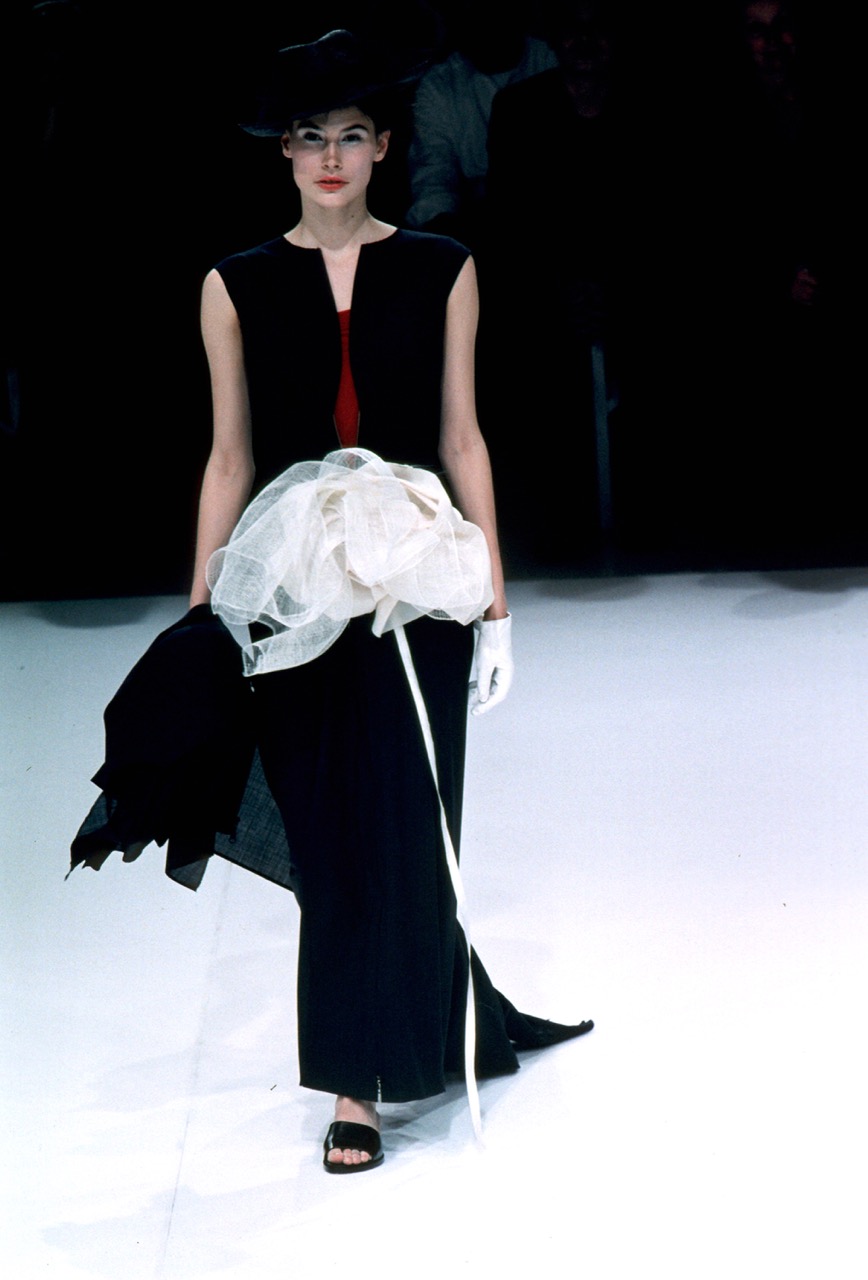
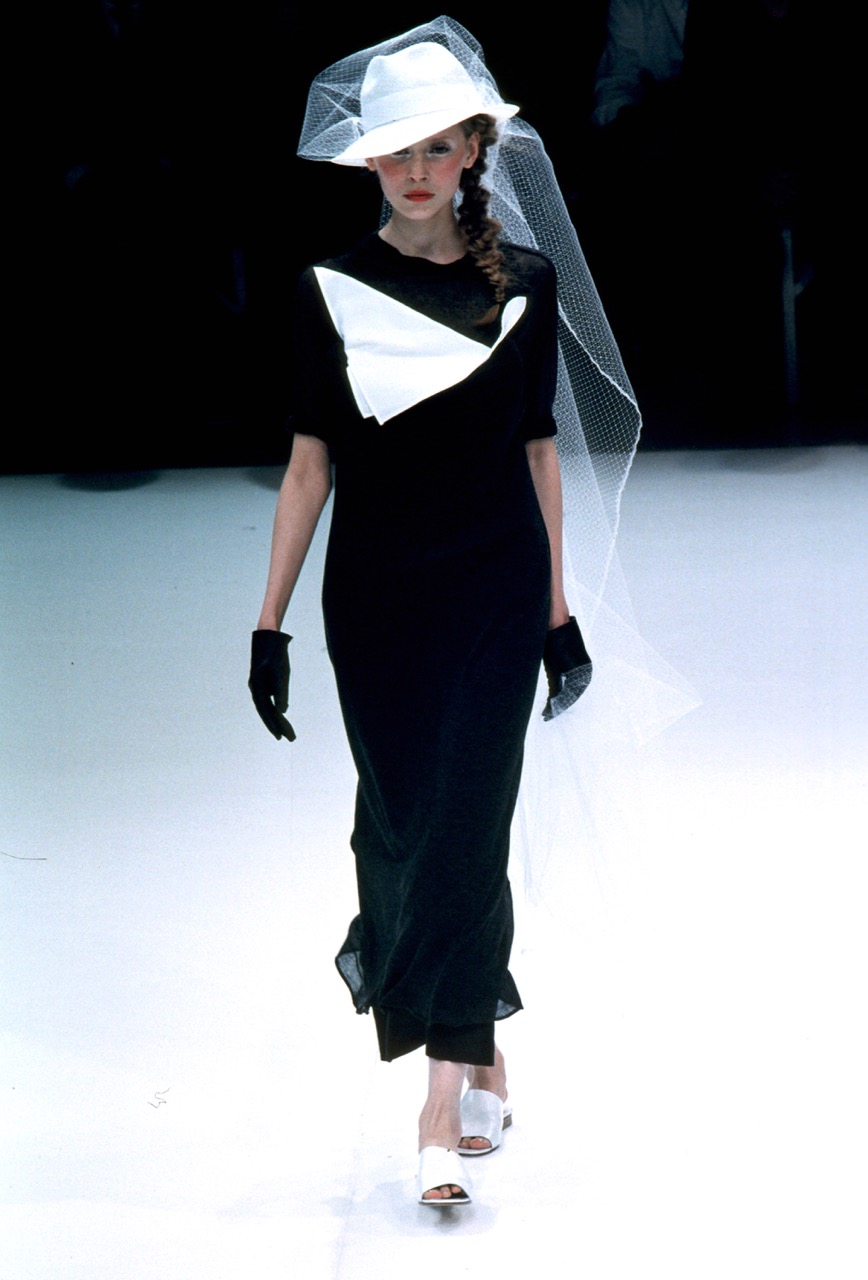
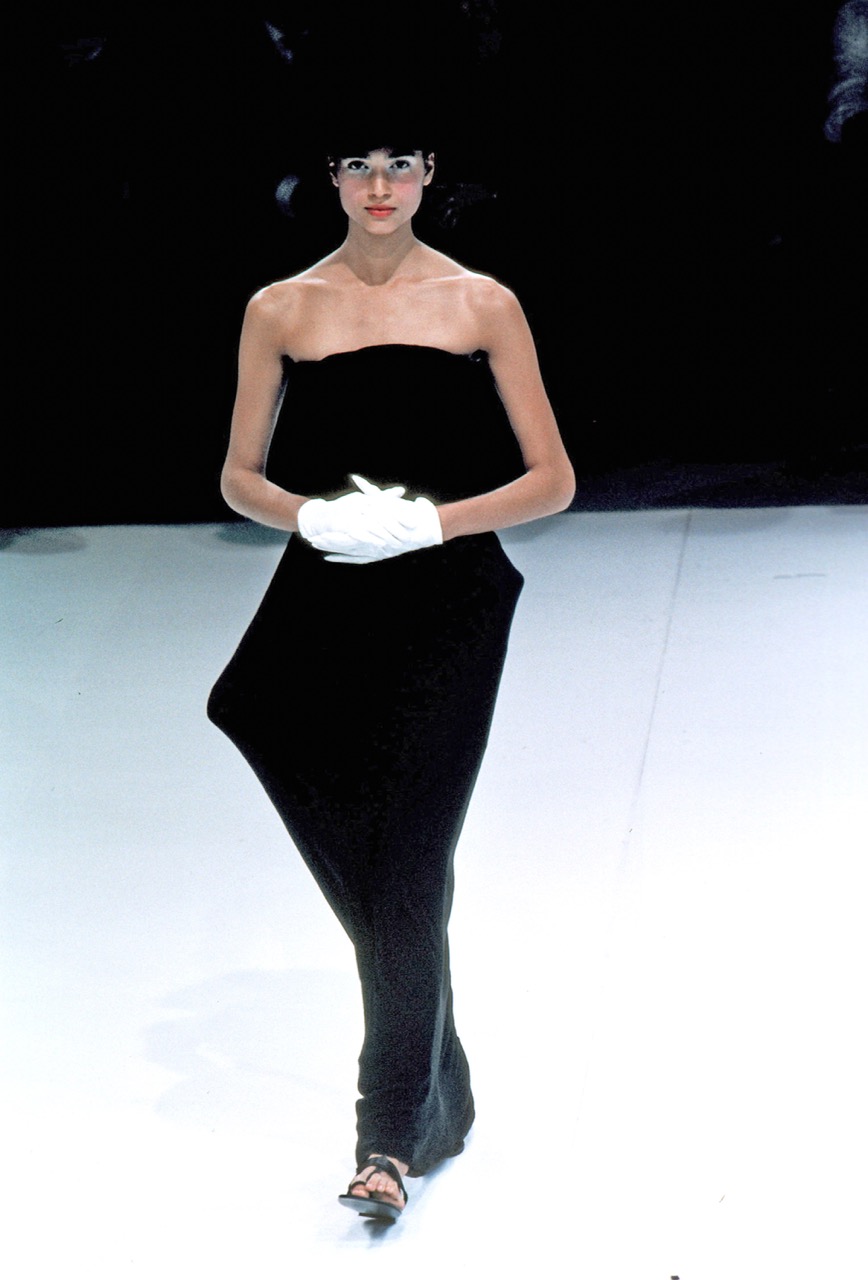
Yohji Yamamoto’s spring 1999 ready-to-wear runway collection. Courtesy of firstVIEW
Presented in a makeshift theater-in-the-round, the show starred models dressed in Mr. Yamamoto’s version of traditional wedding attire—sometimes in bright ivory and sometimes in his beloved black. As they moved through the room, they disrobed. They peeled off gloves, unbuttoned corsets, and stepped out of large crinolines to reveal a simple skirt or a silky undershirt. Sometimes they’d slip on pieces that might have been pulled from a gentleman’s wardrobe.
It was pre-social media and there was no elaborate set. As I looked at a grainy, old video of the show, I didn’t see anyone watching the presentation through the lens of an iPhone. The audience sat quietly as models paraded past. And with each dramatic reveal of a new layer of clothing, the guests applauded. Not politely but in thoughtful appreciation.
The audience was in the moment, immersed in Mr. Yamamoto’s playful treatise on weddings and our insistence on trussing up women like carnival floats and handing them off to their betrothed.
As the show drew to its conclusion, a blonde, curly-haired model walked out on the arm of the fashion editor André Leon Talley. Even if someone in the audience was unfamiliar with the rarefied place he occupied in the fashion ecosystem, Mr. Talley still was a striking figure. He towered over the very tall model. He was dressed in a loose-fitting, formal black suit and bright red shoes, with a stole tossed over his shoulders like an ecclesiastical collar. He was also wearing a fedora that was tilted to the side. Just so.
It was pre-social media and there was no elaborate set. As I looked at a grainy, old video of the show, I didn’t see anyone watching the presentation through the lens of an iPhone. The audience sat quietly as models paraded past. And with each dramatic reveal of a new layer of clothing, the guests applauded. Not politely but in thoughtful appreciation.
The audience was in the moment, immersed in Mr. Yamamoto’s playful treatise on weddings and our insistence on trussing up women like carnival floats and handing them off to their betrothed.
As the show drew to its conclusion, a blonde, curly-haired model walked out on the arm of the fashion editor André Leon Talley. Even if someone in the audience was unfamiliar with the rarefied place he occupied in the fashion ecosystem, Mr. Talley still was a striking figure. He towered over the very tall model. He was dressed in a loose-fitting, formal black suit and bright red shoes, with a stole tossed over his shoulders like an ecclesiastical collar. He was also wearing a fedora that was tilted to the side. Just so.
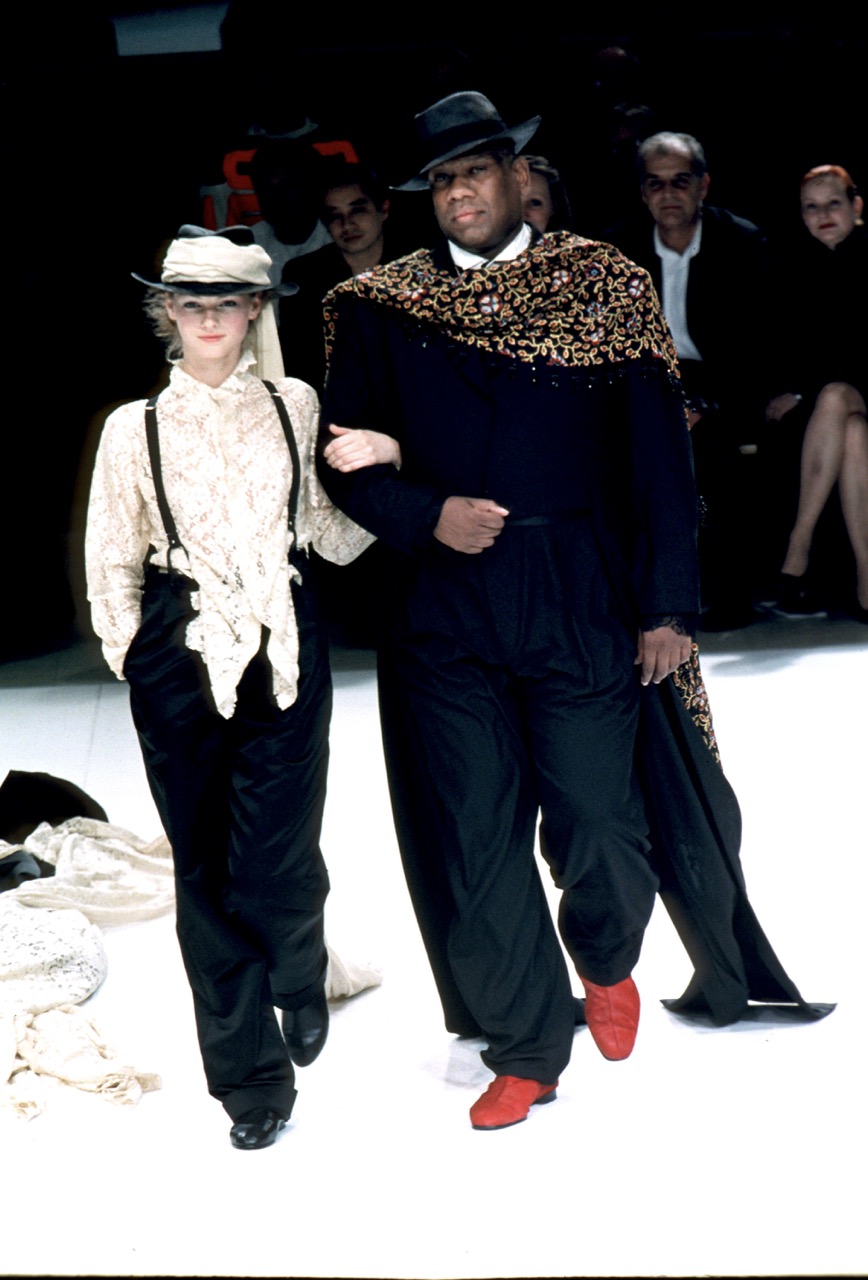
André Leon Talley walking the runway for Yohji Yamamoto’s spring 1999 ready-to-wear collection. Courtesy of firstVIEW
The look had the whiffs of a Southern gentleman, a churchgoer, a cool cat, a fashion plate.
Talley was a Black man at the highest echelons of fashion. And for much of his career at American Vogue, he was alone at the top. His Blackness was something that was historic and yet, mostly left undiscussed. He was seen but not seen, calling to mind the figure in one of Mr. Marshall’s most famous works: A Portrait of the Artist as a Shadow of His Former Self (1980). The painting depicts the artist as a silhouette—a man in a dark suit wearing a wide-brimmed hat. Unlike Mr. Talley, who bore a model’s impenetrable expression, the figure in the painting displays a gap-toothed smile. His white teeth and the whites of his eyes are luminous against the darkness of his skin.
When I saw Mr. Talley on the runway, I thought I knew who he was. I made assumptions about him as a fashion insider, a fashion character. But, considered alongside Mr. Marshall’s painting, I wonder who was Talley really? Years later, not long before his death in 2022, I got a hint.
“Race does define me,” Talley told me in 2018. It was woven throughout his life, from his Southern upbringing to his singular journey to the fashion mountaintop. What did all of those identities add up to? In some ways, I’d seen the summation on the runway all those years ago, in that dignified black suit, an old-fashioned black hat, and the flourish of a train. That, too, was a portrait of an artist. A commanding gentleman at the center of the spotlight. A fashion nobleman enrobed in black and Blackness.
Mr. Yamamoto and Mr. Marshall each treat black in distinct ways. For the artist, Blackness is a cultural foundation that distinguishes a community of people. While Black was once eagerly weaponized as a tool for racial separation and demonization, Mr. Marshall finds humanity and thus, universality in black. For the designer, black is an aesthetic gesture that can reveal a truth. It declutters the eye and focuses our attention on the body, the person. But they both utilize black as a way of rebuking historical assumptions and omissions. They pour beauty, intellect, and soulfulness into a seemingly impenetrable hue. In their hands, black provides a way forward toward a more legible version of oneself. And over a lifetime, both of them have reminded me of how exceedingly beautiful black has always been.
Talley was a Black man at the highest echelons of fashion. And for much of his career at American Vogue, he was alone at the top. His Blackness was something that was historic and yet, mostly left undiscussed. He was seen but not seen, calling to mind the figure in one of Mr. Marshall’s most famous works: A Portrait of the Artist as a Shadow of His Former Self (1980). The painting depicts the artist as a silhouette—a man in a dark suit wearing a wide-brimmed hat. Unlike Mr. Talley, who bore a model’s impenetrable expression, the figure in the painting displays a gap-toothed smile. His white teeth and the whites of his eyes are luminous against the darkness of his skin.
When I saw Mr. Talley on the runway, I thought I knew who he was. I made assumptions about him as a fashion insider, a fashion character. But, considered alongside Mr. Marshall’s painting, I wonder who was Talley really? Years later, not long before his death in 2022, I got a hint.
“Race does define me,” Talley told me in 2018. It was woven throughout his life, from his Southern upbringing to his singular journey to the fashion mountaintop. What did all of those identities add up to? In some ways, I’d seen the summation on the runway all those years ago, in that dignified black suit, an old-fashioned black hat, and the flourish of a train. That, too, was a portrait of an artist. A commanding gentleman at the center of the spotlight. A fashion nobleman enrobed in black and Blackness.
Mr. Yamamoto and Mr. Marshall each treat black in distinct ways. For the artist, Blackness is a cultural foundation that distinguishes a community of people. While Black was once eagerly weaponized as a tool for racial separation and demonization, Mr. Marshall finds humanity and thus, universality in black. For the designer, black is an aesthetic gesture that can reveal a truth. It declutters the eye and focuses our attention on the body, the person. But they both utilize black as a way of rebuking historical assumptions and omissions. They pour beauty, intellect, and soulfulness into a seemingly impenetrable hue. In their hands, black provides a way forward toward a more legible version of oneself. And over a lifetime, both of them have reminded me of how exceedingly beautiful black has always been.

Robin Givhan is an award-winning journalist.
She is a contributing Opinion writer for the New York Times and the former senior critic-at-large for the Washington Post.
She received her Bachelor of Arts in English from Princeton University and a Master of Science in journalism from the University of Michigan. In 1995, she arrived at the Washington Post where she began covering the news, trends, and business of the international fashion industry. She also wrote a weekly culture column. In 2009, she began covering Michelle Obama and the cultural and social shifts stirred by the first African American family in the White House. From 2010-2012, she was special correspondent for style and culture at Newsweek Daily Beast. She returned to the Post in 2014 as fashion critic. In 2020, she was appointed senior critic-at-large with a focus on politics, race, and the arts.
Givhan’s work has appeared in Harper’s Bazaar, Vogue, Vogue Italia, British Vogue, Essence, Elle UK, New York, and the New Yorker. She has contributed to several books including “Runway Madness,” “No Sweat: Fashion, Free Trade and the Rights of Garment Workers,” and “Thirty Ways of Looking at Hillary: Reflections by Women Writers.” She is the author, along with the Washington Post photo staff, of “Michelle: Her First Year as First Lady.”
Her first solo book, “The Battle of Versailles: The Night American Fashion Stumbled into the Spotlight and Made History,” was published in March 2015. It is a cultural history of the 1973 Franco-American runway extravaganza that altered the trajectory of the fashion industry. “Make It Ours: Crashing the Gates of Culture with Virgil Abloh” was published June 24, 2025. It tells the story of Abloh’s rise to the heights of the fashion industry and how the industry transformed to accommodate him.
Givhan is the recipient of numerous awards including the Rabkin Prize for her arts reporting and the Pulitzer Prize in criticism for her fashion coverage.
She lives in Washington, DC.
Photo by Kevin J. Miyazaki
She is a contributing Opinion writer for the New York Times and the former senior critic-at-large for the Washington Post.
She received her Bachelor of Arts in English from Princeton University and a Master of Science in journalism from the University of Michigan. In 1995, she arrived at the Washington Post where she began covering the news, trends, and business of the international fashion industry. She also wrote a weekly culture column. In 2009, she began covering Michelle Obama and the cultural and social shifts stirred by the first African American family in the White House. From 2010-2012, she was special correspondent for style and culture at Newsweek Daily Beast. She returned to the Post in 2014 as fashion critic. In 2020, she was appointed senior critic-at-large with a focus on politics, race, and the arts.
Givhan’s work has appeared in Harper’s Bazaar, Vogue, Vogue Italia, British Vogue, Essence, Elle UK, New York, and the New Yorker. She has contributed to several books including “Runway Madness,” “No Sweat: Fashion, Free Trade and the Rights of Garment Workers,” and “Thirty Ways of Looking at Hillary: Reflections by Women Writers.” She is the author, along with the Washington Post photo staff, of “Michelle: Her First Year as First Lady.”
Her first solo book, “The Battle of Versailles: The Night American Fashion Stumbled into the Spotlight and Made History,” was published in March 2015. It is a cultural history of the 1973 Franco-American runway extravaganza that altered the trajectory of the fashion industry. “Make It Ours: Crashing the Gates of Culture with Virgil Abloh” was published June 24, 2025. It tells the story of Abloh’s rise to the heights of the fashion industry and how the industry transformed to accommodate him.
Givhan is the recipient of numerous awards including the Rabkin Prize for her arts reporting and the Pulitzer Prize in criticism for her fashion coverage.
She lives in Washington, DC.
Photo by Kevin J. Miyazaki
